


Welding. Oxy-Acetylene Welding. Continued
Description
This section is from the book "Workshop Receipts For Manufacturers And Scientific Amateurs. Supplement Aluminium To Wireless", by The Chemical Publishing Co.. Also available from Amazon: Workshop Receipts For Manufacturers And Scientific Amateurs.
Welding. Oxy-Acetylene Welding. Continued
Note
" R " type heads will not fit " P " type shanks and vice versa.
The heads are removed and replaced by unscrewing the milled head nut A.
It will also be noticed that the gas mixing bent-head D is constructed to form a swivel joint with the elbow on the end of the shank. It can be turned (without even extinguishing the flame) between the two positions shown into any designed angle in relation to the shank, or handle, of the blowpipe, and can be fixed in any such position by hand tightening of the milled nut A.
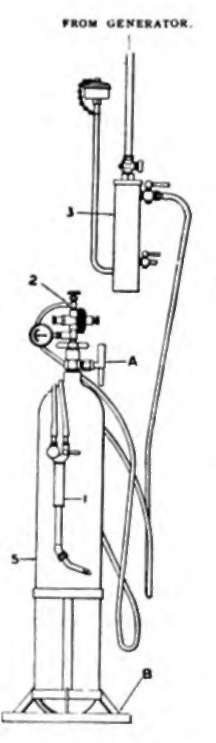
Unit No. 1-The Blowpipe.
„ „ 2-Oxygen Pressure Regulator.
„ „ 3-Hydraulic Back Pressure Valve.
„ .. 5-Oxygen Cylinder.
A. ;-Cylinder Valve Key.
B. ;- Cylinder Stand
Fig. 222,

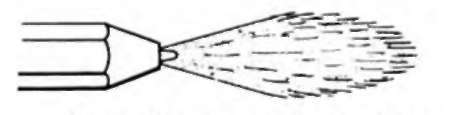
Excess Acetylene (Carbonising Flame).
The flame is long and brilliant, the inner cone is also long without a distinct outline. If used, the work will be hardened and discoloured.
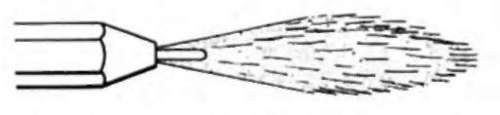
Excess Oxygen (Oxidising Flame).
The flame is short and pale, the inner cone is also short with violet tinge. If used, sparks will be produced off metal, indicating burning.
Correct Adjustment (Neutral Flame).
Flame is of medium length and pah, the inner cone is sharply defined (length according to size of blowpipe).
Fig. 221.
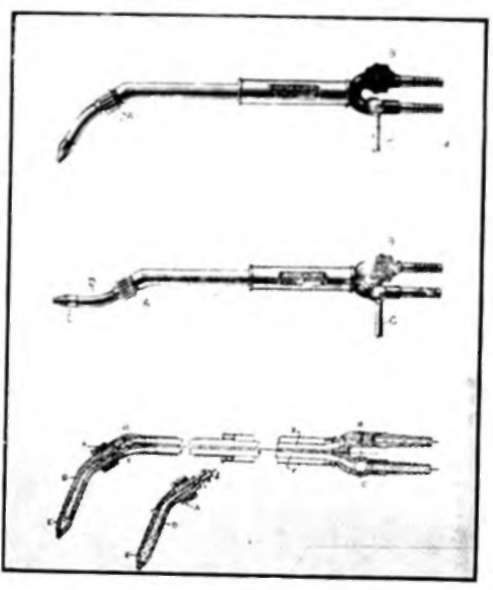
Fig. 224.

Unit No.. I-Blowpipe.
„ 2-Oxygen Regulator.
„ " .2a-Acetylene Regulator.
„ " 4-Acetylene Cylinder.
„ „ 5-Oxygen Cylinder.
Fig. 223.
Whilst for ordinary work the head can be set to the usual angle, the practical advantage of being able to alter the relative position of the nozzle will appeal to operators who often have to carry out difficult welding repairs in awkward and somewhat inaccessible parts of boilers and other structures.
In addition to this conspicuous advantage the construction of the blowpipe renders it particularly accessible for cleaning. By simply screwing back the milled nut A altogether the interchangeable bent head-piece D can be removed, and all the essential parts of the blowpipe can be inspected and cleaned. Back-firing of the flame is, however, practically prevented in this construction of blowpipe, so that cleaning due to the " sooting up " of internal parts is rarely required.
The oxygen and acetylene supplies are independently controlled by separate valves B and C placed in a convenient position for adjustment at the extremity of the blowpipe handle. This independent control is a feature of all good blowpipes, and where welds are being carried out in a confined space, or where it is difficult to instantly change the position, it is inadvisable to use blowpipes which are not fitted with a valve or valves for both the oxygen and acetylene supplies.
The oxygen passes through the valve B along the pipe x to the injector. The combustible gas is drawn by the injector action through the valve C along the pipe y through the holes c and discharged mixed with the oxygen, by way of the expansion head D, through the nozzle E.
The pull or vacuum obtainable is specially tested in the case of each blowpipe, and none are passed for sale unless they are capable under working conditions of creating a vacuum of 5-14in. of mercury, according to the size of the blowpipe. High efficiency in this respect coupled with unrestricted acetylene passages, is an essential condition of all good injector blowpipes, for it enables the acetylene to be adjusted to the exact proportion required by means of the tap C.
When the correct welding mixture of oxygen and acetylene is obtained (i.e., the correct flame conditions, see Fig. 221) the tap C should not be more than three-quarters open. If it is ever found necessary to work with this tap fully open it is probable that for some unusual cause the acetylene supply is short and an oxidising flame is almost sure to be the result. When this is found to occur it may be due to any of the following causes :-
1. ;Insufficient generation of acetylene.
2. ;Insufficient pressure on the acetylene pipes. This ought not to be less than 8in. of water.
3. ;Water or other obstruction in the acetylene pipes.
4. ;Accumulation of deposit in the gauze filter at the inlet to the tap C, or " sooting up " at the injector of the blowpipe, which may impair the injector action.
If the first three conditions do not exist or have been rectified so as to give an abundant supply of acetylene, attention may be turned to the blowpipe.
If the blowpipe is found to be obstructed the gauze filter can easily be removed and cleaned or replaced, and as already mentioned, the bent head-piece D has only to be unscrewed to give access for the same purpose to the injector. Care must be taken not to injure the hole in the injector nozzle.
The injector and other passages and profiles which are shown in the sectional view, Fig. 214, have all been carefully proportioned to give the best results, and to enlarge these passages would result in unsatisfactory working. Therefore, should the injector become obstructed a soft copper wire or piece of wood should be employed to clear it. Never use a hard or sharp instrument.
If, after cleaning, the blowpipe still appears to be inefficient, some internal damage is probably the cause and it is best then to return it to the makers for overhaul. The Universal blowpipe is, however, so substantially constructed that with ordinary careful handling it should work for many years without requiring to be overhauled.
The copper nozzle E will require occasional renewal. These nozzles can be obtained separately and a new one can easily be substituted for the old one by the blowpipe operator. Other spare parts can also be obtained, but when these are required it is probable that a general overhaul of the blowpipe is desirable and where possible it is best to return it to the makers for this purpose.
Continue to:


My Books

