


Advertisements. Vol 3. Part 3
Description
This section is from the book "Turning And Mechanical Manipulation", by Charles Holtzapffel. Also available from Amazon: Turning and Mechanical Manipulation.
Advertisements. Vol 3. Part 3
The 4-looped figures are produced by changing the train of wheels. For the ellipses, the train consists of a fixed wheel of 48 teeth, leading into one of 24, to which is attached a 36 wheel, leading into another 36 wheel fixed to the axis carrying the eccentric frame A. For 4-looped figures, the relative velocity of the eccentric frame is doubled by employing wheels of 48 and 24 teeth, instead of the pair of 36 wheels. The adjustment of the 4-looped figures, for eccentricity and position, is effected in the same general manner as the adjustment of the elliptical figures.
In the illustrations shown on the previous pages, Pattern 1 consists of ellipses only; the two central series are placed at right angles by the division plate of the lathe. The positions of the outer series are also determined by the division plate, and the ellipses are made to intersect, by moving the slide rest screw between every cut. Pattern 2 is produced by the right line and 4-looped movements. The positions of the right lines are determined by the division plate, and the series of ten 4-looped figures are interposed either by the tangent screw E, or by the division plate. Pattern 3 consists of ellipses and looped figures. The positions of the ellipses constituting the central portion of the pattern, and the small 4-looped figures of which the border is composed, are given by the division plate and sliding rest. The general position of the intermediate series of 4-looped figures is also given in the same manner; but the figures being eccentric, are duplicated by shifting the tangent screw E 18 3/4 turns. Pattern 4 shows a modification of the 4-looped figure in which the eccentricities of A and B are in the proportion of 1 to 8. Thus, in producing each of the sixteen squares of the central figure, A was 3, and B 24, divisions eccentric, and the lines were doubled by reducing the eccentricity of A 1/4, and B 2 divisions. The local positions of the squares were determined by the division plate, but 8 were worked with E central, and for the other 8, E was shifted 18 3/4 turns. The border consists of 72 squares, for which A was one, and B 8 divisions eccentric, 36 of the squares were worked with E inclined 9 3/8 divisions to the right, and for the intermediate 36 squares, E was inclined an equal quantity to the left.
HOLTZAPFFEL & CO.'S
Pen-Holder For Enfeebled Hands
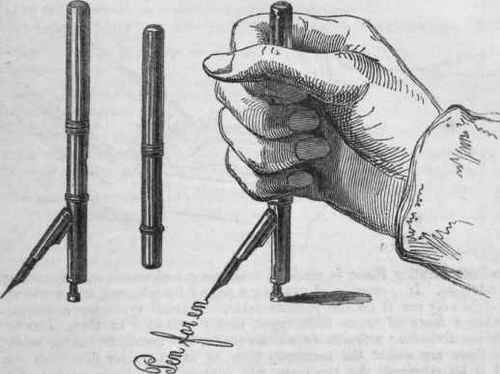
THE Pen-holder for enfeebled hands was invented for the use of those persons who, from age, rheumatism, gout, stiffness in the joints of the fingers, defects in the nerves of the hands, paralysis, or other infirmity, are deprived of the free use of the fingers, so that they cannot hold a pen in the customary position.
The instrument is represented in three views: in the center as closed for the pocket; on the left as opened for use; and on the right in the act of being used. The shaft of the Pen-holder for enfeebled hands is held quite vertically in the central part of the hand, and grasped by the whole of the fingers; this position the most infirm can usually command. The lower extremity of the shaft is allowed to rest firmly upon the paper, and thereby support the hand, whilst the socket that actually receives the pen or nib is jointed to the vertical shaft at about the angle of 45 degrees, and is pressed on the paper by a feeble spring, so as to assimilate in the closest manner to the action of the ordinary quill pen. The Pen-holder for enfeebled hands will be used with more freedom when neither the hand nor the arm rest upon the paper, but the little finger should almost touch the sloping socket.
The Pen-holder is adapted to receive a gold, steel, or quill pen, at the option of the individual; and the instrument may be carried in the pocket as an ordinary pencil-case. The purpose of the screw at the bottom of the holder is to adapt the length of the vertical shaft to the projection of the pen, as when the latter touches the paper, the length of the central shaft should be such as just to give the shaft the vertical position. Whereas, if the pen should project too much, or too little, it will be needful to incline the shaft to, or from, the individual, which it is desirable to avoid.
Price of the Pen-holder for Enfeebled Hands, in Silver, with Everlasting
Gold Pen, 1l. 16s.
COWPER'S PARLOUR PRINTING PRESS,
MADE ONLY BY HOLTZAPFFEL & CO., 64, Charing Cross, and 127, Long Acre, London.
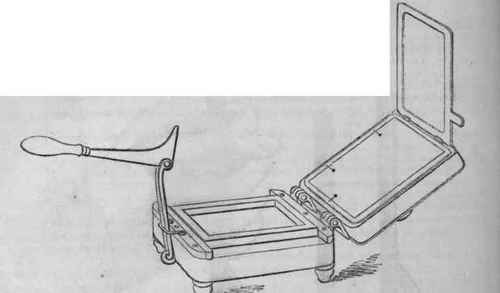
This little Printing Press is made of mahogany, and stands in the small space of 11 by 8 inches. It is capable of printing a page 7 by 6 inches, and works so easily that a child may use it on the parlour table. A small type-case accompanies it, containing a fonte of about 2500 types, neatly arranged in three drawers with appropriate divisions; a fourth drawer serves for the furniture, inking tablet, etc.; and to these are added the necessary tools, so as to render the whole complete. Should it be required, the type-case will contain a duplicate supply of type in addition to that usually furnished, and which doubles the efficiency of the apparatus at a slight additional cost.
The above apparatus is well adapted to the amusement and education of youth, and also to various applications of the inestimable typographic art to the common concerns of mankind.
For example. - Companies, institutions, and individuals, have found it convenient for circular letters, invoices, and papers, subservient to the despatch and methodical arrangement of business; naturalists and travellers for short memoirs of scientific researches, or labels for specimens; the friends of education, for disseminating original and other papers; wood-engravers, for examining the progress of their blocks: practical printers, for proofs of title-pages, stereotype plates, or cards; and nearly every different pursuit will suggest some new application of this little Press.
Continue to:


My Books

