


Chisels And Planes. Section I. - Introduction; Bench Planes. Part 3
Description
This section is from the book "Turning And Mechanical Manipulation", by Charles Holtzapffel. Also available from Amazon: Turning and Mechanical Manipulation.
Chisels And Planes. Section I. - Introduction; Bench Planes. Part 3
Fig. 321 represents, one-eighth the full size, a very effective plane, which is commonly used on the continent for roughing out, or as our jack plane, the horn h, being intended for the left hand, whilst the right is placed on the back of the stock. The Indians and Chinese bore a hole through the front of the plane for a transverse stick, by which a boy assists in pulling the plane across the work. When the plane is very large, it is by the Chinese, and others, placed at the end of the bench at an angle, and allowed to rest on the ground, whilst the work is slid down its face; and a similar position is employed by the coopers in our own country, for planing the staves of casks, the plane being in such cases, five or six feet long and very unwieldy, the upper part is supported on a prop, and the lower rests on a transverse of wood or sleeper. The amount of force required to work each plane is dependent on the angle and relation of the edge, on the hardness of the material, and on the magnitude of the shaving; but the required force is in addition greatly influenced by the degree in which the shaving is bent for it- removal in the most perfect manner.
Fig. 321.

The diagrams 322 to represent, of their full size, parts of the irons and mouths of various planet, each in the act of re-moving a shaving. The sole or surface of the plane rests upon the face of the work, and the cutter stands as much in advance of the sole of the plane, as the thickness of the shaving, which is in each case so bent as to enhable it to creep up the face of the inclined iron, through the narrow slit of the plane, called its mouth, the width of which determines the extent to which the fibre of the wood can tear up or split with the grain.
The spokeshave, fig. 822, cuts perhaps the most easily of all the plains, and it closely assimilates to the penknife; the angle of the blade is about 25 degrees, one of its planes lies almost in contact with the work, the inclination of the shaving is slight, and the mouth is very contracted. The spoke have works very easily in the direction of the grain, but it is only applicable to small and rounded surfaces and cannot be extended to suit large flat superficies, as the sole of the plane cannot be cut away for such an iron, and the perfection of the mouth is comparatively soon lost in grinding the blade.
Fig. 322

Fig. 323.

The diagrams, figs. 323, 4, and 5, suppose the plane irons to be ground at the angle of 25°, and to be sharpened on the more refund oilstone at 35°, so as to make a second bevil or slight facet, as shown by the dotted lines a, in each of the figures; the irons so ground arc placed at the angle of 45°, or that of common pitch ,• it therefore follows, that the ultimate bevil which should be very narrow, liesat an elevation of 10° from the surface to be planed. Fig. 323represents the mouth of an old jack plane, from the sole of which about half an inch of wood has been lost by wear and correction, which is no uncommon case. The wide mouth allows a partial splitting of the fibres before they creep up the face of the single iron; this plane works easily, and does not greatly alter the shavings, which come off in spiral curls, but the work is left rough and torn.
Fig. 324.

Fig. 325.

Fig. 326.
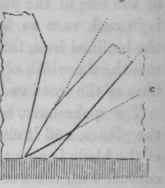
Fig. 324, a similar but less worn plane with a closer mouth, allows less of the splitting to occur, as the shaving is more suddenly bent in passing its narrower mouth, so that the cutting now begins to exceed the splitting, as the wood is held down by the closer mouth: the shaving is more broken and polygonal, but the work is left smoother.
The same effects are obtained in a much superior manner in the planes with double irons, such as in fig. 325, the top iron is not intended to cut, but to present a more nearly perpendicular wall for the ascent of the shavings, the top iron more effectually breaks the shavings, and is thence sometimes called the break iron.
Now therefore, the shaving being very thin, and constrained between two approximate edges, it is as it were bent out of the way to make room for the cutting edge, so that the shaving is removed by absolute cutting, and without being in any degree split or rent off.
The compound or double iron is represented detached, and of half size in fig. 327: in this figure the lower piece e, is the one used for cutting, the upper piece t or the top iron, has a true edge, which is also moderately sharp, the top iron is placed from one-sixteenth to one-fiftieth of an inch from the edge the cutter, the two are held together so closely by the screw which passes through a long mortise in c, and fits in a tapped hole in t. th:it no shaving can get between them.
Fig. 327.

The constant employment of the top iron in all available cases, shows the value of the improvement; and the circumstances of the plane working the smoother, but harder, when it is added, and the more so the closer it is down, demonstrate that its action is to break or bend the fibres. This is particularly observable in the coarse thick shavings of a double-iron jack plane, compared with those of the same thickness from a single-iron plane; the latter arc simply spiral and in easy curves, whereas those from the double-iron are broken across at short intervals, making their character more nearly polygonal; and the same difference is equally seen in thinner shavings, although of course less in degree.
Fig.326 represents the iron of a plane intended "for the use of cabinet-makers and others, who require to cut either hard or coarse-grained wood," the upper bevil given to the iron, being considered to dispense with the necessity for the top-iron; but it is obviously much more difficult to produce a true right-lined edge, by the meeting of two planes, each subject to error in sharpening, than when one exists permanently flat as in the broad surface of the blade.*
Continue to:


My Books

