


Internal Hemisphere In Softwood
Description
This section is from the book "Turning And Mechanical Manipulation", by Charles Holtzapffel. Also available from Amazon: Turning and Mechanical Manipulation.
Internal Hemisphere In Softwood
The internal hemisphere of large or small diameter figs. 379. 380, is roughly hollowed to shape with the gouge, used as described for the internal cylinder; it may then be entirely completed with the gouge held and used as on the plankways surface, or, sometimes more conveniently with the hook tool. The hook tool is held well underhand, and is swept around the curve with a moderate cut but free action, so far as the two positions fig. 379, usually commencing to cut from the center. The tool is moved by the action of the body and hands, both always exerted upon it, but in varying degree. Towards the center, it is held firmly to the side and is moved more by the sway of the body; as it travels away from the center towards the circumference, it is controlled more by the pull of the left hand, the right hand and the handle of the tool frequently having to leave the side. The orifice or lip of the curve, may also be turned with the stem of the hook tool nearly parallel with the axis of the work, the tool is then again held against the side, and is withdrawn cutting outwards by the backward poise of the body.
Fig. 379. Fig. 380. Fig. 381.
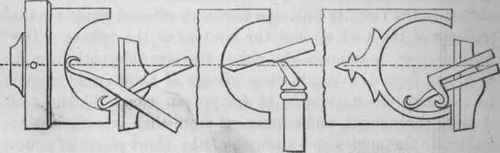
The cutting action and management of the hook tool in the internal hemisphere, combines those necessary to this tool on the internal cylinder and surface; while, for about two thirds of its traverse around the curve, from the center, the hook tool divides the fibres across the grain, and for the remaining distance, removes them with the grain. It leaves the work clean and sharply cut and does not require to be followed by any other.
A thin ring or plate, accurately turned to the required diameter, fig. 437, may be applied from time to time within the internal hemisphere or cup, as a gage, to test the truth of the sweep and equal cutting action of the tool around the curve. The portions in excess of the true line prevent its entry, these, are noted and reduced until the two are in agreement; when the last thin and equal shavings, are taken continuously from one end of the curve to the other, from the center outwards. The orifice of curves greater than the internal hemisphere, such as fig. 381, the hollow form employed for humming tops, more or less impedes the traverse of the straight stemmed hook tool. Internal forms of this character are worked with it, so far as they will permit, and a hook tool, differing only in its having the stem bent at right angles, is then employed to turn the end of the curve towards the opening.
Continue to:


My Books

