


The Constellation Of The Great Bear, Or Ursa Major
Description
This section is from the book "Time Out for Living", by Ernest DeAlton Partridge and Catherine Mooney. Also available from Amazon: Time Out for Living.
The Constellation Of The Great Bear, Or Ursa Major
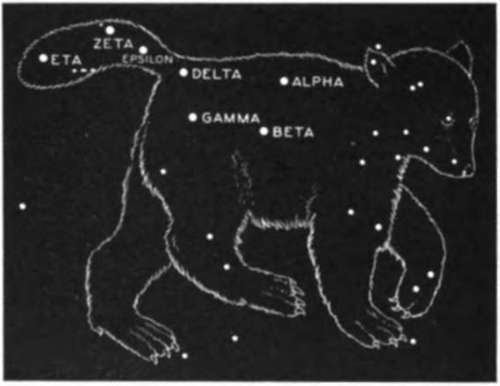
The tail is the handle of the Dipper.
One way to learn the constellations and the names of the stars is to take any star atlas and find on the chart the Great Bear. Remember that the tail of the Bear is the handle of the Dipper. Then, if you look at the north sky, you will almost surely see the Great Dipper if it is a clear night. When you have accomplished that, you have made the contact between the star charts and the sky.
Starting with this dipper of seven stars, it is an easy matter to compare the neighboring stars on the map with the neighboring stars in the sky. In this way it is not difficult to learn the location of each constellation and the names of the brightest stars. If you want to have an especially good star map, you can make one yourself, and with a pin make holes for the important stars. Paste this in the mouth of a funnel made of paper and put a flashlight in the other end. You can now take this out in the dark and look up at it to find the stars you are searching for.
The stars are rising in the east and setting in the west for the same reason that the sun thus rises and sets. The earth is spinning around on its axis not fast enough to make us dizzy but fast enough to make all the stars appear to revolve around us.
If you go into the woods and turn around on your heels, the trees and rocks will apparently go around you in the opposite direction. If there happens to be a bird's nest directly overhead, it will apparently stay in the same place. That nest will always be directly overhead no matter how much or how rapidly you turn on your heels. The astronomer would say: "Of course that nest docs not move; because it is in your axis of rotation - it is in line with your backbone." In the same way, the star which is in line with the earth's axis of rotation does not move. It is always in the same place in the sky. There is no bright star that is in that exact position, but there is a fairly bright one which is extremely close to the extension of the earth's axis. We call this star Polaris. It is the most important star in the sky because it has been used for thousands of years to guide sailors and travelers. If the stars are shining, the hiker in the woods or the sailor on the sea can always tell which direction is north. As you can see from the star chart shown on page 167, the North Star can be found by sighting along the two pointer stars on the Great Dipper.
Continue to:


My Books

