


Rural Youth And Free Time
Description
This section is from the book "Scouting For Rural Boys. A Manual For Leaders", by Boy scouts of America. See also: Outdoor Adventure Manual: Essential Scouting Skills for the Great Outdoors.
Rural Youth And Free Time
While rural young men, in general, have less free time than do those in the city-yet by no means does one dare assume that free time in rural districts is no hazard.
There is relatively less provision for free time in the country and rural village than in the city. There are fewer libraries, fewer club buildings for boys, fewer educational opportunities for boys, fewer programs for free time, fewer worthwhile recreations, either commercial or non-commercial. The few existing "places" have an open door of welcome-the village and town loafing places-here cronies "hang out" together and get their contacts for good or evil. Many worthwhile citizens of the village are too busy with their own affairs to be concerned about the village and near-country young men-yet the hangers-on, the ne'er-do-wells and the actual or potential "crooks" of the neighborhood have lots of time to be rather cordial to boys and actually give them attention. They are a type of "ready" leadership which is frequently overlooked by the social worker. When the Indiana farm boy Dillinger was locked out on the street as the village loafing den closed for the night- there wasn't much of any place to go, and the suggestion that they break and enter the grocery store fell on ready ears. Luther Burbank, as a young man, found the little New England public library, and in it encountered Darwin's "Origin of Species" and started a significant career. There was a difference in the opportunities facing the young men-quite independent of any differences in the young men or their home backgrounds.
A comparison of the average figures of 100 urban and 100 rural crimes, as reported by the Federal Bureau of Investigation, is revealing.
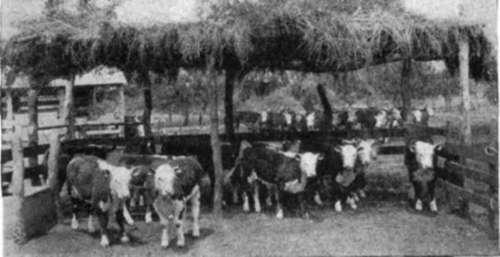
Four-H Club Herefords In Texas.
Of 100 Urban Crimes | Of 100 Rural Crimes | ||
53.9 22.5 14.9 4.1 | Larceny Burglary Auto Theft Robbery | 46.8 28.2 9.7 4.1 | Against Property |
(95.4%) 3.2 0.6 0.4 0.4 | Aggravated Assault Rape Murder Negligent Manslaughter | 5.6 2.6 1.5 1.5 | (88.8%) Against Person |
(4.6%) | (11.2%) | ||
The above summary shows a greater frequency of crimes "against the person" in every 100 rural crimes.
While detailed data are not available, the statement is made in the "Recent Social Trends in the United
States," Vol. II, Page 1135, that smaller cities generally have lower crime rates, all other factors being equal.
Crime among rural youth, as among urban youth, bears a very definite relation to the opportunities for self-expression provided by the community or neighborhood and their relation to safe character building programs.
Recent studies report an increase in general rural community cooperation in developing recreation and social life. Of course in recent years, the farm areas have shown a higher cooperability than the town areas, as their farm "cooperatives" bear testimony.
Unemployment and Rural Youth
Studies made during the "depression" and "recession" periods have stressed how hard hit youth were. Official pronouncements of the U. S. Bureau of Labor have cited some five million young men and women, who had come through our schools and colleges and were unable to find places for themselves in the present structure of things.
In 140 selected American agricultural villages, studied by Brunner and Lorge, the 5,095 who graduated from the High Schools in 1935, by 1936 showed 24.7% employed, 35.1% continuing their education, and 40.2% unemployed. Here the Council and the District Committees of the Area Council have an opportunity to be of great service to the unemployed who are not continuing their education.
Leadership training, Merit Badge explorations in life's work lines, and the leading of groups of younger rural Scouts or Cubs are very definite ways to bring stabilizing duties and outlook to these unemployed rural young men.
Continue to:


My Books

