


Backgammon
Description
This section is from "The American Cyclopaedia", by George Ripley And Charles A. Dana. Also available from Amazon: The New American Cyclopædia. 16 volumes complete..
Backgammon
Backgammon, a game, believed to be of English origin, played with dice and 30 pieces called men, upon a board or table peculiarly divided and marked. Chaucer, Shakespeare, and Bacon mention it under the name of "tables." The name backgammon is supposed by some to be derived from the Anglo-Saxon words baec, back, and gamone, a game; by others, from the Welsh bach, little, and cammon, a battle. The game is played as follows: The men, 15 of which are black and 15 white, in shape like those used in draughts, are arranged, as shown in the cut, on a board each quarter of which is marked with six lines, alternately white and black or red and black. Each of these quarters is called a table; those marked A and B, in which the game begins, are the inner tables, the others the outer. The number of lines across which a player is allowed to move his men is decided by the dice; and the object of the player having the white men, for instance, is to move those of his men which are in his opponent's table (A) through the tables C and D, and finally into his own inner table B; at the same time endeavoring also to bring into that table all his other men, wherever on the board they may be placed.
The player having the black pursues a similar course in moving his men gradually around to his inner table A. Neither player can, no matter what throw he makes with the dice, place his men on a line already occupied by more than one of his opponent's pieces. Should only one of these, however, be found on a line to which he has otherwise the right to move, he can "take up " this solitary man, that is, remove him from the board, and oblige his adversary to begin with him anew in the furthest table from his own inner one. When a player has brought all his men safely into his inner table, he may begin to "throw off" his pieces, that is, remove from the board a man standing on any point the number of which he throws. Should he throw doublets, he may remove four from the point indicated by them. The player who by this means first rids himself of all his men, wins the game. Should he win it before his opponent brings all his men into his inner table, he is said to "gammon" him; if before the latter even has all the men out of his first table, to "backgammon" him.
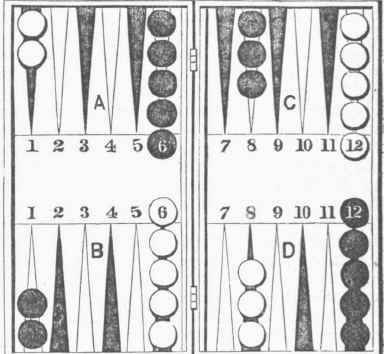
Backgammon Board.
Continue to:


My Books

