


Bagdad
Description
This section is from "The American Cyclopaedia", by George Ripley And Charles A. Dana. Also available from Amazon: The New American Cyclopædia. 16 volumes complete..
Bagdad
Bagdad, a city of Asiatic Turkey, situated on both sides of the river Tigris, here about 700 feet wide, in lat. 33° 20' N., lon. 44° 25' E.; population estimated at about 100,000, of whom about 15,000 were Jews, 3,000 native Christians, and the remainder Mohammedan Arabs. Kurds, Turks, and Persians. Bagdad is unequally divided by the river Tigris, two thirds being on the left bank, and the remainder on the right, and the two divisions are connected by two bridges of boats. The town is fortified or one side by a high brick parapet wall, flanked at intervals with high-bastioned towers and surrounded by a wide fosse. The citadel is situated on the N. W. extremity. A large suburb, enclosed by ramparts to resist the attacks of the Arabs, is on the other side. The houses in Bagdad, like those of other oriental towns, present on the exterior either dead walls or ruins, and the streets are narrow, winding, and unpaved. The interiors of the houses of the wealthier classes are comfortable in an eastern sense, and compare .favorably with those of Damascus and other cities. There are several mosques ornamented with glazed tiles of various colors, and crowned with domes. There are Syriac, Chaldee, Armenian, and Roman Catholic churches, and several Jewish synagogues.
A new Jewish school was established in 1872 by the alliance Israelite unuerselle. A large general hospital has recently been erected. The bazaar built by Daoud Pasha is one of the finest in the East, and well stocked with home and foreign manufactures. The view of the city from the river presents a pleasant spectacle, the luxuriant date groves and orange gardens forming an agreeable contrast with the domes and minarets. In summer the heat is intense, and sometimes the thermometer for several days ranges between 110° and 120° F. Five miles below Bagdad the Saklavieh or Isa canal brings during the season of the floods a portion of the waters of the Euphrates into the Tigris. The commercial importance of this city has greatly declined, though during the last 25 years its decay has been somewhat checked. Large rafts supported by 200 or 300 inflated skins are much used for the transportation of goods. Fleets of boats of from 40 to 70 tons burden ascend and descend the river with cargoes to and from the Persian gulf, and caravans carry goods in different directions from this great emporium. The products of the region round Bagdad are tobacco, timbac (a plant used as a substitute for tobacco), maize, wheat, barley, cotton, rice, fine wool, goats' hair, gall nuts, and yellow berries.
The fruits are grapes, melons, apricots, quinces, figs, cherries, pomegranates, oranges, lemons, citrons, pears, and dates. Wild asses abound en the plains. Besides the above-mentioned articles, the city exports also horses, pearls, coral, honey, raw silk, bitumen, naphtha, saltpetre, and salt. The imports from Asiatic Turkey and Europe are soap, silks, woollen cloths, prints, opium, and copper; from Arabia, raisins, gum, coffee, and drugs. The revenue derived from the tax on transit goods is estimated at $3,500,000. An English company has projected a railway from Bagdad to the Mediterranean, by way of Aleppo. Bagdad is the seat of a Turkish vali or governor general, whose vilayet contains an area of about 10,000 sq. m., comprehending parts of Kurdistan and Khuzistan, most of Al-Jezireh, and Irak-Arabi. - The city was built by the caliph Al-Mansour as his capital, 762-'6, and called Medinat el-Pa-lem, "City of Peace." It was a favorite residence of the Abbasside caliphs, was beautified by Haroun al-Iiashid, and under his son Al-Mamoun became the great seat of Arabian literature and learning. In 873 the city was said to have 2,000,000 inhabitants.
It was oonquered In 1258 by Hulaku, the grandson of Genghis Khan, and by Tamerlane in 1401, by the Persians and Turks successively in the 15th centary, by the Persians again in 1623, and by the Turks finally in 1038. It suffered severely from plague in 1831, and from famine in 1870-71.
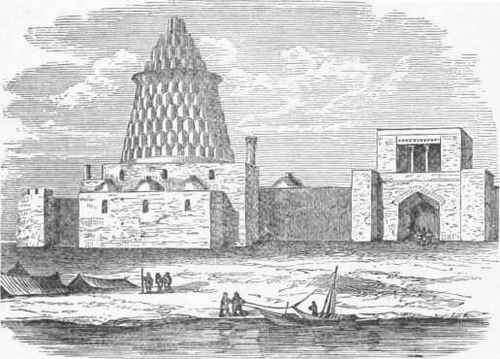
Ezekiel's Tomb.
Continue to:


My Books

