


Biruch, Or Benedict Spinoza (Also Written Spinosa)
Description
This section is from "The American Cyclopaedia", by George Ripley And Charles A. Dana. Also available from Amazon: The New American Cyclopædia. 16 volumes complete..
Biruch, Or Benedict Spinoza (Also Written Spinosa)
Biruch, Or Benedict Spinoza (Also Written Spinosa), a Dutch philosopher, born of Jewish parents in Amsterdam, Nov. 24, 1632, died at the Hague, Feb. 21, 1677. He translated his Hebrew name Baruch into Latin as Bencdic-tus. His father, a Portuguese merchant, had fled from persecution to Holland. The son was educated for the rabbinical profession, and gained the admiration not only of the masters of the Hebrew school in Amsterdam, but also of the chief rabbi Morteira, who became his instructor in the Talmud and the Cabala. But he was suspected even before his 15th year of verging toward heresy, and was accused of contemning the law of Moses and denying the immortality of the soul and the reality of angelic communications. Summoned before a rabbinical tribunal, he anticipated excommunication by withdrawing himself from the synagogue. He neglected the repeated summons of the synagogue to trial, and at length in 1656 the anathema maranatha, or greater excommunication, was uttered against him. He was already familiar with the Portuguese, Spanish, Italian, German, and Flemish languages, and was studying Latin under the physician Van Ende. This language introduced him not only to Christian learning, but also to the literature and philosophy of classical antiquity, then studied with special enthusiasm, and opened to him the writings of Descartes. The Talmud makes it the duty of scholars to learn some mechanical art.
Spinoza had therefore, while in the synagogue, learned the art of polishing lenses, by which he gained his subsistence during the remainder of his life. Exiled from Amsterdam by the magistrates on application of the rabbis, he lived for a short time with a friend in the vicinity, went thence to Rhyns-burg, near Leyden, whence in 1664 he removed to Voorburg, near the Hague, and finally yielded to the request of his friends to reside entirely at the Hague, all the leisure time saved from labor being given to philosophy. After the death of his parents his sisters attempted to deprive him of his portion of the inheritance. Having established his rights by law, he contented himself with taking only a bed. In 1673 the professorship of philosophy in the university of Heidelberg was offered to him, the condition being that he should teach nothing opposed to the established religion; but he declined it. When it was proposed to obtain a pension for him from Louis XIV., he replied that he had nothing to dedicate to that monarch. Meanwhile he endured the toil and wants of poverty, and was wont to protract his labors into the night.
His first work, Renati Des Cartes Principiorum Philosopliim Pars I. et II, More Geometrico Demonstratm (Amsterdam, 1663), which contains in an appendix the germ of his Etlika, immediately gave him the reputation of a great philosopher. His second work, Tractatus Theologicp-Politicus, published anonymously in 1670, treats the relation between church and state, and is entirely dis-tinctfrom his philosophical writings. Religion, he maintained, is neither doctrine nor cultus, hut is essentially the love of God, the expression of which is piety and obedience, and its worship is virtue. Doctrines belong to the domain of philosophy, actions to that of the state, feelings to that of religion. Absolute freedom should prevail in the first and the last, while the second should be regulated by the state in the interest of order and tranquillity. He therefore advocated a state religion, which should ordain ceremonials, but leave liberty of thought inviolate. He referred for support'of his opinions to the Bible, in which he distinguished between the facts narrated and the coloring received from the minds of the writers, and thus laid the foundation of the rationalistic school of interpretation in Germany. Numerous refutations of his work appeared, especially from Cartesian theologians; yet it was read throughout Europe, being published and translated with divers devotional, historical, antiquarian, and even medical titles employed to disguise it.
Averse to controversy, Spinoza withheld his other and more important works, which were first published after his death by his friend Ludwig Meyer, a physician of Amsterdam. His health, never vigorous, suffered from unremitted confinement and devotion to study. He sometimes passed entire months without leaving his chamber, occupied only with meditation, conversation with his friends, and answering letters on philosophical subjects. In a letter dated July 15, 1676, he promises further explanations "if my life be continued." After his death his manuscripts were, in accordance with his order, sent to his publisher at Amsterdam, and within a year appeared Ethica, Ordine Geometrico Demon-strata, containing his philosophical doctrine, which had been written between 1663 and 1666; Tractatus de Intellectus Emendatione, and Tractatus PoIiticus, both of them fragments; a collection of letters to Oldenburg, Simon de Vries, Ludwig Meyer, and Bleyen-bergh; and a fragmentary sketch of Hebrew grammar, aiming to give it a logical development. - The whole system of Spinoza is a demonstration from the eight definitions and seven axioms of the first book of the Ethica. According to him, it follows from the definition of substance that it is necessary and infinite, that it is one and indivisible, and that it is therefore God, the only self-existent, all-perfect, and absolutely infinite Being. Nothing exists except substance and the modes of its attributes.
Substance cannot produce substance, and therefore there is no such thing as creation, no beginning or end, but all things have necessarily flowed from the Infinite Being, and will continue to flow on for ever, in the same manner as from the nature of a triangle it follows, and will follow from eternity to eternity, that the angles of it are equal to two right angles. Of the infinite number of infinite attributes of Deity, only two are known to us, extension and thought, the objective and subjective of which he is the identity. Body is a mode of extension, which being illimitable cannot be divided; thought is also infinite, and mental acts are modes of it. It follows also that God is the only free cause (causa libera); all other things and beings move by fixed laws of causation, without free will or contingency. He is the causa immanens omnium, not existing apart from the universe, but expressed in it, as in a living garment. As conceived in his attributes simply and alone, he is natura naturans; as conceived in the infinite series of modifications which follow from the properties of these attributes, he is natura naturata. Between bodies, the modes of extension, and ideas, the modes of thought, there is a constant parallelism.
The duality everywhere appears, and a soul belongs alike to animals, vegetables, and minerals. Man is a complex example of this compound. There is no reciprocal influence between the bodily and the ideal world, but a perfect harmony, since it is the same substance, affected in the same manner, but expressed under each of the two attributes. Individual beings, whether ideas or bodies, are modes, the changing forms of substance, to which they are related as wavelets to the ocean. The finite has no existence as such; substance is not made up of modes, but is prior to them; and Hegel therefore remarks that Spinoza rather denies the existence of the material universe than identifies God with it. The human mind has two chief ways of knowledge, the intuitive through the reason, and the imaginative. The imagination, which deals with the objects of experience, represents the world as a multiplicity of individuals. It obtains a partial and inadequate view of the images which appear before it, considers modes as things, and names them man, horse, tree, etc.
The reason sees together in their unity what the imagination isolates and individualizes, and attains to adequate or exhaustive knowledge, to universal or divine ideas, which are pure thoughts, not involving the conception of extension, and not consisting in images or words. The mind is passive and in bondage in so far as it is influenced by inadequate ideas, and is active and free in so far as its ideas are adequate. If all objects of knowledge be regarded in their relations to the one absolute Being, the knowledge of particular outward things, nature, life, or history, becomes in fact a knowledge of God; and the more complete such knowledge, the more the mind is raised above what is perishable in the phenomena to the idea which lies beyond them. It dwells exclusively upon the eternal, is occupied with everlasting laws, emancipates itself from the conditions of duration, and secures its immortality, by becoming " of such a nature that the portion of it which will perish with the body, in comparison with that of it which shall endure, shall be insignificant." The law of passion is that all things desire life, seek for energy, for fuller and ampler being. Every single being pursues that which will give it increased vitality.
Man gathers life and self-mastery only from the absolute Being; the love of God is the extinction of all other desires; and virtue is the knowledge and power of God in the human soul, the exhaustive end of human aspiration. The ethical principles in which the philosophy of Spinoza results were proposed by him as identical with those of the Christian religion. - The best complete editions of his works in the original Latin are by Paulus (2 vols., Jena, 1802-'3), Gfrorer (Stuttgart, 1830), and Bruder (3 vols., Leipsic, 1843-,6). There are German translations by Berthold Auerbach, with a biographical notice (5 vols., Stuttgart, 1841; new ed., enlarged, 1874), and by J. II. von Kirchmann and Schaarschmidt (1871 et seq.); French translations by Emile Saisset (2 vols., Paris, 1843; enlarged ed., 3 vols., 1861), and by J. G. Prat (1863 et seq.), Spinoza's newly discovered Tractatus de Deo et Homine has been edited by Van Vloten (Amsterdam, 1862; German and Dutch translations, 1870), and commented upon by Sigwart (Gotha, 1866) and Trendelenburg (Berlin, 1867). Among his biographers are Colerus (Dutch, 1698; French, 1706; German, 1733), Lucas (Amsterdam, 1719), Dietz (Dessau, 1783), Phi-lippson (Brunswick, 1790), A. Saintes (Paris, 1842), Van Vloten (Amsterdam, 1862), and R. Willis (London, 1870). See also F. II. Jacobi, Ueber die Lehre des Spinoza in Briefen an Mendelssohn (Berlin, 1785); Herder, Gott, einige Gesprache (Gotha, 1787); Sigwart, Der Spi-nozismus historisch und philosophisch erlautert (Tubingen, 1839); Kuno Fischer, B. Spinoza's Leben und Charakter (Mannheim, 1868); S. E. Lowenhardt, Benedict von Spinoza in seinem Verhaltniss zur Philosophie und Naturfor-scliung der neueren Zeit (Berlin, 1872); and Die Ethih des Spinoza, with the original text, edited by Hugo Ginsberg (Leipsic, 1875). In 1875 a movement was commenced for erecting a monument to Spinoza at the Hague on the 200th anniversary of his death, Feb. 21, 1877. SPIREA (supposed to be from Gr. σπειρέιν to wind, some kinds being useful to form garlands), a genus of plants of the rose family, comprising about 50 species, widely distributed throughout the temperate and subarctic portions of the northern hemisphere.
It includes both herbs and shrubs, some of which have received popular names, while for many cultivated species the botanical name is in common use. The alternate leaves are simple or compound, with mostly manifest stipules; the small white or rose-colored flowers (sometimes dioecious) are in dense or long, loose, terminal panicles or cymes, or in axillary umbel-like corymbs, and consist of a short, persistent, five-cleft calyx, with five equal petals, numerous stamens, and mostly five pistils (two to twelve), the ovaries to which become several-seeded pods or follicles in fruit. In some rare cases the parts of the flower are in fours instead of fives. - The most common native species, S. salicifolia, is known as meadow sweet and queen of the meadows, and is abundant in moist meadows and on the margins of swamps, where its slender, purplish, very brittle stems form clumps 3 ft. or more high; the variable leaves, mostly wedge-lanceolate, are simply or doubly serrate, acute or obtuse, thin, and mostly smooth; the flowers, in a crowded terminal panicle, are white or sometimes flesh-colored; it remains in flower from July to September, and is sometimes cultivated.
A hybrid variety, said to be produced from this and Douglas's meadow sweet (S. Douglasii), of the N. W. coast, has longer flower clusters, of a lively rose color, and is a garden favorite on account of its long continued bloom. - Hardback and steeple bush are common names for S. tomentosa, found in low grounds from Canada to Georgia, but more abundant in New England than elsewhere; the stems, smooth and dark bronze-colored when old, are 2 or 3 ft. high and thickly furnished with ovate or oblong serrate leaves, covered on the under surface with a very thick woolly down, which is whitish or slightly rusty, and in marked contrast with the very dark green of the upper surface; the flowers, appearing in July and lasting till autumn, are in a dense, tapering, spire-like panicle, rose-purple, or rarely white. The plant is very astringent, and is used as a domestic remedy, and by physicians as a tonic and astringent in diarrhoea and other bowel complaints. - The largest of our native species, S. opulifolia, grows in its different forms from Canada to the gulf states, and west to Oregon and California; it is a rugged shrub, from 4 to 10 ft. high, with long recurved branches and a loose bark, the numerous layers of which, spontaneously separating, have caused it to be called nine-bark; its roundish heart-shaped leaves are often three-lobed and doubly serrate; the abundant white flowers are in umbel-like clusters, and are succeeded by bladdery pods which turn purplish.
The golden spiraea (S. aurea of the catalogues) is only a variety of this, in which the leaves when young are bright greenish yellow; it is very showy in spring, while the foliage is fresh; this is sometimes used with good effect for ornamental hedges. - Among the many shrubby species in cultivation the most frequent are: the plum-leaved spiraea (S. prunifolia), from Japan, with smooth lanceolate leaves, and in the form generally cultivated very double pure white flowers; Reeves's spiraea (S. Reevesiana of the catalogues, but properly S. lanceolata), from China, with numerous umbels of white flowers; St. Peter's wreath or Italian May, with long recurved branches crowded with small sessile umbels of white flowers; Fortune's spi-rrea (S. Fortunei or callosa), from China, with long slender stems bearing flat corymbs of rose-pink or white flowers; S. ariafolia, from Oregon, with terminal panicles of yellowish white flowers; and Thunberg's spirrea (S. Thunbergii), from the mountains of Japan, a dwarf species, with small flowers in clusters of three.
The tall Chinese shrub, with flowers several times larger than the others, and formerly called S. grandiflora, is now placed in a separate genus, exochorda. - Among the herbaceous species, the finest native is the queen of the prairie (S. lobata), found wild from Pennsylvania to Kentucky, and common in cultivation, with small flowers of a peach-hlossom color. Goats' beard (S. aruncus) is another native from New York westward, found also in Europe, with numerous slender spikes of dioecious, whitish flowers. Dropwort (8. fllipendula), from Europe, has large cymes of white or pink-tipped flowers. The fine herbaceous plant which is often called spiraea Japonica belongs to the saxifrage family; its proper name is astilbe Japonica.

1. Meadow Sweet (Spirea salicifolia). 2. Hardback (8pira?atomentosa).
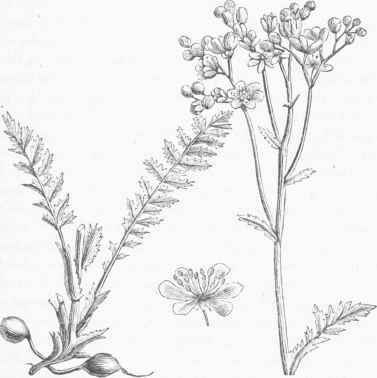
Dropwort (Spiraea fllipendula).
Continue to:


My Books

