


Boa
Description
This section is from "The American Cyclopaedia", by George Ripley And Charles A. Dana. Also available from Amazon: The New American Cyclopædia. 16 volumes complete..
Boa
Boa, a large serpent of the family boidae, order ophidia. This family is known by the following characters: The under part of the body and tail is covered with transverse bands, each of a single piece, narrow, scaly, and often six-sided; there is neither spur nor rattle at the tip of the tail; the hinder limbs, formed of several bones, are developed into an ex-serted horny spine or hook on each side of the vent; the body compressed, larger toward the middle; the tail short and prehensile; the pupil oblong and erect; and scales small, at least on the hinder part of the head. They are the largest of serpents, and though without venom, their immense muscular power enables them to crush within their folds large animals, which they first lubricate with saliva, and then swallow whole by their enormously dilatable jaws and gullet. - It appears that serpents of this family once existed in Italy, Greece, and the Mediterranean regions of Africa. Virgil's description of the death of Laocoon and his two sons, as well as the magnificent marble group which either furnished the subject for his description, or was suggested to the sculptor by it, and again the account in the 24th idyl of Theocritus of the serpents sent by Juno to destroy the infant Hercules in his cradle, all show that the artists were perfectly acquainted with the action of constricting serpents.
The narrative by Valerius Maximus of the gigantic serpent which had its lair by the waters of the river Bagradas (Mejerda), not far from Utica, or the present site of Tunis, and kept the whole army of Regulus at bay, killing many of his soldiers, until it was at length destroyed by stones cast from the engines used in the siege of cities, is familiar to most readers. Pliny adds that the serpents called boo? in Italy confirm this; for that they grow so large that one killed on the Vatican hill in the reign of Claudius had the entire body of an infant in its belly. Suetonius mentions the exhibition of a serpent of 50 cubits (75 feet) in length, in front of the Comitium. These reptiles, which are now found in tropical countries only, have been distinguished into 25 genera, under which are arranged, according to characteristic differences, the serpents in the British museum. Among these genera, most of which contain Several species, are the following: I. Python, two species, distinguished from the boas by placing its eggs in groups, and covering them with its body, a habit which had been doubted, but has been verified from observation of the proceedings of a python in the jardin des plantex at Paris: the ular mwad of Hindo-stan, Ceylon, and Borneo, and the rock snake of Java. The former is one of the largest and most terrible of all these monsters, said to grow to 30 ft. in length, and proportionally stout, and to be able to manage a full-grown buffalo.
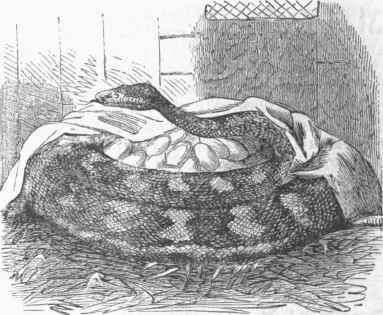
Female Python incubating.
There have been living specimens of both these snakes in the zoological gardens, Regent's park, London. II. Hortalia, three species, all of South Africa: the Natal rock snake, 25 ft. long, and as large as the body of a stout man; the Guinea rock snake, of which there was a specimen in the Regent's park; and the royal rock snake, supposed to weigh over 100 lbs. III. Boa, four species, peculiar to Mexico, Honduras, Santa Lucia, and Peru. This is the genus which has given the general name to the whole family of great constricting serpents. The skin of one of these serpents, of the first species, boa constrictor, the tlicoatl and tema-cuilcahuilia of the Mexicans, and the object of their serpent worship, is preserved in the British museum. The proper boa is decided by Cuvier not to be a native of any portion of the old world. IV. Evnectes, one species, the native of tropical America; this is the anaconda, a name said to be of Ceylonese origin, which, like that of boa, has been vulgarly given to the whole family. (See Anaconda.) - This is the most terrible class of destructive reptiles in existence. Their long, keen teeth are curved strongly backward, each tooth in either jaw fitting between the interstices of two in the other, clasping whatever they seize upon inextricably.
The body is readily wound about the victim in huge knots, compressed closer and closer until life is extinct Mr. McLeod, who wrote a narrative of the voyage of H. M. S. Alceste, in which was brought over to England from the island of Borneo a serpent of the family of boidae, 16 ft. long and 18 inches in circumference, describes their process of constriction. A goat was put into the cage of the boa every three weeks and swallowed, not by the power of suction, but by the effect of muscular contraction, assisted by two rows of strong, hooked teeth. This snake was 2 hours and 20 minutes employed in gorging the goat, during which time, particularly while the animal was in the jaws and throat of the constrictor, the skin of the latter was distended almost to bursting, while the points of the horns could be seen, threatening as it were at every moment to pierce the scaly coat of the destroyer. The snake coiled himself, and remained torpid for three weeks, during which he so completely digested and converted to his own use the whole of the goat, that he passed nothing from him but a small quantity of calcareous matter, not equal to a tenth part of the bones of the animal, and a few hairs; and at the end of that time was in condition to devour another goat.
Mr. Broderip, the author of "Leaves from the Note Book of a Naturalist" and the "Zoological Journal," describes in almost the same words the killing and deglutition of a rabbit, which he observed in the tower of London. The time required to kill the rabbit was eight minutes. In every respect, indeed, Mr. Broderip corroborates the observations of Mr. McLeod, except on one point, whether the respiration of the serpent is suspended during the act of swallowing, which Mr. McLeod affirms and Mr. Broderip denies, although without dissection the mode of his breathing cannot well be determined.
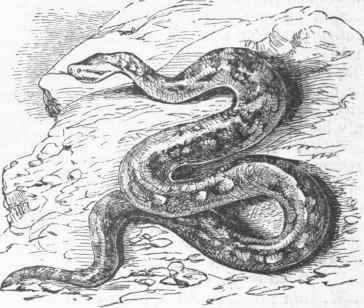
Natal Rock Snake (Hortalia Natalensis).
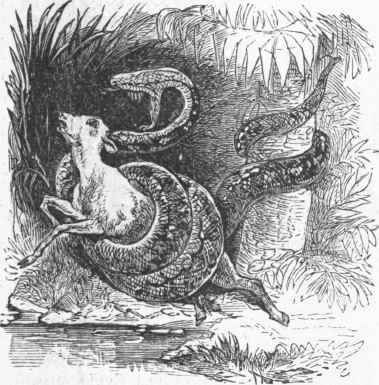
Boa Constrictor.
Continue to:


My Books

