


Brush
Description
This section is from "The American Cyclopaedia", by George Ripley And Charles A. Dana. Also available from Amazon: The New American Cyclopædia. 16 volumes complete..
Brush
Brush, a common name for a variety of implements, employed for removing dirt, for smoothing and polishing surfaces of objects by rubbing, and for laying on colors. They are usually made by inserting the bristles or hairs of animals in a firm support, which holds them in their proper arrangement, and at the same time serves as a handle. Most brushes are manufactured of the bristles of the hog. - The first process of the brush manufacturer is to sort the bristles according to their colors, unless he obtains them thus assorted. The divisions are into black, gray, yellow, white, and lilies. The last are the purest white, and are preferred for tooth and shaving brushes. Each kind is then assorted according to size, which is done by passing a bunch of them, held in the hand, between a row of steel points, like the teeth of a comb, which catch the coarser bristles. By using a succession of these combs of increasing fineness, the bristles are separated into as many heaps as desirable. Care is taken to keep them always arranged uniformly. The cylindrical brush used by house painters is made by taking a bundle of bristles, and tying them firmly around their root ends. This bundle is then strongly bound between the prongs of a forked stick, and covered with a coating of glue and red lead.
Another and more common method is to arrange the bristles around the small end of a conical stick, the small ends of the bristles pointing to the larger end of the stick. The bristles being secured by twine wrapping, and placed in a cup or socket with a hole in the bottom to let the handle pass through, this is driven home till the large end is buried in the centre of the bundle, tightening the fastenings, when the bristles are further secured by saturating their ends with glue or pitch. Other brushes are made for the most part by inserting little tufts of bristles into holes bored in rows into a stock of wood, bone, or ivory. The bristles are in some kinds secured by dipping their root ends into hot pitch, winding a piece of string round these ends, then dipping them again, and quickly introducing them with a twisting motion into the holes, where the pitch soon sets, and holds them. - Many brushes, as hair brushes, and indeed most of those made with tufts which are not too large, are made by drawing the bristles, which are doubled in the middle, through holes and fastening them on the back with wire. The process of drawing and fastening the bristles is commonly performed by women.
They sit around a table, each with a clamp attached to its edge for holding the stock-board, and each supplied with a fine flexible brass wire which is held in the right hand, and an apron full of bristles. A loop of the wire is passed through a hole in the stock, and a number of bristles being laid in it, the wire is pulled tight, causing the bristles to double and be drawn into the hole. The same process is repeated with the next hole, and so on, until all are filled with bristles, which are held tightly in their places by the wire. They are then clipped by a pair of shears gauged to cut the length of bristles required. If the bristles are very long, the clipping is done as each row of holes is drawn. Persons skilled in this process have drawn as many as 500 tufts in an hour; but 100 an hour is a more common rate. In brushes that are to be exposed to acid liquors, that would corrode brass wire, as the stopping brush used by hatmakers, a cord is substituted. The brush is finished by gluing a thin veneer upon the back of the stock, which covers over and protects the wire. A process for making hair brushes is employed by the Florence manufacturing company, by which much labor is saved.
The brush, the stock of which is composed of what is known as hard rubber composition, is made in a die, and the operation, after the adjustment of the bristles, is performed in a few moments. The die is composed of two parts, the cover and the base. In the cover there is cut whatever device or ornament the back of the brush is intended to receive. In the base there are holes of a depth to correspond with the length of the tufts which are exposed after the brush is finished. The process commences by filling the holes with bristles, which have been cut by a gauge as much longer than the depth of the holes as it is desired to have them penetrate the back of the brush. The upper part of the die is then covered with a sufficient quantity of plastic rubber composition, when it is adjusted to its fellow and the die is placed in a screw press and subjected to great pressure. After hardening, which takes place in a few minutes, the brush is removed, perfectly finished, having the tufts firmly held. - An ingenious machine for making flat brushes, the invention of Oscar D. and E. 0. Woodbury of New York, was patented in April, 1870. It folds the tuft of bristles at the middle, and secures the knuckle by a wire passed through and wound spirally round it.
It is then forced with a twisting motion into the hole in the back prepared for it, and firmly secured. The machine will fill from 60 to 80 holes per minute. The back of the brush is made of one piece of wood, and the holes may be bored into it (not through it) by a gang of bits. It is not necessary that the holes be bored at certain distances, or with great regularity, because by an ingenious arrangement the hole to be filled is brought immediately beneath the cone which delivers the tuft. The bristles are fed from a metallic comb in the manner shown in fig. 1, the tuft being separated at the point A. It is doubled by the plunger B, and forced down into the cone, as shown in fig. 2. The wire is passed through the bend and twisted around by the rotary motion of the plunger, which passes into a hollow cone, Laving a spiral groove which gives direction to the wire and secures it. The plunger continues to descend with a twisting motion until it reaches the back of the brush, and screws the tuft into it, as shown in fig. 3, when it rises and receives another tuft, which it manipulates as before. - The delicate brushes, called also hair pencils, used for water colors, are made of the hair of the camel, goat, badger, sable, squirrel, etc, by binding a bundle of them together after being carefully arranged, and their points temporarily protected, and sliding this through the larger end of a quill, till the points project sufficiently far through the smaller end.
The tube, having been previously softened by water, contracts as it dries, and holds the bundle of hairs fast. The best brushes of this kind are made of the hair taken from the tail of a species of Russian sable.
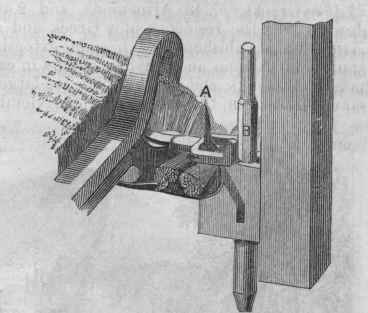
Fig. l.
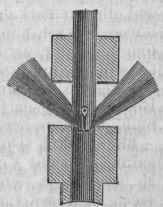
Fig. 2.
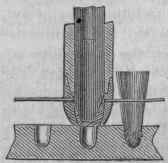
Fig. 3.
Continue to:


My Books

