


Sheep
Description
This section is from "The American Cyclopaedia", by George Ripley And Charles A. Dana. Also available from Amazon: The New American Cyclopædia. 16 volumes complete..
Sheep
Sheep, a hollow-horned, wool-bearing, ruminating animal, of the genus ovis (Linn.). The genus is characterized by horns common to both sexes in the wild state (though sometimes wanting in the females), large, angular, transversely wrinkled, yellowish brown, curved backward, laterally, and spirally, the tip coming forward, and with a porous bony axis; arched forehead, distinct lachrymal sinus, and hairy muzzle; absence of inguinal pores and of beard under the chin; two mammae, small ears, slender legs, and short tail; and hair of two kinds, one woolly, the other exterior, closer, and harsher. In a domesticated state the wool predominates over the hair, the horns vary or disappear, the ears and tail lengthen, and other characters undergo great modifications. Though the sheep is externally sufficiently distinct from the goat (capra) in general appearance, covering, and horns, the generic differences are not so evident when the whole series of these animals is examined; they run into each other so closely that some naturalists have included them in a single genus.
The sheep differs from the goat chiefly in the form of the horns, absence of beard, and presence of an opening on the anterior part of each foot between the hoofs, whence issues a sebaceous secretion; the males are not so odorous as in the goat. Sheep are gregarious, timid, defenceless, and more dependent on man's care than the goat; they inhabit the mountainous regions of temperate climates, and climb rocks and precipices with facility and speed. Some naturalists count four or five distinct species, one of which is found native in each continent; there are few parts of the globe except the polar regions where some breed of the sheep is not found; they thrive remarkably in temperate Australia, producing fine fleeces; in the tropics the wool degenerates into hair. In the skeleton the parietal bone is in the form of a flattened band, encircling the cranium between the orbital wings of the sphenoid, and is narrower than in the goats; frontals large and broad; squamous portion of temporals small, and the tympanic bullae large, terminating anteriorly by a sharp styloid process; nasals long and convex, forming a single V-shaped bone; ascending portion of intermaxil-laries at a very oblique angle, and the incisive openings very large and elongated; infraorbital opening on a line with the second premolar; lachrymals large, articulating with the nasals; malar bones broad, thick, and much prolonged on the cheek; palate bones largely developed, deeply notched posteriorly.
According to Cuvier there are 46 vertebrae, of which 7 are cervical, 13 dorsal, 6 lumbar, 4 sacral, and 16 caudal. The intestinal canal is very long and simple, the small intestines very much convoluted, and the large of nearly the same size, the whole 28 times as long as the body; the stomach compound; hepatic duct enormously large; brain elongated, narrowed in front; organ of smell highly developed. (For other anatomical details, see Kuminantia.) The dental formula is: incisors 0/8, canines none, molars 6/6-6/6; they begin to change their teeth in the first year, and have all their permanent teeth at three years, except the outer two incisors; the last, according to Owen, in the lower jaw, represent canines, as shown by the analogy of the camels, their lateness of development and peculiarity of form; this holds true in all the cavicornia or hollow-horned ruminants. - Sheep formed the principal wealth of the Hebrew patriarchs, and the term pecus (cattle) of the Latins, whence was derived pe-cunia, wealth, was applied especially to them; they came into N. and W. Europe long after the goat, and there is no evidence of their crossing the Rhine or upper Danube until about the time of the fall of the Roman empire, though they then existed in S. Europe. In old times they were bred chiefly for their skins and milk, the last being abundant, agreeable, and highly nutritious.
Now they are valued most for their wool, flesh, and fat; their flocks well managed carry fertility wherever they go, the droppings being richer than any other manure except that of fowls; they are even employed as beasts of burden in the mountains of India; the skins with the wool on are used in some countries for garments, and in the form of leather for gloves, book covers, and for various other purposes; the wool has the property of felting on account of the imbricated scaly surface of the fibres. - The Corsican musimon or moufflon (O. musimon, Pall.), placed by Bonaparte in the genus capra on account of the absence of interdigital glandular openings, and the type of the genus caprovis from its resemblance to a goat, grows as large as a small fallow deer, and has very large horns; it inhabits the mountains of Corsica, Sardinia, the southern part of Spain, European Turkey, and the eastern Mediterranean islands, where however it is comparatively little known. The head is long, with compressed muzzle, swollen forehead, and large, erect, and sharp ears; the horns of the male are long and triangular, comprising more than half a circle, their bases occupying almost all the forehead and separated only by a small space; they grow gradually smaller to the obtuse tip, with transverse wrinkles and raised rings; the body is large and muscular, the tail with 12 vertebrae, turned down and bare on the under side; the legs long and muscular, and the hoofs short; there is an appearance of a moderate dewlap.
The general color is yellowish, with a chestnut tinge, deepest on the neck; head ash-gray; muzzle, space about eyes, interior of ears, abdomen, inside of thighs, edges of tail and end of legs, white; horns ochrey brown; the under wool is ashy or rusty white, and the hair is darker and thicker in winter; the females are without horns, or have very small ones. The average size is about 4 ft. in length and 32 in. in height; there is sometimes a tuft under the chin, and other marks also indicate it to be intermediate between sheep and goats. They are seen in flocks of 100 or more, headed by an old male; they breed with the domestic races, and have been themselves domesticated. - The Asiatic argali (O. Ammon, Cuv.), very similar to the moufflon in general form, is large and powerful, the male standing 3 ft. high at the shoulders and weighing 200 lbs.; the horns 4 ft. in their curve, with a weight of 30 lbs. The fur is short, fulvous gray, in winter, with a ferruginous or buff dorsal stripe, and a light brown anal disk; it is more rufous in summer.
It inhabits the highest mountain ranges of Asia, the Caucasus, and the plains of Siberia; its flesh is much esteemed, and in Russia the skins are still used as articles of dress; it is easily domesticated, and is generally believed to be the source of some of the eastern breeds of sheep; the females have small horns. The African argali or bearded sheep (O. tragela-phus, Cuv.), the aoudad and ammotragus of some authors, is another species intermediate between the sheep and goats, having the inter-digital glands of the former, and the absence of lachrymal sinuses of the latter; it is one fifth larger than the European sheep, with a tail about 7 in. long, ending in a pencil of hairs; the horns are small in comparison with the size of the body, and rather smooth. The color is uniform reddish yellow, with dorsal stripe and anterior part of limbs brownish; under parts and inside of limbs whitish; the anterior parts of the neck, body, and legs are furnished with hair 6 to 12 in. long. It inhabits the mountains of N. Africa, from Abyssinia to Barbary, in small flocks; it is fierce, and bravely defends itself.
America has also an argali, the Rocky mountain sheep (O. montana, Cuv.), called big-horn from the great size of the horns; it is found in flocks of 3 to 30, from the upper Missouri and the Yellowstone river to the Rocky mountains and the high grounds on their eastern slope, as far S. as the Rio Grande, E. to the Mauvaises Terres of Nebraska, and W. to the coast ranges of Washington territory, Oregon, and California; it is said to range as far N. as lat. 68°, but is not found in the hilly regions near Hudson bay. None of the domestic breeds have been traced to this, though it would no doubt cross with them; the effect of all domestication is to improve the fleece, shortening the hair and increasing the wool. - The musimon of Corsica and the Asiatic argali, though differing somewhat in the skeletons from the domesticated races, have generally been considered as their most probable origins. The domestic sheep (ovis aries, Linn.), from whichever of the preceding it be derived, presents a great variety of breeds, only a few of the principal of which can be noticed here; several of them have received distinct specific names.
Among the African sheep is the Fezzan breed, remarkable for the long legs, pendulous ears, arched forehead, and short, curled, and crispy fleece, like a mane on the neck and whorled on the shoulders; the usual colors are black and white. Nearly allied to this is the Persian sheep, with black head and neck, and the rest of the body white; it is very docile and affectionate. From the last or the Fezzan seem to have sprung the Morocco, Congo, Guinea, and Angola breeds; H. Smith figures a variety called the Zunu or goitred breed, having a high collar of fat behind the horns and a goitre-like fatty mass on the larynx. There are several breeds of large-tailed or fat-rumped sheep in S. Africa, extending over that continent and also to Asia; the Hottentot or broad-tailed breed is below the medium size, with short and soft fleece, and two large masses of fat on each side of the lower part of the tail, which are so esteemed as a delicacy that various contrivances are used to prevent them from dragging on the ground; the fat-rumped sheep of Tartary and temperate Asia (O. steatopyga) has a similar growth of fat upon the croup, and long and pendulous ears; the reason of this accumulation of fat, sometimes 70 to 80 lbs., has not been satisfactorily determined. - The most important breed of sheep as regards the texture of the wool is the merino (O. Hispanica), in modern times brought to the greatest perfection in Spain, though its originals probably formed the flocks of the patriarchs thousands of years ago, and have been the stock of all the fine-wooled sheep.
Unlike the British breeds, they have wool on the forehead and cheeks; the horns are very large and heavy, and convoluted laterally; the wool is fine, long, soft, twisted in silky spiral ringlets, and naturally so oily that the fleece looks dingy and unclean from the dust and dirt adhering to the outside, but perfectly white underneath; the form is not so symmetrical as in many English breeds, and there is generally a loose skin hanging from the neck. They are kept in the milder regions in winter, and are transferred to the most favorable localities for shearing and grazing; they are most hardy in the Pyrenees. They are brought every night to a sheltered level valley, but are never housed nor under cover; four shepherds and six large dogs are sufficient for 2,000 sheep; the dogs can easily master a wolf, alone protect the flock at night, and are fed only on bread and milk. Most of these sheep have the horns removed; the legs are white or reddish; the face is in some speckled, and in others white or reddish; they are sometimes black; they are excellent travellers; they have in a remarkable degree the mellow softness under the skin which Bakewell considers an indication of a disposition to fatten in any breed; they are extremely docile.
The average fleece is 4 to 5 lbs.; several million pounds are annually exported from Spain. They readily form cross breeds, called demi-merinos, which have been brought to great perfection in France, whence, as well as from Spain, they have been imported into America. Other fine-wooled varieties of the merino are the Saxon, Silesian, and Flemish breeds, the last abundant in France and the Netherlands, and generally hornless, high on the legs, and mixed with the Barbary long-legged variety. The Astrakhan or Bokharan breed has a fine spirally twisted wool, and furnishes a great portion of the lamb skins so highly valued by furriers; it is generally a mixed black and white; in the very young each lock is divided into two small twisted curls. The Caucasian breed (O. dolichura) is very handsome, resembling some of the Spanish and English varieties; the males are horned, the wool of the adults coarse, and the tail, which consists of 20 vertebrae, is covered with a fine wool, which drags on the ground; they are generally white; by gentle pressure on the wool by linen coverings as the lamb grows, and by pouring warm water over it daily, it is made to lie in beautiful glossy ringlets, constituting a delicate fur much esteemed for lining robes and dressing gowns; the black is most prized.
The Mysore breed of India is without horns, with pendulous ears, short tail, and very fine wool, curled in small meshes and twisted like a corkscrew. - There is no country where more attention has been paid to the improvement of the breeds of sheep, both domestic and foreign, or where more success has been attained, than Great Britain; there are very valuable British breeds suited for the rich soil, luxuriant pastures, and mild climate of southern England, the thinner soil and rich grasses of the upland counties, and the alpine herbage and cold weather of the Scottish highlands; looking to a combination of advantages, some of the English breeds take the first rank for the small farmer. The Leicester or Dishley breed is the most esteemed of the long-wooled sheep of England, and is extensively reared on the rich and lower pasture lands. It may be known by the clean head without horns, lively eyes, straight, broad, and flat back, round body, small bones, thin pelt, disposition to make fat at an early age, and a fine-grained and well flavored flesh.
It was once known as the Lincolnshire breed, noted for the quantity of the wool and the coarseness of the mutton; Mr. Bakewell effected the improvement in the breed, with great profit to himself and advantage to the wool-growing interest of his country; it has extended to the south of Scotland, and a few are kept by almost every small farmer for the wool; the fleece is abundant, the flesh excellent, and the habits docile and home-loving; a valuable breed has sprung from its mixture with the black-faced and Cheviot varieties. The black-faced or heath breed extends from the N. W. parts of Yorkshire to the highlands of Scotland, especially on the W. coast; it is active, hardy, almost goat-like in its climbing habits, with a compact shape and bright, wild-looking eyes; the horns of the male are very large and convoluted; the wool is long, coarse, and shaggy, and the face and slender legs always jet-black; in some mixed breeds the face and legs are brownish spotted with black; the flesh is finegrained and of excellent flavor, but the wool is comparatively unprofitable, the Cheviot, another northern breed, being generally preferred as equally hardy and better fleeced. Many attempts have been made to improve it, and the Norfolk, Suffolk, and Dorset breeds are supposed to be derived from it.
In the Cheviot the head is bare and clean, the face and legs white, the body long, bones small, and fleece of about 3 lbs. The Dorset is an old but handsome breed, with strong and well formed body, finely curved horns, and clear white fleece; they drop their lambs as early as September. The Southdown breed is dark-faced, without horns, with long small neck, very short and fine fleece of 2 1/2 to 3 lbs., and celebrated for the fine flavor of the mutton; it is in the greatest perfection in Sussex, on the chalky downs. Other British breeds without horns and with white face and legs are the Teeswater, Dartmoor, Hereford, and Rom-ney Marsh; and with horns, the Exmoor and Spanish. - America has no indigenous domestic sheep. The first sheep were introduced into the United States at Jamestown, Va., from England in 1609, which in 40 years had increased to 3,000; they were introduced into New York and Massachusetts about 1625. Both Spanish and French merinos have been introduced, the former by David Humphreys, minister to the court of Madrid, in 1802, and the latter by Mr. Taintor, of Hartford, Conn., in 1846. They are hardy, yielding a large amount of fine wool for their size, the males 10 to 16 lbs. of washed wool, and the females 4 to 8, the former weighing from 140 to 175 lbs., the latter from 80 to 130. They thrive in summer on grass and clover, and in winter on hay, wheat bran, barley, oats, and root crops; in winter they require sheds for protection, free space, pure air, and water accessible.
The best breeds are generally considered to be the Vermont Brewer and Atwood flocks; some regard the Saxon merinos as the best, and the French have less oil in their wool than the Spanish. The Leicester breed has a heavier fleece and carcass, but requires more food; as combining the advantages of wool and meat, this is the best breed for the farmer, and is excellently bred in New Jersey; the wool is long staple, and is used mostly for combing purposes, for delaines and similar cloths. The Southdowns are by many preferred to the merinos, as a third larger, hardier, and better mutton; they are very prolific, and the lambs are hardy; the wool is large in quantity and fair in quality. The Cotswold also is highly esteemed. As a general rule, the fine-wooled sheep, like the merino, Saxon, French, and Silesian, are not so profitable for the mutton as the coarse-wooled, like the Leicester, Southdown, and Cotswold; it seems impossible to combine in a single breed both these qualities in their greatest perfection. The northern and western states raise the best sheep for mutton, and the middle and southern for wool. - Sheep are remarkably affected by changes of external condition, as of climate, food, etc., and congenital varieties thence arising may be easily perpetuated.
In Massachusetts in 1791 a lamb was born with a longer body and shorter legs than the rest of the flock, with longer joints and crooked fore legs; as it could not leap over fences, it was determined to propagate its peculiarities, and from it arose the famous otter breed, now extinct; when both parents were of the otter breed, the lambs inherited the form. - Sheep are subject to many diseases, of which the most troublesome is the foot rot, from suppression of the secretion of the gland between the hoofs, and consequent inflammation, generally caused by standing on too wet ground; the best remedy is to pare the diseased hoof thoroughly and apply a solution of blue vitriol (sulphate of copper), 1 lb. to a quart of water; the animal should also be kept in a dry place. They suffer from insects, especially a hot fly (oestrus ovis), the larvae of which get from the lips and nostrils into the frontal and maxillary cavities, causing fatal disease; the wild sheep of elevated regions suffer least from these. They are infested with a species of tick, which may be killed after shearing by a weak solution of tobacco and water, or a preparation of oil, lampblack, and umber.
Sheep are more choice in their food than goats, and yet will thrive where most other animals would starve; they prefer alpine and aromatic plants, and will soon clear a field of weeds, briers, and bushes, and by their droppings prepare it for the plough. They cannot be economically kept amid a dense population, as they would occupy too much land; and they are not profitable to pasture with cows, as they bite the grass too close for the latter to thrive upon. - For full information on the statistics and profits of sheep husbandry, see the agricultural reports of the department of the interior at Washington, and the publications of the various state agricultural societies. It need only be stated here that lambs may be weaned at from two to three months; that the female is fit for procreation at one year and the male at one and a half; that gestation lasts about five months; that one or two young are born at a time; that one male may be kept to 30 females; and that they can produce till the age of 10 or 12, and be fatted with the best advantage at 8 years. - The number of sheep in the United States, as reported by the census of 1870, was 28,477,-951. The states having the largest numbers were: Ohio, 4,928,635; California, 2,768,187; New York, 2,181,578; Minnesota, 1,985,906; Pennsylvania, 1,794,301; Indiana, 1,612,680; Illinois, 1,568,286; Missouri, 1,352,001; and Wisconsin, 1,069,282. According to the report of the bureau of agriculture, the total number in the United States in January, 1874, was 34,038,200, valued at about $89,000,000.
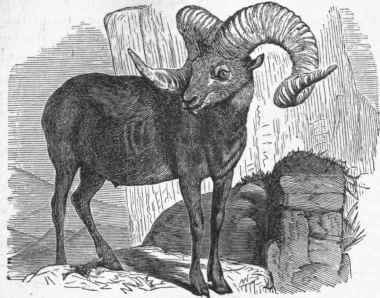
Asiatic Argali (Ovis Ammon).
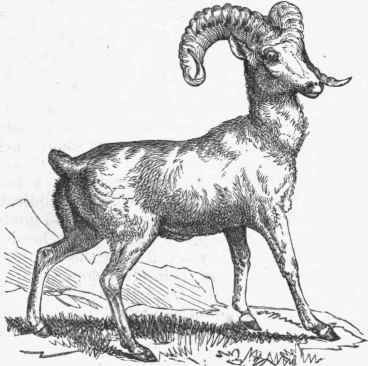
Rocky Mountain Sheep (Ovis montana).
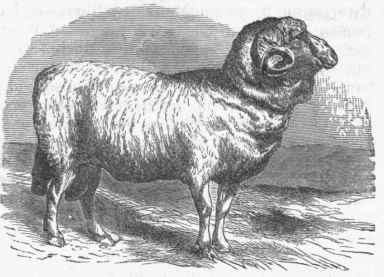
Merino Sheep (Ovis Hispanica).
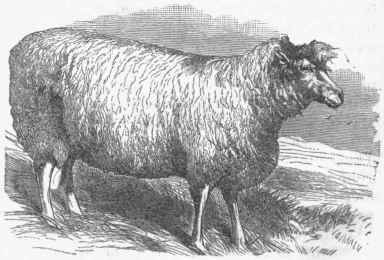
Leicester Sheep.
Continue to:


My Books

