


Skink
Description
This section is from "The American Cyclopaedia", by George Ripley And Charles A. Dana. Also available from Amazon: The New American Cyclopædia. 16 volumes complete..
Skink
Skink, the common name of the scincidoe, a family of lepidosaurian, slender-tongued lizards, with elongated cylindrical body, covered above and below by imbricated fish-like scales, arranged in quincunx and held in membranous sacs; they have no lateral folds. The family, by such forms as the seps and orvet, constitutes a connecting link between the saurians and ophidians. The head is covered with large angular plates, joined by their borders; the neck is of the same size as the chest; the tongue free, without sheath, slightly notched in front, with the surface mostly covered with papilla); the scales are smooth. They creep with a lateral sinuous motion like serpents; they have no crests nor fringes on the neck, back, sides, or tail, the last being conical, and generally long and without spines; the feet (absent in some) are short and clumsy, with well developed digits and claws. The jaws are short and united at the symphysis, so that the opening of the mouth is always the same; the teeth are sharp and slender, suited for seizing insects and worms; in the snake-like forms only one lung is largely developed; the ears are exposed. They are generally small, and live in holes and under stones in dry sandy places; they are usually of an earthy gray color.
They inhabit the torrid zone and the driest portions of temperate regions. Dume-ril makes three great divisions according to the differences in the covering of the eyes: 1, saurophthalmes, with lizard-like eyes, protected by two lids moving vertically; 2, ophi-ophthalmes, with a rudimentary lid, as in serpents; and 3, typhlophthalmes, in which the eyes are concealed under the skin. Most of the more than 30 genera, comprising more than 100 species, belong to the first division, the only one that need be treated here; some of them have four limbs, others two, others none. Dr. Gray divides them into scincinoe, with smooth scales, and tropidophorinoe, with keeled scales. - In the genus scincus (Fitz.) the snout is wedge-shaped, the upper jaw the longer, the teeth simple, conical, and obtuse, with a row on the palate; the limbs are four, with five nearly equal digits, flattened, and with serrated borders; the tail is conical and pointed. The common skink (S. officinalis, Laur.) is 8 or 9 in. long, with stout body, short thick limbs, and a proportionally short tail, very thick at the base; the eyes are small, high up and far back. The colors vary considerably, from silvery yellow to brownish, with seven or eight black transverse bands.
It is a native of Egypt, Nubia, Arabia, and N. and W. Africa. - There are several American species of this family, most of which are popularly called " galliwasps," one of the best known of which belongs to the genus diploglossus (Wieg.), characterized by a tongue with scaly papillae in front and filiform behind, toothless palate, flat head, obtuse muzzle, and flattened body; the feet have five unequal toes, compressed, without lateral edgings, and with tuber-culose palms and soles; the scales are striated, and ridged in the middle; the tail is rounded, long and pointed, with a very large anal operculum. The great galliwasp (D. occidu-us, Wieg.) is about 21 in. long, of which the tail is one half; it is one of the largest of the skinks. The color above is generally light brown, with a dozen or more transverse bands, sometimes darker and sometimes lighter, and yellowish white below with brownish tints. It is found in Jamaica, where it is very much dreaded, though it is perfectly harmless; it forms the type of Gray's genus celestus.
The five-lined skink (euprepes quinquelineatus, Wagl.) is 10 to 11 in. long, the head pale red with six obscure white lines, the two internal confluent at the back part; the body above is olive brown, with five pale white longitudinal lines and a black lateral band; the tail brown, tinged with blue, and the lower surface white. There are no teeth on the palate, otherwise the characters are as in the last genus. It lives in the stumps of old trees in thick woods, not far from the ground, and is found from lat. 35° N. to the gulf of Mexico and west to the Mississippi river.
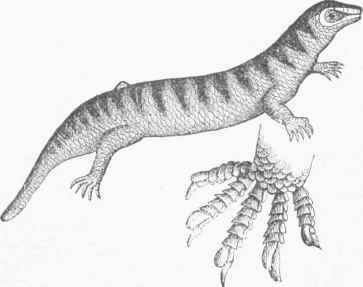
Common Skink (Scincus officinalis).
Continue to:


My Books

