


Tin
Description
This section is from "The American Cyclopaedia", by George Ripley And Charles A. Dana. Also available from Amazon: The New American Cyclopædia. 16 volumes complete..
Tin
Tin (Ger. Zinn; Fr. etain), an almost silvery white, highly lustrous, non-elastic metal; chemical symbol, Sn (Lat. stannum, tin); equivalent, 116; sp. gr. 7.29. It is softer than gold and harder than lead; malleable at ordinary temperatures into thin laminas (tin foil); so ductile at 212° F. that it can be drawn into fine, very flexible wire, which however breaks under a weight of less than one ton per square inch of section; so brittle at 392° F. as to be broken by a blow or fall; not appreciably affected in density by hammering; fusible at 442° F.; burns in air at high temperature, with white light; volatile at very high temperature; comparatively indifferent to air or moisture at ordinary temperatures; a good conductor of heat and electricity. Melted tin has a strong tendency to crystallize on cooling; and the surface of cast tin, when etched with dilute acid, shows its crystalline texture in figures analogous to the tracery of frost on window panes (moire inetallique). The free crystals are monometric, or, when obtained by the electric current, quadratic prisms, showing dimorphism of the metal. A bar of tin crackles when bent (the tin cry, cri d'etain, Zinnge-scJirei), and under rapidly repeated flexures the bent place grows hotter than the hand can bear.
Both noise and heat are due to the friction of the interior crystal faces upon each other. The handling of tin communicates a peculiar odor to the skin. There are three oxides of tin: the stannous, SnO, stan-noso-stannic, Sn203, and stannic, Sn02. A certain obscure modification of the last, the hydrate of which is insoluble in nitric or muriatic acid, is called metastannic oxide. The stannic and metastannic oxides form salts with alkalies, earths, and metallic oxides. Muriatic acid dissolves tin as stannous chloride, SnCl, which is used by dyers and in laboratories as a reducing agent, by virtue of its strong affinity for oxygen and chlorine. Dilute sulphuric acid scarcely attacks tin; heating with concentrated sulphuric acid transforms it to stannous sulphate, setting free sulphurous acid; very dilute nitric acid dissolves it cold, without any escape of gas, ammonia being formed simultaneously with the stannous nitrate and held as nitrate of ammonia in the solution. Concentrated nitric acid attacks tin violently, forming the insoluble metastannic oxide, which is the "putty powder" used in enamelling and in polishing plate. Aqua regia dissolves tin as stannic chloride, SnCl2. Alkalies cause oxidation of tin, forming stannic acid, which unites with the alkaline bases.
Thus, tin be-incr heated in concentrated caustic soda solu-tion, hydrogen is set free, and sodic stannate is formed. This is extensively used as a mordant, the basis of the "tin-prepared liquor" of dyers and calico printers. Sulphuretted hydrogen does not attack massive tin at ordinary temperatures. There are three sulphides of tin, of which the stannous or protosulphide may be obtained by heating sulphur and tin together; the second, sesquisulphide, by heating the first with additional sulphur; and the third, bisulphide, by a similar process. In the last case, the high temperature, which would otherwise decompose the bisulphide, must be kept down by adding to the ingredients volatile substances (mercury, sal ammoniac), which in escaping will absorb heat. This sulphide, thus produced, presents delicate golden or brownish yellow scales, and is used as a bronze powder (mosaic gold, the aurum musivum or mosai-cum of the alchemists). A mixture of stannous and stannic chloride, added to gold chloride in solution, precipitates a purple powder, supposed to be stannic oxide, colored by metallic gold in fine particles, or a mixture or combination of the oxides of gold and tin.
It is known as the purple of Cassius, and is used for coloring porcelain and glass, with which it is incorporated by fusion. The amalgam of tin and its alloys with lead and other metals is employed in the arts. (See Amalgam, Britannia Metal, Bronze, Mirror, Pewter, and Speculum.) - History. Tin ore, being a heavy mineral, not altered by ordinary meteoric agencies, may occur in alluvial and diluvial deposits, like gold and precious stones; and being also, when pure, easily reduced by smelting, its treatment might naturally become known to nations of great antiquity. It is often said that the Hebrews, Egyptians, and Greeks employed this metal; but so far as the question turns upon the Hebrew bedil (Ezek. xxvii. 12; Numb. xxxi. 22; Isa. i. 25, etc.) and the Greek κασσίτερος, which have been translated as tin, this seems doubtful. Tin was certainly often confounded with lead, being called by the Romans plumbum candidum. Even the stannum of Pliny was not tin; and not until the 4th century does stannum definitely bear this meaning. (See Kopp's Gesrltichte der Chemie.) But bronze vessels found at Thebes are said to be in part composed of tin, which Wilkinson suggests the Egyptians may have obtained from Spain or India long before the Phoenicians voyaged in the Atlantic. The latter people brought κασσίτερος from the Cas-siterides, supposed to have been the Scilly islands, off the coast of Britain. This may have been brought to the Scilly islands from Cornwall, or else, it is presumed, the Phoenicians pretended to visit these islands, and gave them a deceptive name, in order to mislead the Romans and conceal their real trade on the Cornish coast. (See " Transactions of the Geological Society of Cornwall," vols. iii. and iv.) Spain also is believed to have furnished tin to the Phoenicians. In the middle ages Cornish tin was used for church bells, and later for bronze cannon.
The ancient Mexicans obtained tin from the mines of Tasco, and with it made bronze for very hard cutting tools; and they used small T-shaped pieces of tin for money. Cortes had bronze cannon made with the tin of Tasco. - Distribution. Native metallic tin is one of the rarest of minerals. It has been reported from Siberia, Bolivia (doubtful), and Pennsylvania. (See Genth's recent volume on the mineralogy of that state.) There is a native sulphide (stan-nine, tin pyrites), but the only ore commercially utilized is the stannic oxide, called tinstone or stannite, Sn02; sp. gr. 6.94; crystalline form, tetragonal pyramids; percentage of tin, 78.38; crystals yellowish and translucent when pure, but usually dark brown, almost black, from admixture of ferric and manganic oxide. This occurs in veins, beds, and Stockwerke, or in secondary (alluvial and diluvial) deposits. In the former case, it is found in quartzose crystalline rocks (granite, gneiss, porphyry, mica and hornblende schists, quartz-porphyry, &c), associated with arsenical pyrites, iron and copper pyrites, bismuth, zinc blende, wolfram, molybdenite, specular iron, etc, and with such earthy minerals as feldspar, tourmaline, chlorite, topaz, apatite, flour spar, and scheelite.
The leading localities where such deposits have been worked are Cornwall and the Saxon and Bohemian Erzgebirge. Tin veins also occur in Brittany, Finland, Spain, Mexico, Bolivia, and New South Wales. The placer deposits are illustrated at the islands of Banca and-Billiton in the Malay peninsula, and at' some other points in the East Indies. The tin placers of Australia have also furnished of late large quantities of tin ore; and such deposits (stream tin) occur subordinately in Cornwall, Brittany, Spain, and elsewhere. A remarkable deposit of tin ore in a dike of trachyte is said to exist in Durango, Mexico. Stannite occurs with cryolite in Greenland. Tin ore in veins, dikes, or beds of dark porphyry is found in San Bernardino county, southern California; specimens are said to have been found in Idaho, in the bed of a stream; and several localities in the Appalachian regions are known to mineralogists as furnishing the ore in occasional crystals or in thin veins. Chesterfield and Goshen, Mass., and Lyme and Jackson, N. II., are localities of stannite; and tin has been detected in the magnetic iron ore of the highlands of New York and New Jersey, and in some of the auriferous ores of Virginia. The tin-ore deposits of Missouri, the object of a considerable speculative excitement a few years ago, seem to consist in the replacement to a minute extent, in certain crystalline schists, of titanic by stannic acid, the two being iso-morphous. The relative importance of the chief tin-producing regions is shown by the following estimates of production in tons :
REGIONS OF PRODUCTION. | 1872. | 1873. | 1874. |
United Kongdom ........................... | 0.560 | 9,970 | 10.000 |
Banea ...................... | .3.203 | 4,355 | 4.040 |
Billiton......................... | 2.946 | 2.980 | 3.157 |
Malacca........................ | 9.785 | 6.963 | 7,140 |
Australia ........................................ | 150 | 2,990 | 5,800 |
The amount credited to Great Britain includes the tin produced in that country from imported Australian ores. The product of Bolivia or Upper Peru, known as Peruvian tin, was estimated in 1868 by English authorities at 1,500 tons; but it is probably much less at present, since no account is taken of it in the trade reports. Saxony and Bohemia produce an insignificant quantity, not more than 200 or 300 tons in all; and Spain yields still less. - In the tin mines of Cornwall the ore occurs in small strata, veins, or masses (" tin floors "); in congeries of small veins; in large veins; and disseminated in alluvial deposits. The congeries or networks of small veins (Stockicerke of the Germans) occur in granite and "elvan" (feld-spathic porphyry). The large metalliferous veins are grouped in three districts: the S. W. part of Cornwall, beyond Truro; the neighborhood of St. Austell; and the neighborhood of Dartmouth, in Devonshire. The first is the richest and best explored. The tin veins belong to different systems, having nearly the same general course, but differing in dip.
It was formerly thought that tin occurred in the upper portions of the lodes only, and the appearance of copper pyrites in depth was considered to be a sign that the tin ore had been "cut out;" but more recently tin ore has been found at great depths and below the copper. Thus the Dolcoath mine was worked first as a tin mine for a very long period; then as a copper mine for half a century; and finally again, at still greater depth, and with considerable profit, as a tin mine. Alluvial tin ore or stream tin deposits occur on the hillsides and in the valleys, and furnished for centuries the whole of the Cornish tin. The largest works of this kind are around St. Just and St. Austell. Many of the Cornish mines have been unprofitable since 1872, on account of the great fall in prices resulting from the influx of Australian ore and metal. The mines in the East Indies might perhaps have brought about this revulsion still earlier, since they were capable of producing tin very cheaply; but the supply from that source was limited at the will of the governmental authorities, so as to divide the market with Cornwall, on terms which left some profit to the Cornish mines.
One authority estimates the product in 1868 at 7,200 tons for Great Britain, and 7,500 tons for southern Asia and India. According to a recent writer (Berg- und Huttenmannisclie Zei-tung, 1875), the total product of tin in the world about 1870 was something over 11,000 tons annually, of which 6,000 tons came from Cornwall and 4,000 tons from Asia. (This estimate for Asia is apparently too low.) But since that time, and especially since 1872, a very extraordinary development of tin mining in Australia has revolutionized the market. - The Australian tin-ore deposits thus far known occur in the region of the Cordilleras, in Victoria, New South Wales, and Queensland. In Victoria the older outcropping rocks are predominantly Silurian, and tin, ore is found in small quantity in alluvial deposits, but hitherto not in veins. In New South Wales and Queensland there is a greater quantity and variety of exposed rock formations, and among them granites, porphyries, and metamorphic schists, with which the tin ore is associated. In a portion of New South Wales it appears connected with more recent eruptive rocks.
The alternations of rain and drought in the seasons are a serious inconvenience to alluvial mining, which suffers also, like the placer mining of gold in Australia and the United States, from occasional excessively dry years. The existence of tin ore in this region was made known by the Rev. W. B. Clarke, colonial geologist, in 1845; in 1809 a shepherd brought to market a considerable quantity which he had obtained by washing, without knowing its value; a population of 10,000 miners was attracted to the district, and a feverish speculation raged until near the end of 1871, followed by disastrous reaction and a gradual renewal of industry in a more reasonable way. Up to the end of 1871 the production had been about 2,000 tons of tin. The present export in metal and in ore (sent to England for reduction) is said to exceed 7,000 tons of tin; the number of workmen is between 2,000 and 3,000. Veins are abundant, but the entire product is at present derived from alluvial mines. These occur in five principal districts, interspersed with scattered minor districts, the aggregate area being about 1,000 sq. m., the greater part of which lies south of the boundary between Queensland and New South Wales. The placers usually lie along present or former watercourses, and present at the surface granitic sand and pebbles, with underlying gravel, and at the bottom, resting upon the bed rock, a layer of clay, gravel, and bowlders, in which occur tin ore, wolfram, tourmaline, quartz, and occasionally sapphire and ruby.
Sometimes the series is repeated, giving two layers of stanniferous gravel, of which the lowest rests upon the rock, a phenomenon familiar to placer miners for gold; and the methods of working are similar to those of the latter. The total depth of the deposit is rarely less than 4 or more than 20 ft. The labor employed is partly Chinese; the average cost of the ore, delivered at the nearest harbor, is perhaps £40 a ton, though rich mines, favorably located, can deliver it at £30. Some furnaces have been erected near the mines to smelt the ore; but wood, the only fuel available there, though cheap at present, is likely to be rapidly exhausted. Two large establishments, at Sydney and Brisbane, have successfully smelted the Australian tin ores with coal in reverberatory furnaces. The metal, however, even after refining, contains but 99 per cent, of tin, on account of the wolfram invariably present in the ore. For this reason Australian ore is disliked by the smelters of Cornwall, and Australian tin always commands a somewhat lower price than Banca or Cornish metal. Kew and extensive discoveries of tin ore have been recently reported in Tasmania. - The tin ore of the island of Banca, in the Dutch East Indies, occurs as stream tin and also in veins in granite.
The Dutch government at present works the alluvial deposits only. These consist of 9 to 30 ft. in depth of loam, red and blue clay, coarse and fine sand, and tin ore. The tin-bearing layer is from 3 to 22 in. thick, in some cases even more. The mines are worked during the dry season of eight months, the rainy season being devoted to smelting the ore. The workings are open pits and cuts; and the material is conveyed away to be washed, water being collected by means of dams and reservoirs. After the washing the ore is calcined, leached in water (to remove sulphates of iron and copper), smelted in shaft furnaces with charcoal, drawn into a purifying receptacle, and poled. The resulting tin is the best in the market. The government furnishes engineers, superintendents, and furnaces; all the rest is supplied by the workmen (Chinese), who receive about $5 09 for each 100 lbs. of cast tin. The "Straits" tin comes from the British settlement of Malacca, and from various points on the Malay peninsula and the islands between it and Java. Drought and troubles with the Malays have temporarily reduced the supply from this source.
Its quality varies according to the locality of the mines and the skill of the metallurgical treatment; but it is usually less pure than Banca tin. - Metallurgy of Tin. The tin ore found in drift or alluvium is usually purer than that in veins, because the arsenides, sulphides, and metallic salts are decomposed and carried away by the action of water. The veinstuff as mined is usually rock or gangue containing disseminated ore (sometimes as little as 1/3 of 1 per cent, of tin), and requires a careful preliminary concentration, the difficulty of which is enhanced by the presence of heavy minerals (wolfram, bismuth, &c), which must be removed to secure a pure metal as the result of smelting. Connected with the mechanical concentration there is usually a calcination, to convert heavy sulphides into oxides, which can be more easily washed away. The apparatus of concentration comprises launders, plane tables, buddies, percussion tables, jigs, etc. (See Metallurgy.) The theory of the reduction of tin ore is simple. The stannic oxide must be deprived of its oxygen by contact with carbon at high temperature, and reduced to metallic form in fusion, while the earths and metallic oxides accompanying it must be collected in the slag. In practice the operation is embarrassed by several difficulties.
One of these arises from the high temperature necessary for the reduction of the stannic oxide, at which temperature other metallic oxides, which should pass into the slag, are also partially reduced and enter the metallic bath, or cause "salamanders" or "scaffolds" by chilling in the furnace. Hence the necessity of removing lead, bismuth, copper, antimony, arsenic, zinc, iron, tungsten, molybdenum, etc, as far as practicable, before smelting. There is also danger that the stannic oxide, which plays the part of an acid toward many bases, and of a base toward acids, may pass partly into the slag as ferrous or calcic stannate, or stannic silicate. The oxidability and volatility of tin are also sources of loss, to avoid which the shaft furnace is so constructed as to remove the metal, once reduced, as soon as practicable from the influence of the heat and blast. The earthy, ingredients of the ore, in which usually silica predominates, tend to form " stiff" (not easily fusible) slags; and, rather than add fluxes to counteract this evil, at the cost of an increase of the amount of zinc carried into the slag, it is common to smelt with little or no extra flux, producing a scarcely fused slag, in which more tin is mechanically caught and retained than is chemically combined with silica or the bases.
This slag may be nemelted or treated by mechanical concentration, to extract the tin which it contains, in tine metallic grains. Wolfram, which cannot be completely washed out, either with or without preliminary roasting, and which if present in the smelting charge goes partly into the slag and partly as tungsten into the metallic tin, is sometimes removed by a preliminary smelting of the ore with sodic carbonate or sulphate (Glauber's salt), by which a soluble tungstate of soda is formed, which can bo leached out. Muriatic acid will leach out from roasted tin ore the chlorides of iron, copper, and bismuth. - The melting of the concentrated and purified tin ore may take place in a reverberatory or in a cupola furnace. The former is advantageously employed where coal is cheap and good. It loses less tin by oxidation than the shaft furnace, in which the blast acts more or less on the tin, and it requires less fuel for the production of a given amount of tin. Zirkel says the reverberatory consumes for each part of tin produced 1¾ part of coal and loses 5 per cent, of tin, while the shaft furnace consumes 3 parts of coal and loses 15 per cent, of tin. But when the ore is impure, the reverberatory furnishes an inferior tin.
The greater product is due to the better opportunity afforded for the grains of tin to settle from the slag into the bath, which in the shaft furnace must be quickly removed to prevent oxidation from the blast. But this oxidizing blast, on the other hand, removes more completely arsenic, bismuth, etc. The principal ingredients added in the reverberatory are reducing agents (carbon), and sometimes, to counteract predominant silica in the ore, small quantities of slacked lime and fluor spar. This furnace is used in England, and also in Australia. In the cupola furnace, which is employed on the continent of Europe and in the Indies, the additions, aside from the fuel, are chiefly stanniferous slags and residues from the same process, which serve to prevent the fine dressed ore from packing too closely in the furnace to permit the passage of the blast. The cupola furnaces are made comparatively small in section, and contracted near the tuyeres, in order to secure the necessary temperature; and to prevent the reduction of iron oxides, they are made low (in Saxony, 1.88 to 2.82 metres; in Banca, 1.26 to 2.82 metres). The hearth slopes at the bottom from the rear wall toward the breast, and the fused material, flowing down this slope, passes continually under the front wall and into a receptacle before it, cut in stone and lined with clay and charcoal powder.
Here the metal separates and settles, away from the influence of the blast. Such a shaft furnace (Saxon) is shown in the accompanying section, in which a is the rough masonry of granite or gneiss; b, the inner wall, of granite; c, the front wall; f, the hearth; g, the tuyere (with two nozzles); A, the "eye," or opening in the breast, through which the molten material escapes; i', the fore hearth, built with granite, k, and clay and powdered charcoal, I; m, the tapping duct, ending in an opening in the iron front plate p; n, the crucible or refining pot. The arrangements for removing the slag from i, and the chambers for saving dust and fumes, placed above the furnace, are not shown in the diagram. The dimensions of the furnace here shown are, in metres: height, 2.83; width at top 0.96, at bottom, front, 0.58, and rear, 0.48; depth from front to rear wall at top 0.62, at bottom 0.48; inclination of hearth, 20°; size of " ye," 0.10 high by 0.38 at top and 0.5 at bottom; depth of fore hearth 0.38, of crucible 0.4; diameter of each, 0.5. The product of the shaft or reverberatory furnace contains more or less of the impurities of the ore.
Of iron there are at least traces in all sorts of tin; 0.5 per cent, injures the silvery color and lustre, and 1 per cent, diminishes perceptibly the softness and smoothness. Of copper, 1 to 1.5 per cent, makes tin harder and less malleable; and as the proportion is increased, the metal becomes more brittle and suffers a change in lustre. Of antimony and bismuth, 0.5 per. cent., without affecting the lustre, causes a brittle, crystalline structure. Of lead, 1 per cent, injures color and lustre, and softens the tin. Arsenic to the amount of 0.5 per cent, affects color and lustre; over 1 per cent, of it renders the tin lighter, and gives it a spotted, dull, or darkened appearance. "Wolfram and molybdenum in considerable proportions diminish rather the fusibility than the strength or lustre; zinc renders the metal harder, more brittle, and whiter; sulphur makes it "short;" tin oxide reduces its brilliancy; quicksilver, contained in several varieties of East Indian tin, renders it crumbly, and hinders its union with other metals.
The refining of crude tin is conducted in England as follows: The blocks of tin are set on the hearth of a reverberatory, and liquated at low temperature, by which process a purer tin is obtained in a kettle, while an alloy consisting mainly of less fusible metals (iron, wolfram, copper, etc.) reniains on the hearth. The liquid tin in the kettle is further purified by "poling;" that is, green wood or damp coal is submerged in it, causing by the generation of gases a violent ebullition, which continually changes the surface of the bath exposed to the air, and promotes the oxidation of the foreign substances. These are skimmed off, and the bath is allowed to settle, when there is a further deposit of heavy metals (iron, copper, etc.) on the bottom. After settling, the tin is drawn off in three portions, the upper layer being refined block tin, the middle common tin, and the lowest an impure alloy which is again liquated. Block tin is cast in moulds of marble. The purest metal (containing only 0.01 per cent, of iron) is called grain tin, and is produced by heating the best block tin until it is brittle, and dropping it from a considerable height upon flat stones.
The German process of refining consists in pouring the melted crude tin from a certain height upon an inclined cast. iron plate, coated with loam and covered with a layer of glowing coal about 0.25 metre thick. The less fusible impurities remain among the coals, and the purified tin flows along the plate, to be collected in a sump of cast iron filled with coal. The operation is performed repeatedly; the coals are subsequently beaten, to remove adhering grains of tin, and the residue is returned to the smelting furnace. Care must be taken to cast tin at the right temperature. If too hot, it becomes iridescent and "red. short;" if too cold, it assumes a dull appearance, becomes "cold.short," and loses ductility. The proper moment for casting is shown by a mirror.like clearness of the surface of the bath. A special refiniug of tin in the humid way consists in dissolving the granulated metal in muriatic acid, and precipitation by zinc. The zinc solution is subsequently decomposed with milk of lime, and the precipitate manufactured by heating into zinc white. . The following analvses are from Keils Metallhutten. leunde (Leipsic, 1873):
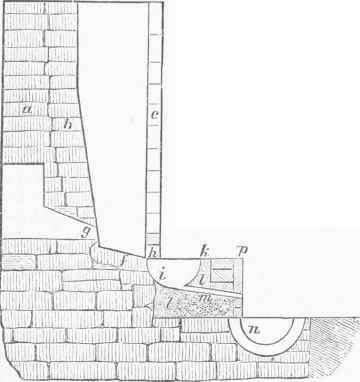
Saxon Shaft Furnace.
CONSTITUENTS. | l. | 2. | 3. | 4. | 5. | 6. | 7. | 8. | 9. |
Sn.... | 99.961 | 99.9 | 99.76 | 98.64 | 93.50 | 95.66 | 99.9 | 99.594 | 98.18 |
Fe.... | 0.019 | 0.2 | trace | trace | 0.07 | 0.07 | .... | trace | trace |
Pb.... | 0.014 | ...... | ....... | 0.20 | 2.76 | 1.93 | ..... | ...... | ...... |
Cu.... | 0.006 | ..... | 0.24 | 0.16 | ..... | ...... | ...... | 0.406 | 1.60 |
As.... | ....... | trace | .... | ..... | ..... | ...... | ...... | trace | trace |
Bb.... | ....... | ..... | ..... | ...... | 3.76 | 2.34 | ...... | ..... | ....... |
Bi.... | ..... | ...... | ...... | ...... | ..... | ...... | 0.1 | ...... | ----- |
1. 2. Banca. 3, 4. English. 5, 6. Peruvian (Bolivian). 7. Saxon, from ore treated with muriatic acid. 8. Bohemian, refined. 9. Bohemian roll tin, third class.
Uses Of Tin
Tin foil is used for coating the backs of mirrors, wrapping articles requiring to be kept from the air, lining boxes, covering Leyden flasks, etc. The latter uses require less copper in the composition, and the material is sometimes called stanniol. Of the following four analyses by Stotzel, the first two are of foil for large mirrors, the third for small mirrors, and the fourth for wrappers and linings:
CONSTITUENTS. | l. | 2. | 3. | 4. |
Tin...................... | 97.6 | 97.8 | 98.47 | 96.21 |
Copper ..................... | 2.16 | 1.23 | 0.38 | 0.95 |
Lead .......................... | 0 . 04 | 0.76 | 0.S4 | 2.41 |
Iron ......................... | 0.11 | 0.10 | 0.12 | 0.09 |
Nickel................... | ----- | ----- | ----- | 0.30 |
Tin foil is prepared by rolling cast tin into plates, and beating and doubling as with gold foil, though by a simpler process. (See Gold. beating). Tin foil consisting of a surface of tin, with an interior of lead or tin.lead alloy, is prepared by placing a plate of lead or alloy in a mould slightly larger, casting tin around it, and rolling and hammering. Tin.lined lead pipe for plumbers' use is made by setting a core of block tin in the centre of a mass of melted lead, so that the more fusible tin is melted, but does not mix with the remainder of the bath, and then proceeding as in the ordinary manufacture of lead pipe. (See Lead, vol. x., p. 262.) Tin plating is performed either by covering the metallic articles to be plated with melted tin, or by humid processes. The former method is chiefly confined to copper, iron, and zinc. Copper may be heated, cleaned with sal ammoniac, sprinkled with resin to prevent oxidation, and then plated by pouring melted tin upon it, and spreading the tin with tow, a high temperature being maintained.
The plating of sheet iron, to form so.called " tin plate" or sheet tin, for domestic utensils, etc, is conducted as follows: The thin sheets of iron are cleaned by immersion in dilute sulphuric acid and subsequent rubbing with sand and water and washing, after which they are annealed by exposure to cherry heat for 12 hours in cast.iron boxes, tightly closed and luted. Imperfect or seriously oxidized plates are rejected. The accepted ones, which are purplish from a thin external film of oxide, are polished by being passed cold through rolls, then subjected to a second and less prolonged annealing, then sorted and cleansed again, and finally taken to the tinning apparatus. After cleansing they will quickly rust on exposure to air, but may be kept indefinitely without injury if immersed in pure water. The tinning apparatus comprises a series of long rectangular pots or tanks, with a fire under each. These tanks contain the liquid baths into which the plates are to be plunged. The operation comprises a series of immersions: first into melted grease, in which the plates are left till all moisture has evaporated; then successively into several baths of tin, each of which is purer than the preceding, so that the sheets acquire a coating first of alloy and finally of pure tin; then into melted grease again, in which the superfluous tin runs off, while the liquid grease prevents a too rapid cooling and consequent cracking of the surface.
As the tin in the final tin bath becomes fouled by alloyed iron, it is removed to the preceding tin bath, and from this in turn to the first bath. After the final grease bath (tallow and palm oil), which anneals the plates, the edging of tin which usually forms around them is removed by dipping into melted cast iron, which melts it, so that a quick blow on the plate causes it to drop off. The plates are at last rubbed with bran and then with sheepskin to remove grease and dirt, sorted, packed in boxes, and marked to indicate size and quality. The sheet iron for tin plates is rolled from the best charcoal or coke bar. Terne plates have, instead of tin, a coating of tin.lead alloy, containing from one third to two thirds lead. Iron may be coated with zinc first, and then very readily tinned by dipping into the fused metal, since tin and zinc unite with ease. Sheet zinc is tinned in the same way, but should not be left in the bath so long as to become alloyed with tin beyond the surface. Lead and its alloys maybe tinned in like manner. The process above given for tinning iron is not applicable to cast iron, unless it has been decarbonized on the surface by heating in iron oxide, after the manner of the "annealing" practised in the manufacture of malleable castings.
The humid methods of plating tin upon various metals are numerous. Pins, which are made of brass wire, and other objects of brass or copper, are dipped into an aqueous solution, containing 1 part argal, 2 parts alum, and 2 parts salt, in which tin has been dissolved, or to which stannous chloride has been added. In this liquid they remain unaffected until brought into contact with metallic tin, whereby an electro.chemical action is caused, and all the objects connected directly or through one another with the metallic tin are immediately coated with tin reduced and precipitated from the solution. Boiling brass or copper objects, in contact with tin filings, in a solution of stannic oxide in caustic potash, is also an excellent way. Iron objects (nails, hooks and eyes, etc.) may be tinned, after suitable cleansing, in a bath of argal and stannous chloride, with the addition of zinc filings; or the bath may be composed of equal parts of the tin salt and common salt, dissolved in water, or of 1 part tin salt, ¼ part sal ammoniac, and 1 part common salt, dissolved in 2 parts nitric and 4 parts muriatic acid, diluted with water. In the latter liquid most metallic objects may be tinned by sufficiently prolonged immersion, copper or iron being kept in contact with a zinc wire during the process.
Zinc is most easily tinned. For galvanic tinning a weak battery may be employed, and a solution of stannic chloride in caustic potash. But the use of the battery in this and similar operations on a commercial scale will doubtless be superseded by the modern magneto-electric machines, which furnish the necessary current by mechanical instead of chemical means; or, to speak more accurately, by the combustion of coal, a cheap fuel, instead of the combustion of zinc or other expensive substances.
Continue to:


My Books

