


Trout
Description
This section is from "The American Cyclopaedia", by George Ripley And Charles A. Dana. Also available from Amazon: The New American Cyclopædia. 16 volumes complete..
Trout
Trout, a name popularly restricted to the species of the salmon family inhabiting exclusively or principally fresh water, and embracing members of the three subgenera of the old genus salmo made by Valenciennes, viz., salmo, fario, and salar; the family characters have been given under Salmon. The salmon trouts belong to the genus fario (Val.), having one row of teeth on the vomer, the true salmons having the palate smooth; the species are so called from the redness of the flesh, but all the trouts have this color at some epoch of their lives, depending probably on their food. The salmon trout of Europe (F. argenteus, Val.; salmo trutta, Linn.), called also white or sea trout, is found in the larger lakes and rivers of that continent; it varies considerably in color, like all of the family, according to the character of the water and the quality of the food; it is greenish gray or bluish black above, lighter on the sides, and silvery white below, with a few black spots above the lateral line; it attains a length of 2 to 2½ ft., and, being abundant in the markets of London and Paris, is next in value to the salmon, which it resembles in habits.
The so-called sea trout of the gulf of St. Lawrence (salmo immacula-tus, H. R. Storer) has the flesh of a fine pink color and superior flavor; the color is sea-green above, lower parts and the fins white; it rarely exceeds a weight of 7 lbs.; it probably belongs to the genus fario. There are several species called salmon trout in lakes shut off from the sea and near the mouths of the rivers of Maine. The spots of trout resist the action of heat and even of alcohol for a long time. - The common brook or speckled trout of North America (salmo fontinalis, Mitch.) is from 8 to 20 in. long, pale brownish above with darker reticulated markings; sides lighter, with numerous circular yellow spots, many with a bright red spot in the centre; white or yellowish white below; the first ray of pectorals, ventrals, and anal edged with white and black, with the rest of these fins reddish. It is found abundantly in the streams of the British provinces, the New England, middle, and western states, and is everywhere highly esteemed as food; it is rarely taken weighing more than 1½ lb.; the markings vary considerably according to locality and season; in New Brunswick and Nova Scotia it descends to the sea when it can; it is the same species from Labrador to Pennsylvania and Ohio. It is a great favorite with anglers; it is taken by the hook and line baited with a minnow, shrimp, worm, or artificial fly; in narrow streams, just before the spawning season, when it is little inclined to bite, it may be caught by titil-lation, by passing the hand carefully under the tail, and, as the tickling is gently performed, slowly moving it toward the head, until by a sudden grasp it is seized and landed. - In the genus salmo belongs also the char of the British and Swiss lakes (S. umbla, Linn.), usually 9 to 12 in. long, but sometimes 18 or 20 in.; it is umber-brown above, the sides lighter with numerous red spots, the lower parts and fins reddish orange; it varies like all other trouts, and occasionally attains a larger size than the above; it frequents the deep part of the lakes, feeds chiefly at night, and affords but little sport to the angler.
Its American representative is the S. oquassa (Girard) of the great lakes of Maine. - In the genus salar (Val.) there are two rows of teeth on the vomer. The common European brook trout (salar fario, Val.) is usually 10 to 14 in. long, though sometimes considerably larger, even to a weight of 15 lbs.; it is shorter and stouter than the salmon, yellowish brown above, passing to yellow on the sides, and silvery below, the back spotted with reddish brown and the sides with bright red; the young are transversely banded; deformed specimens are frequently seen. The colors are brightest in rapid streams with rocky or gravelly bottom; the flavor is finest from the end of May to the end of September, soon after which the spawning season begins. This species is highly prized by anglers, and especially fly-fishers. As it is fond of swiftly running waters, and swims almost always against the current, the bait must be thrown up stream. The eggs are deposited in nests or holes in the sand, as with the salmon.
The gray trout of the North American great lakes, from the northern United States to the Arctic ocean, is the S. namaycush of Valenciennes, and the salmo amethystus of Mitchill and De Kay; it is called togue by the Canadian lumbermen, and from its size and voracity the tyrant of the lakes; it is greenish ashy above with yellowish gray spots, and below white with bluish reflections; the average weight is 12 to 20 lbs., though it attains sometimes more than twice this size. The siskiwit (8. siscowet, Ag.) belongs to the genus salar (Val.); it is of large size, stout and thick, of a rich flavor, but so fat as to be almost unfit for food; for description and figure see Agas-siz's "Lake Superior," p. 333 (8vo, Boston, 1850). - The trout, both in Europe and America, is a favorite subject for pisciculture, from the ease with which artificial fecundation of the eggs can be effected; but it has as yet been practised here on a small scale only; the labor and expense attending a large vivarium of trout are very small, while the remuneration may be made very large.
For an illustrated account of the manner of hatching trout artificially, see "American Naturalist," vol. iii., p. 202, and vol. iv., p. 601 (1870).
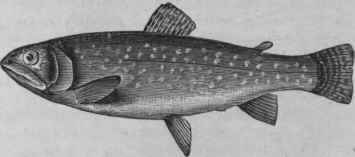
Speckled Trout (Salmo fontinalis).
Continue to:


My Books

