


Tunis
Description
This section is from "The American Cyclopaedia", by George Ripley And Charles A. Dana. Also available from Amazon: The New American Cyclopædia. 16 volumes complete..
Tunis
I. One Of The Barbary States Of N. Africa
One Of The Barbary States Of N. Africa, bounded N. and E. by the Mediterranean, S. E. by Tripoli, S. by the desert of Sahara, and W. by Algeria, between lat. 32° 20' and 37° 20' N., and Ion. 7° 20' and 11° 30' E.; extreme length about 350 m., general breadth 130 m.; area, about 45,000 sq. m.; pop. about 2,000,000. Besides the capital, of the same name, the chief towns are Kairwan, Susa, Hammamet, Bizerta, Kef, and Sfax. The coast line is irregular, and has three extensive indentations, forming the gulfs of Tunis, Hammamet, and Cabes (Syrtis Minor). The only considerable river is the Mejerda (anc. Bagradas), which falls into the gulf of Tunis after a N. E. course of about 200 m. Near its mouth, and for some distance W. of it, are several large lagoons. The Shot Kebir (anc. Palus Tritonis), over 100 m. long, and the Shot Gharnis, further W., over 50 m. long, in the southern part of the country near the Sahara, are marshy depressions which become nearly dry in summer. The interior of Tunis is but little known. The N. W. portion is mountainous, the summits having a height in many places of 4,000 or 5,000 ft. The mountains are well timbered, and have many tracts of cultivated land and olive plantations on their lower slopes.
An extensive plain or table land, 100 m. long by 30 m. broad and quite level, extends from this region to the gulf of Hammamet; it is nearly destitute of trees, and is used by the Arabs for pasturing their horses and camels. S. of this plain the country is believed to be nearly desert, though in ancient times it was celebrated for its fertility. Silver, lead, and copper are found in the mountains. The climate is very healthful; rain falls at intervals between November and April, but droughts prevail during the rest of the year. Wheat, barley, and maize are raised, but dates furnish a great part of the subsistence of the inhabitants. Olives, tobacco, cotton, indigo, and various drugs and dyes are grown; and the fruits of southern Europe are abundant. The principal domestic animals are horned cattle, mules, and camels; the breed of horses, once famous, has been allowed to degenerate. The tunny and sponge fisheries on the coast are important. The lion, panther, lynx, ounce, wolf, and boar are the principal wild animals found in the country. - The people of the interior are principally Arabs and Kabyles, while those of the coast comprise Turks, Moors, Jews, and Christians, with various degrees of mixture. They are generally good-looking, but very ignorant.
The language is a dialect of Arabic, but an Italian idiom is used by the traders. The Arabs resemble the Bedouins of Arabia in their mode of life, but are inhospitable to strangers. The Kabyles live on the mountains in villages of rudely constructed huts, and subsist chiefly on dates, bread, and milk. Arms are carried by all classes, and on the borders of Algeria the inhabitants do not acknowledge allegiance to either government. The religion is strict Mohammedanism. The principal manufactures are woollen fabrics, particularly the red caps so much worn along the shores of the Mediterranean; considerable numbers of skins are tanned and dyed; and trade is carried on with Europe and the interior of Africa. The government of Tunis, though nominally dependent on Turkey, and called a regency, is in reality a perfectly independent and absolute despotism. The sovereign is known as the bey. He pays no tribute, but is nominally restrained from making war or ceding territory without the consent of the sultan. The Turkish law of succession to the throne prevails. There are many ancient ruins in different parts of Tunis, more particularly in the valley of the Mejerda, where at Dukhah (anc. Thugga) are temples, an arch, cisterns, baths, barracks, gates, theatres, an aqueduct, and many inscriptions.
The great aqueduct which conveyed the water 52 m. from the mountain of Zagwam to Carthage can still be traced along the whole line, while some remaining portions rise to the height of 98 ft. - Under the Romans this country formed the province of Africa, and was divided into Zeugitana in the north and Byzacena in the south; and its most important cities were Carthage, Utica, Hippo Zarytus (Bizerta), Hadrumetum, Leptis Minor, Thapsus, and Zama. In A. D. 429 it was taken by the Vandals, and a century afterward became subject to the Greek empire, under which it remained till N. Africa was overrun by the Mohammedans in the latter part of the 7th century. Early in the 13th century it became independent. Louis IX. of France in 1270 made an unsuccessful crusading expedition against it, and died before the capital. In 1535 Charles V., after defeating the pirate Khair ed-Din Barbarossa and capturing Goletta and the city of Tunis, made the country tributary to Spain; but in 1574 it was conquered by the Turks. The Moors ultimately enforced their right of electing their own bey, agreeing only to pay a certain tribute to the sultan at Constantinople. The pirates of Tunis subsequently became very daring, but in Cromwell's time received severe chastisement from the British under Admiral Blake, and afterward from France and Holland. In 1816 the Tunisians agreed to renounce piracy and Christian slavery.
Under Ahmed Bey (who succeeded in 1837) and his successors, Mohammed Bey (1855) and Mohammed Sadyk Bey (1859), various reforms were effected, including the suppression of the slave trade and of many monopolies and oppressive taxes, the establishment of military conscription and of mixed tribunals, and the creation of a municipal government for the capital. French influence has long been predominant in the country.
II A City (Anc. Tunes Or Tunis)
II A City (Anc. Tunes Or Tunis), capital of the state, on the W. side of a lagoon near the mouth of the river Mejerda, connected with the gulf by the narrow channel of Goletta, 400 m. E. of Algiers, in lat. 36° 46' N., Ion. 10° 9'E.; pop. estimated at 120,000. It is surrounded by a double wall 5 m. in circuit, and defended by a strong castle, which commands the approach from the sea, and by several forts. Its appearance from a distance is imposing, but the streets are narrow and dirty, and the houses generally consist of a single story without windows on the exterior. The town is well supplied with water. Among the principal buildings are the bey's palace, many handsome mosques, and several large barracks, one of which has room for 4,000 men. There are Moorish schools and a college, a Roman Catholic church and convent, a Greek church, a theatre, and public baths and bazaars. The leading manufactures are woollen cloths and caps, embroidery, leather, and essences of musk, rose, and jasmine. The trade is extensive, comprising exports of oil, caps, soap, grain, wool, hides, cattle, sponges, wax, gold dust, and ivory, and imports of cotton, linen, and woollen goods, tin, lead, iron, coffee, sugar, and spices. The depth of water at Tunis is only 6 or 7 ft., and vessels lie in the gulf and discharge by lighters.
In 1873, 1,272 vessels of 121,957 tons entered the port. Tunis is not far from the site of ancient Carthage, and is itself a place of great antiquity.
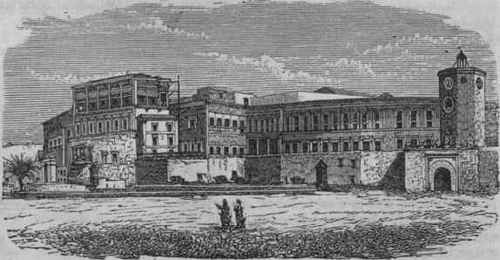
The Bey's Palace, Tunis.
Continue to:


My Books

