


Yircilia
Description
This section is from "The American Cyclopaedia", by George Ripley And Charles A. Dana. Also available from Amazon: The New American Cyclopædia. 16 volumes complete..
Yircilia
Yircilia, a name given by Lamarck to a genus of south African leguminous trees, to which Michaux referred one of the finest of our North American trees, the yellow-wood, as Virgilia lutea. As the tree differs, especially in its pods, from the Virgilia, Rafinesque made a new genus for it, calling it cladrastis, the meaning of which remains unexplained; the correct botanical name of the tree is cladrastis tinctoria, but the nurserymen retain it in their catalogues as Virgilia. It rarely exceeds 30 or 40 ft. in height, and a diameter of 12 in. The bark, even on old trees, is smooth, and the yellow heart wood readily imparts its color to water. The long leaves have 7 to 11 leaflets, the base of the petiole being expanded to cover the bud of the following year. The flowers, which appear when the tree is quite young, are in loose pendent racemes, 10 to 20 in. long, of the purest white, except a small yellowish spot in the centre of each, and have a slight fragrance; while they have the appearance of the flowers of the tribe papilionaceoe, their distinct stamens and other characters place the genus in the tribe sophoreoe.
The pod, 3 to 4 in. long, is narrow, flat, and four- to six-seeded. The tree is hardy in the climate of Boston, there being a notably fine specimen in the botanic garden at Cambridge. Its moderate size well adapts it for lawn planting; it is interesting at all times, and when in flower is surpassingly beautiful. It is readily raised from seeds.
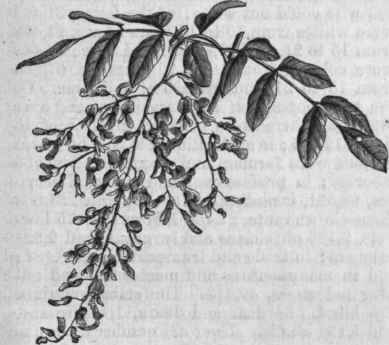
Virgilia or Yellow-wood (Cladrastis tinctoria).
Continue to:


My Books

