


York (Anc. Udoracum)
Description
This section is from "The American Cyclopaedia", by George Ripley And Charles A. Dana. Also available from Amazon: The New American Cyclopædia. 16 volumes complete..
York (Anc. Udoracum)
York (Anc. Udoracum), a city and the capital of Yorkshire, England, on both sides of the river Ouse, at its junction with the Foss, 172 m. N. N. W. of London, and 58 m. N. E. of Manchester; pop. in 1871, 43,796. The Ouse is here crossed by a handsome bridge, and there are several bridges across the Foss. There are several suburbs, mostly on the opposite side of the Foss. The city proper is nearly 3 m. in circuit, and is partly enclosed by ancient walls, which were originally erected by the Romans. It is entered by four principal gates, and the streets are generally narrow, but several have been improved and widened. York minster, or the cathedral, is by many considered the finest church in England. Its history begins in the 7th century, but the present edifice was commenced in the second half of the 12th century and completed in 1472. It is in the form of a cross, with a central square tower 213 ft. high, and two other towers, each 196 ft. high, flanking the W. front, which is highly ornamented. The extreme length is 524 ft., and the extreme breadth across the transepts 249 ft. The E. window is 78 ft. high and 32 ft. wide, and filled with stained glass representing about 200 historical events.
An elaborate screen contains statues of all the kings of England from William I. to Henry VI.; and upon this screen is the organ, one of the finest in the kingdom. The cathedral has a peal of 12 bells, one of which weighs 11½ tons, and is the largest in Great Britain. The edifice has been twice nearly destroyed by fire, in 1829 and in 1840. The archbishop's palace is on the N. side of the cathedral. It was built toward the close of the 12th centurv, and is now used as the library of the dean and chapter; and the residence of the archbishop is at Bishopthorpe, a little distance from the city. In 1872 there were 52 places of worship, of which 27 belonged to the church of England, and 12 to various denominations of Methodists. York has numerous schools, an ancient Gothic guildhall and large mansion house, the valuable museum of the Yorkshire philosophical society, public baths, a castle occupied by the assize courts and the county prison, a large modern jail, a merchants' hall, handsome assembly rooms, a concert room, theatre, lecture hall, numerous charitable institutions, and extensive cavalry barracks. The manufactures are not very important; and though the means of cornmunication are very extensive, the trade of the town is mostly local.
The archbishop of York is primate of England, though inferior in rank to the archbishop of Canterbury, who is styled primate of all England. His ecclesiastical province includes the dioceses of Carlisle, Chester, Durham, Manchester, Ripon, Soder and Man, and York. - During the Roman dominion York was the seat of the general government of the island. The emperors Septimius Severus and Constantius Chlorus died here, and Constantino the Great was here proclaimed emperor. Under the Saxon heptarchy it was the capital of Northumbria, and afterward of Deira. The citizens joined the Scots and Danes against William the Conqueror, who after their defeat razed the city to the ground. It was partially rebuilt, but destroyed by fire in 1137. During the massacres of Jews which took place in England after the coronation of Richard I., several hundred Jewish inhabitants of York, having in vain attempted to defend themselves in the castle, slew their wives and children, set fire to the houses, and perished in the flames.
Fairfax captured York from the royalists in 1644, and in 1688 James II., for its opposition to the arbitrary measures of the crown, took away its charter.
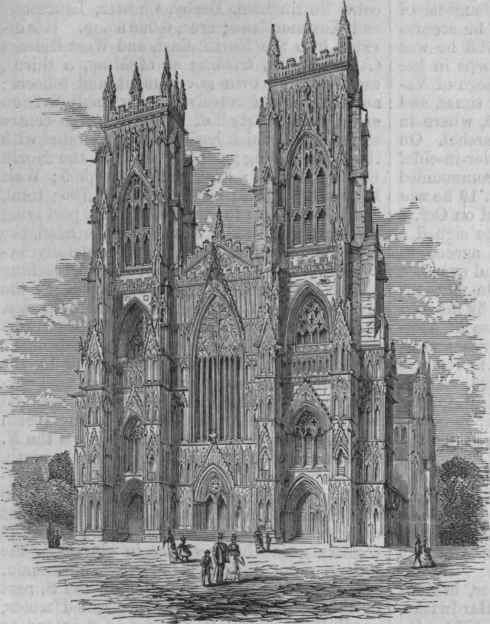
York Minster.
Y0RK, Duke of, a title formerly conferred on younger sons of the kings of England. It was first borne by Edmund Plantagenet, fifth son of Edward III., who was created duke of York Aug. 6, 1385, and died in 1402. He was the founder of the house of York, the house of the white rose; while his elder brother John of Gaunt, fourth son of Edward III., created duke of Lancaster Nov. 13, 1362, was the founder of the rival house of the red rose; and their respective claims were urged for nearly half a century in the so-called wars of the roses. (See England, vol. vi., p. 610.) The first duke of York was succeeded by his son Edward, who fell at Agincourt in 1415, and was succeeded by his nephew Richard, son of Anne Mortimer, who was great-granddaughter of Lionel duke of Clarence, third son of Edward III. It was by virtue of this descent from the duke of Clarence that the house alleged its superior right over that of Lancaster, which was descended from the fourth son of Edward III. The title was subsequently borne by Edward Plantagenet, afterward Edward IV.; Richard Plantagenet, supposed to have been murdered in 1483 by his uncle Richard III.; Henry Tudor, afterward Henry VIII.; Charles Stuart, afterward Charles I.; and James Stuart, afterward James II. It was conferred by the pretender, James III., on his second son Henry Benedict, known in history as Cardinal York, the last of the royal family of the Stuarts. (See Stuart, Heney Benedict Maeia Clement.) - After the accession of the house of Hanover to the British throne, George I. created, July 5, 1716, his brother Ernest Augustus, prince-bishop of Osnabrück, duke of York and Albany. He died in 1728, and Edward Augustus, the second son of Frederick, prince of Wales, received the title in 1760, but died childless in 1767. - The last duke of York and Albany was Frederick, second son of George III. (born Aug. 16, 1763, died Jan. 5, 1827). He received the title Nov. 29, 1784. He had at the age of six months received the dignity of prince-bishop of Osnabrtick, that bishopric being held alternately by a Catholic and a Protestant. It was secularized in 1803, and became a part of Hanover. He returned to England in 1787 from the continent, where he had gone to study the military art, and took his seat in the house of lords.
In 1789 he fought with pistols on Wimbledon common a duel with Col. Lennox, afterward duke of Richmond, who challenged him because he refused to retract or explain words uttered in the house; the bullet of Col. Lennox grazed his hair, and he then fired in the air. In 1791 he went to Prussia, and on Dec. 29 married Frederica, eldest daughter of Frederick William II., from whom he separated a few years afterward. In 1793 he was appointed to command a British corps in the Netherlands, and took part in the siege of Valenciennes, but was defeated several times, and returned to England in April, 1795, where in February he had been made field marshal. On April 5, 1798, he became commander-in-chief of the British army. In 1799 he commanded an expedition in Holland. On Sept. 19 he was defeated by Brune near Bergen, and on Oct. 6 near Alkmaar, where on Oct. 18 he signed a convention, by which the British agreed to surrender 8,000 prisoners of war and evacuate the territories of the republic. On Jan. 27, 1809, in consequence of disclosures by his mistress, he was arraigned in the house of commons for corrupt disposal of military commissions. (See Clarke, Mary Anne.) He was acquitted by 278 votes against 196, but so great was the scandal of the investigation that he resigned his office of commander-in-chief; to which, however, he was restored by the prince regent, May 15, 1811. By the death of the princess Charlotte, Nov. 6, 1817, he became heir presumptive to the throne.
In 1819 he was appointed keeper of the person of his insane father. His last speech in the house of lords was delivered in 1825 against Catholic emancipation.
Continue to:


My Books

