


Clam
Description
This section is from "The American Cyclopaedia", by George Ripley And Charles A. Dana. Also available from Amazon: The New American Cyclopædia. 16 volumes complete..
Clam
Clam, a common name for several species of bivalve shells. The largest of these, the giant clam, the tridacna gigas of Lamarck, but formerly classed in the genus chama, is an edible species found among the sheltered lagoons of coral islands, and imbedded in the coral; the animal sometimes weighs 20 lbs., and with the valves over 500 lbs. Such are the valves of the specimen used for Mnitiers in the church of St. Sulpice, Paris. Sir Joseph Banks possessed one which weighed, one valve 285, and the other 222 lbs. The shell is susceptible of a fine polish, and is carved by the Chinese into snuff bottles, tops of walking sticks, and similar articles. Poets and sculptors have made it the cradle of the sea goddess. The common soft clam of the northern shores is the mya arenaria; the hard clam or qua-haug is the venus mercenaria; and the broad sea clam is the mactragigantea. The unios, anodonts, etc, of the brooks and rivers are often called fresh-water clams. The mya arenaria, by its abundance on the coast of New England, is of importance as an article of food, and is also largely used for bait in cod and haddock fishing. They frequent soft bottoms, especially the gravelly mud of river mouths, and are most abundant between low water and half-tide mark.
The siphon is neither head nor tail, but a double retractile tube for respiratory and feeding purposes; mantle open at the opposite end, nearest the mouth, for the extrusion of the foot, by which they burrow in the mud with considerable rapidity; the shells are generally very hard, light-colored or sandy, and almost black on muddy bottoms. With the exception of the soft mass usually called the belly, they are, especially when cooked, rather indigestible. The shells are dug up from their beds, which are exposed at low water, where they are found lying about a foot below the surface, their siphon tube projecting upward in the hole by which they communicate with the water at high tide. They are taken out of the shells, or " shucked," and salted down in barrels. About 5,000 barrels are put up every year for the fisheries, and are valued at from $6 to $7 each. In the early history of the Plymouth colony clams were several times the principal source of sustenance for the people.

Giant Clam (Tridacna gigas).
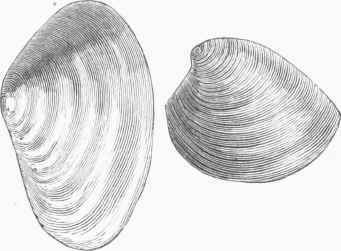
Soft Clam (Mya arenaria) and Quahaug (Venus mercenaria).
Continue to:


My Books

