


Coal Plants
Description
This section is from "The American Cyclopaedia", by George Ripley And Charles A. Dana. Also available from Amazon: The New American Cyclopædia. 16 volumes complete..
Coal Plants
Coal Plants, traces and fossil remains of ancient vegetation found in the strata constituting the coal measures. To many of these reference has already been made in the article Coal. The occurrence of the huge stems of the calamites in the sandstones, the woody matter entirely removed, and its place filled by the stony material of the rock itself, only to be distinguished from it by the form of the plant being still preserved - these and the abundant sigillaria stems found in the coal, their roots proving to be the obscure stigmarko with which the underlying fire clay is often filled, have already been noticed. So too the manner of occurrence of the larger stems or trunks standing in groups in many localities, as if they still occupied the places where they grew. But these, interesting and instructive as they are from the light they shed upon the nature and origin of the coal, are far inferior in numher to the ferns, which form perhaps more than half of all the species of the carboniferous flora - species which amount, according to Adolphe Brongniart, to about 500 in number, of which about 250 are ferns. The abundance of these and of the lycopods, both of which cryptogamic genera belong to the group acro-gens of Lindley, led Brongniart to apply to this period the term le regne des acrogens.
The same division also includes the genus lepido-dendron, about 40 species of which are found with the coal. These are gigantic club mosses, the living analogues of which in tropical climates are sometimes found 3 ft. high. Their fossil remains met with in the coal shales have been found no less than 49 ft. long, and fragments of other specimens indicated a still greater size. Many species of the ferns also are remarkable for the same gigantic growth, a number of them being tree ferns, resembling those which now flourish in the islands of tropical oceans and of the southern temperate zone. In these islands, even as far south as lat. 46° in New Zealand, in a climate not necessarily very warm, but of equable temperature and very humid, the arborescent ferns attain a height of 40 to 50 ft., and with the coniferse, which also abound as fossils of the coal formation, constitute important portions of the flora of these regions. Many of the smaller fossil ferns bear a striking resemblance to those now living; and on a careful comparison of the shape of the leaves, the arrangement of the veins of the leaves, and the manner of their attachment to the stems, which, in the want of more distinguishing characters preserved in the fossil specimens, are taken as the distinctive marks, it is by no means certain that some of them should not be referred to genera of living ferns.
The species, however, of all the ferns differ from the recent. The other families of the coal plants, excepting the coniferse, are so totally unlike any living plants, that they cannot always be referred even to the class to which they belong. The ferns, like the other coal plants, are found in the coal itself, their forms being preserved by impressions or prints on the rocky strata; and the preponderance of this family in the flora of this period has led some naturalists to believe they may have furnished a large portion of the coal beds. In the coal shales, particularly in those which make up the stratum overlying the coal beds, their impressions are often wonderfully abundant, so that when the coal beds are excavated, these slates appear filled with a complete network of the impressions of fern leaves. It is apparent that they must have formed a large portion of the mingled mass of vegetable matters and fine sediment, which now constitute these beds of black shale. As the thin mud in the course of ages slowly became indurated, the leaves were decomposed, and their carbon was diffused through all the mass; but their forms, even to the most minute markings, were left as perfectly impressed as though they had been purposely taken in the finest clay, and left behind to harden.
The preparations of recent plants for the herbarium of a naturalist could not be more beautiful than these naturally preserved relics of the most ancient vegetation. The delicacy of the specimens will not admit of the supposition that the plants could have been transported to any distance from the places of their growth. Wherever they are found thus perfect, they must have accumulated as the beds of vegetable matter now accumulate in the dense swamps of warm regions, the growth of each year slowly and silently adding to the increasing mass of indurated rock. The testimony of the fossil stumps and trunks is usually confirmatory of the same conclusion. - Next to the ferns, the coniferse are the most abundant of the coal plants, and also the most similar to living forms. Five genera have been distinguished. Those of the European coal mines are allied to the arauca-rian division of pines more than to other living forms; but in Nova Scotia and New Holland genera are met with of genuine pines. In a sandstone quarry in the Midlothian coal field, near Edinburgh, a trunk of an araucarian was uncovered from beneath 136 ft. of strata, which measured 47 ft. in length, flattened by the pressure, so that while its longer diameter was 5 ft., its shorter was 19 in.
The bark was converted into coal, but the rest was silicious matter. All the coniferse were distinguished by a large pith, the fossil called Sternbergia having been proved to be the stony cast of the cavity left by it in the axis of the trunk. Some also bore, instead of cones, a fleshyfruit larger than hazel nuts, similar to the products of the Chinese genus Salisburia, one of the yew tribe or taxoid conifers. This fossil fruit, called tri-gonocarpon, is found so abundantly in some of the European coal measures that in certain localities it may be collected by the bushel. It is met with in the shales, sandstones, coal, and ironstones. The coniferae and cycadae are included in Lindley's group of gynmogens, the dicotyledonous gymnosperms of Brongniart. - The calamites are very numerous, particularly in the sandstones. They are cylindrical jointed stems like those of reeds, and were formerly supposed to be gigantic equiseta of the group of acrogens. The conical termination of one end is now believed to be the lower end of a root.
Brongniart is of the opinion that they cannot belong to the equiseta, nor to any tribe of the flowerless plants, but more probably they must be classed with the gymnospermous dicotyledons; though, as Prof. Williamson remarks, the arrangement of their tissues differs widely from that of all known forms of gymnosperms. By many naturalists both the calamites and lepidodendra are thought to have possessed the peculiarities both of the acro-genous and gymnogenous families; the great height attained by some of the species requiring a different tissue from that possessed by the ordinary unaspiring acrogens, if not one un-distinguishable from that of the conifers. - The sigillariae were trees without lower branches, though probably acrogens with spreading tops, which grew sometimes to the height of 70 ft.; their trunks were cylindrical, fluted, and marked at regular intervals with spots, the different forms of which now serve to distinguish the species. They give to the plants their name, from the Latin sir/ilium, a seal. In the scalariform structure of their vessels they exactly resemble the ferns, and Dr. Hooker is inclined to believe they may have been cryp-togamous plants, though more highly developed than any flowerless plants now living.
They are often found most abundantly where the coal shales exhibit the greatest profusion of ferns; but in those instances in which leaves have been met with attached to the stems, they were long and slender, unlike those of ferns. These plants are so common, that no less than 22 species have been described in the coal fields of Great Britain; and some of the large beds of coal appear to have been almost entirely made up of 'them. Their roots, called stig-mariae, so named from the curious spots or stigmata systematically arranged upon their surface, have been found spreading out from the base of the trunks to a distance of 16 ft., and from the spots or tubercles upon the roots rootlets radiated like spokes from the nave of a wheel. Both the ferns and lepidodendra, and many other coal plants, appear to have had the same character of roots, as the stig-maria) abound in the fire clays which underlie most coal beds. These roots, however, are not coal, but of the same material as the clays in which they exist. Lyell noticed at the South Joggins locality in Nova Scotia, that the trunks of the sigillar'me divided below into four great roots, each of which soon bifurcated, and each of these was soon after subdivided into two smaller ones.
The fire-clay beds under the coal seams are frequently as filled with them, converted into fire clay, as the soil of the forests is filled with the roots of modern trees. - The coal plants of the oolite period differ in some respects from those of the true coal formation. The class of monocotyledons is then first represented by undisputed palms; the coniferse are greatly multiplied in proportion to the rest, and in forms more closely resembling existing genera; and the cycadas, a family allied both to the ferns and conifers, then first appear. The equiseta abound, the same species being met with in Great Britain and in the Richmond coal field. The fossils of the Brora coal in Sutherlandshire, which is the thickest coal bed of this fonnation in England, affording 3 1/2 ft. of good coal besides some of poorer quality, consist almost exclusively of plants belonging to this family. The ferns still constitute about two thirds of all the species met with; but most of the strange forms of the older coal measures, the lepidodendra, the sigillarim, favularice, ulodendra, etc., have disappeared.
The calamites, too, though seen in a few forms, were about disappearing, as they passed away before the termination of this period. - It is an interesting question respecting the ancient flora, whether it is fairly represented by the forms now preserved in a fossil state or impressed in the coal shales. From the celebrated experiments of Dr. Lindley, it would appear that this admits of reasonable doubt; while the observations of Dr. Hooker, made in the regions where the living flora most nearly resembles that of the specimens preserved in the coal formation, seem to render it probable that, as in recent times the ferns and conifera), where they greatly abound, nearly monopolize the vegetation, so it was in the ancient periods. The experiment of Lindley consisted in immersing a large number (177) of species of living plants in a tank of fresh water, to prove their relative powers of resisting decomposition. The results obtained were: 1, that the leaves and bark of most dicotyledonous plants are wholly decomposed in two years, and that of those that resist it the greater part are conifera) and cycadoa; 2, that monocotyledons are more capable of resisting the action of water, particularly palms and scitami-neous plants, but that grasses and sedges perish; 3, that fungi, mosses, and all the lowest forms of vegetation disappear; 4, that ferns have a great power of resisting water, if in a green state, not one of those submitted to the experiment having disappeared, but their fructification perished.
Thus those plants (the ferns) were found by this experiment most enduring in water, which we find most abundant in a fossil state; while the dicotyledonous tribes had little capacity to resist its action, and their organic remains are comparatively rare. From this it might be inferred that a large mass of vegetable organization has probably perished, and that the forms preserved are but a few specimens of the ancient flora of the earth. The fact that a collection of the fragments imbedded in the deposits of recent periods would prove but a poor index to the general mass of existing vegetation, may also be applied to the support of this inference. It is true that of the growth upon the more elevated regions of the earth, during the distant period of the production of the coal, we have no knowledge; but to the vast districts now constituting the coal fields it is reasonable to suppose that the observations of Hooker may be fairly applied, and that throughout these the vegetation varied but little from that indicated by the fossil plants.
The immense area over which the same flora was spread, with no apparent differences between that of the 30th and that of the 55th degree of north latitude, must have enjoyed a mild and uniform temperature, similar to that which now prevails through almost as great a range of latitude and almost as far from the equator in the southern hemisphere, where in the islands of New Zealand the flora is now found of more uniform character and more abounding in ferns than in any other part of the globe. If there were as small a proportion of land above the water in the northern regions as is now found in the southern, Sir Charles Lyell is of opinion that the same mild climate would be extended over all the regions occupied by the coal fields. - Many scientific men now suppose that the saps or juices of the coal plants were resinous or oily rather than hygroscopic as at present, and that the hydrocarbon oils were expressed beneath the water and rocky strata, forming petroleum, and subsequently by evaporation coal, with or without aid from the insignificant woody fibre of the coal plants, some of which, such as the fucoids and hydrophytes in general, are destitute of woody fibre; and with this class a large proportion of the coal plants undoubtedly were closely connected.
They leave no fossil remains, but simply prints or impressions of their flattened form, when pressed between the strata. - The distribution of fossil plants is as follows: 683 species in the carboniferous rocks, 910 in the lower tertiary coal group, 294 in the Jurassic coal strata; or 1,887 in 5,000 to 10,000 ft. of strata, leaving only 534 species in the remaining 50,000 to 60,000 ft, of palaeozoic and neozoic rocks; total, 2,421 species.
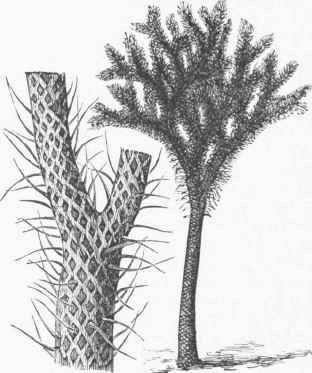
Lepidodendron Sternbergii.
Continue to:


My Books

