


Cowry
Description
This section is from "The American Cyclopaedia", by George Ripley And Charles A. Dana. Also available from Amazon: The New American Cyclopædia. 16 volumes complete..
Cowry
Cowry, the common name of the marine gasteropod mollusk cypraa, the representative genus of the family cyprmdce. The shells are well known for their beautiful colors and polished surface; the aperture is narrow, the lips thickened, ridged, and turned in, channelled at each end; no operculum; the mantle expanded on each side, meeting on the back, where there is a paler line. The young shell has a thin and sharp outer lip, a prominent spire, and is without the enamelled surface of the adult. They inhabit shallow warm waters near the shore, feeding upon zoophytes. Those of special interest are the orange cowry (C. aurora), worn by natives of the Friendly islands as a mark of chieftainship; the ring cowry (C. annulus), used by the Asiatic islanders to adorn their dress, for sinkers to their nets, and for barter; and the money cowry (C. moneta), used as money, and the young shells of which, with the convex portion cut away and the cavity filled with sealing wax, are favorites with boys in the game of " shaking props." This last is an eastern and Pacific shell, and is an important article of trade, being largely imported into Calcutta and Bombay from the Laccadive and Maldive islands.
Their value in Bengal used to be rated at 2,400, then at 2,560, but now more than 3,200 to the rupee, the worth of which is about 50 cents. They are largely imported into Liverpool. They are sent to the western coast of Africa for barter with the natives. A species of this family called the G. princeps, "the brindled cowry of the Persian gulf," is very highly prized by conchologists for its rarity and beauty. Only two specimens are known; one is in the British museum, and the other was sold some years since in London, at the sale of the collection of the earl of Mountnorris, for £40. A specimen of the G. umbilicata was sold in 1850 for £30. The cowries, from the great variety and beauty of the markings upon their smoothly polished surface, have long been in demand among civilized and uncivilized nations for ornaments to their dress and habitations. The tiger cowry (G. tigris) is the one so generally seen upon the mantels of houses in various parts of this country.
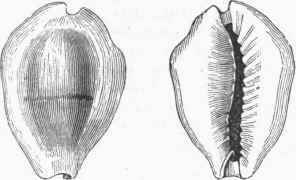
Tiger Cowry (Cyprsea tigris).
Continue to:


My Books

