


Curlew
Description
This section is from "The American Cyclopaedia", by George Ripley And Charles A. Dana. Also available from Amazon: The New American Cyclopædia. 16 volumes complete..
Curlew
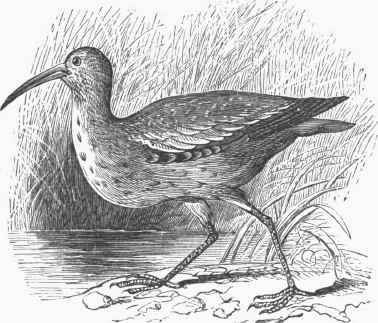
Curlew, a bird of the order grallatores, family scolopacidm, subfamily limosinae (which includes both curlews and godwits), and genus numenius (Linn.). The bill is long, slender, curved from the base, with sides compressed and grooved; the upper mandible projecting over the lower, and obtuse; wings long and pointed, the first quill the longest; tail short and even; tarsi long and slender; toes moderate, lateral ones unequal and united at their bases; hind toe long, slender, and partly resting on the ground; claws short and dull. There are nearly 20 species described, scattered over the temperate regions of the world in winter, and going north in summer; they frequent the borders of the sea, and muddy and sandy shores, sometimes visiting moors and marshy plains, in search of worms, larvae, Crustacea, and mollusks, which they extract from the moist ground, often from under water, with their long bills; they also eat berries from the fields and woodlands. The nests are formed on the ground in holes, lined with grass, and the eggs are generally four in number.
The long-billed curlew, or sickle-bill (N. longirostris, Wils.), is the largest American species, and may readily be distinguished from all others by the length of the bill, which is from 7 to 9 in.; the total length to end of claws is 29 in., the extent of wings 40 in., and the weight about 1 3/4 lb. The general color of the plumage is pale reddish brown, the head and neck streaked with dusky; the upper part of the throat, and a band from the bill to the eye, light buff; above marked with blackish brown, tail barred with the same; abdomen plain yellowish red; feet bluish. Though found in the north, it is most abundant at the south, where it resides all the year and breeds; it feeds during the day in the marshes, retiring to the shores in large flocks at night; the favorite food is small fiddler crabs. They are easily shot, though rather tenacious of life, frequenting the same resting place for some time; they readily answer the fowler's call. The flesh is tough and fishy, and decidedly inferior to the smaller species. They are occasionally seen as far north as Boston. - The Esquimaux curlew, sometimes called dough bird (N. oorealis, Lath.), has a bill about 2 1/4 in. long, and tarsi 1 5/8 in.; the length to end of claws about 17 in., extent of wings.28 in.; weight 1/2 lb.
The upper plumage is dusky brown, marked with numerous spots of light brownish yellow; a line of white from the bill to the eye; upper part of head brownish black, with streaks and a median line of grayish or yellowish white; throat white; neck and breast yellowish gray, with longitudinal marks and spots of dusky; abdomen dull yellowish white; flanks with brown bars; tail and its upper coverts pale grayish brown, with deep brown bars, and brownish white tip; primaries dark brown, first shaft white with dusky tip. The females very closely resemble the males. In the New England and middle states this bird arrives from the north in the latter part of August, remaining through October, when it moves off to the south in flocks, going north again to breed in the spring. In Labrador its favorite food is the curlew berry, a small black fruit growing on. a creeping shrub an inch or two high; in the open grounds in the vicinity of the sea, it feeds on insects, especially grasshoppers, seeds, worms, and berries. In the autumn they are very fat, whence their common name, and are considered great delicacies. They are not shy, running, squatting, and flying very much like a snipe. - The Hudsonian or short-billed curlew (N Hudsonicus, Lath). is considerably larger than the last named species.
Its bill is about 4 in. long, the total length to end of claws 21 in., extent of wings 33 in., and weight a little over a pound. The upper part of the head is deep brown, with a central and two lateral whitish lines; between the bill and eye, and behind the latter, brownish; the neck pale yellowish gray, with longitudinal brown streaks; chin grayish white; upper parts generally blackish brown, with numerous brownish white spots; wings and rump lighter; tail and its upper coverts with brown and yellowish gray bars, the former white-tipped; primaries brownish black; lower parts grayish white, the sides cream-colored and barred with grayish brown; shaft of first quill white. This species often associate with the sickle-bill, and arrive in large flocks on the New Jersey shore in May from the south; they soon move northward to breed; they return toward the last of August, remain a few weeks, and then proceed to the south to spend the winter. The habits and food are about the same as in the other species. The flight is high and rapid, and in their migrations accompanied by a constant whistling; they fly steadily, answer the sportsman's whistle readily, and are easily shot; they are considered excellent eating.
Like the long-billed curlew, this species will linger around its wounded companions until many of a flock are killed. - The largest of the European curlews is the AT. ar-quatus (Linn.), of the size of a capon; the general color is brown, with the edges of the feathers whitish; the rump is white, and the tail barred with white and brown. It is a well flavored species. The whimbrel (N. phceo-pus, Linn.) is about half the size of the preceding, which it resembles in its plumage.

Long-billed Curlew (Numenius longirostris).
Esquimaux Curlew (Numenius borealis).
Continue to:


My Books

