


Deer
Description
This section is from "The American Cyclopaedia", by George Ripley And Charles A. Dana. Also available from Amazon: The New American Cyclopædia. 16 volumes complete..
Deer
Deer, the common name applied to an extensive group of ruminating animals, embraced in the family cervidae. This group, which includes animals varying in size from the small muntjac to the gigantic moose, is characterized in most genera by the presence in the males of solid horns arising from the frontal bone, falling off annually in the large species, and covered when first developed by a hairy skin. They are remarkable generally for their lightness and elegance, the velocity of their movements, and the timidity of their disposition; they are found in all parts of the world except Australia, and are valuable as furnishing food, clothing, and beasts of draught for many northern nations. The forms of the horns or antlers are various, being sometimes flat and palmated as in the moose, or nearly round and branching as in the stag; their substance is very different from horn, being compact and solid, without any central core like that of the antelope and ox family; their production is intimately connected with the generative function.
In the young animal a kind of exostosis, or bony growth of great hardness, is perceptible on each side of the frontal bone; this increases rapidly, pushing the skin before it; the enlarged vessels are compressed and obliterated by the growing horn, the cutaneous envelope dies, and the exposed horn in time is cast off; under the wound, which rapidly cicatrizes, a new horn soon rises with a burr around it; during the rutting season the reproduction of the horn is most active, with considerable heat and irritation; when it is fully developed the skin falls as before, leaving the hard and bare horn, which falls and is reproduced; at each successive growth the horn increases in size and complexity, but its duration is the same. When the horns fall, the animal retires into the thick forest, not appearing among the females until these organs reappear; when the horns are covered, they are said to be "in the velvet." The origin of the horns is called the burr, the main shaft the beam, and the branches the antlers; the latter may be near the head, when they are termed brow antlers, or in the middle of the beam (median or bezantlers); the termination of the beam is sometimes styled a perch, and the small processes snags and prickets.
The teeth of the deer are eight incisors in the lower jaw, and none in the upper, in their place being a callous pad; generally there are no canines, but these exist in the upper jaw alone in a few species; there is a space between the incisors and the grinders, the latter being six on each side in each jaw, with the crown marked by the disposition of the enamel in two double crosses, whose convexity is turned inward in the upper teeth, and outward in the lower. The feet end in two toes, each with its sharp hoof, resembling a single hoof which has been cleft; behind and above these are two small rudimentary toes or hoofs. The two metacarpal and metatarsal bones are united into a single cannon-bone. The head is long, and terminated in most by a muzzle; the ears are large, the pupils elongated, and the tongue soft; there are four inguinal teats. The skeleton is constructed for lightness and rapid springing motions; the neck is long to permit grazing, and the spines of the dorsal vertebral are long and strong for the origin of the thick ligamentum nuchae to support the ponderous head; the cavity of the skull is small, in conformity with the limited intelligence of the group. The internal structure is that of other ruminants feeding only on vegetable substances; they have no gall bladder.
The external covering consists of close and thick crisp hair, with a kind of wool next the skin in the species of cold regions; the general color is a variety of shades of brown, with rufous tints and white spots. The senses of smell, hearing, and sight are very acute, enabling them to detect their enemies at a distance. Under each eye in most is a sinus, which secretes largely a viscid fluid like tears, whence the French call these gland-containing sacs larmiers; they communicate with the nose by the lachrymal ducts; the secretion is the most profuse during the rutting season. Deer are capable of a certain degree of domestication, and the reindeer may be completely subjected to man; some species reside in thick forests, others in open plains, and others in swampy districts. - All the arrangements of this group are more or less artificial and unnatural; but there are several subdivisions generally admitted, founded on similarity of structure and on geographical limitation, which are of advantage in classification.
Cuvier, De Blainville, and more especially Col. Hamilton Smith, made the horns the basis of division into subgenera; Mr. J. E. Gray and Dr. Sundevall have pointed out some other external distinctions which they believe more characteristic of genera and species than modifications in the form of the skull, teeth, and horns, as they are not changed by age, and are evident in both sexes. These are the form and extent of the muffle, and the metatarsal hair-covered glands on the hind legs. In the "Annals and Magazine of Natural History" (London, vol. ix., 1852, p. 413) is a paper by Mr. Gray, which presents a good synopsis of the varieties of deer. He divides them as follows: I. Those of snowy regions, with broad muzzle entirely covered with hair, expanded and palmated horns, short tail, and their fawns not spotted; containing (a) the alcine deer, with no basal anterior snag to the horns, and a small bald muffle between the nostrils, as in the genus alces, the elk or moose; (b) the Tangerine deer, with a large basal anterior snag, close to the crown or burr, and no muffle, as in tarandus, the reindeer.
II. Those of temperate and warm regions, with a tapering muzzle ending in a bald muffle; the fawns, and sometimes the adults, spotted; containing (c) the elaphine deer, with an anterior basal snag, the muffle oroad and separated from the lip by a hairy band, and the tuft of hair on the outside of the hind leg above the middle of the metatarsus, as in cervus, the stag, and dama, the fallow deer; (d) the rusinedeer, with an anterior basal snag, the muffle very high and not separated from the edge of the lip, and the metatarsal tuft as in the last division, as in the genera panolia, rucerwus, rusa, axis, hyelaphus, and cervulus; (e) the capreoline deer, with no basal anterior snag, the first branch being at some distance above the burr, the suborbital fossa generally small, as in the genera capreolus (roebuck), furcifer, blastocerus, cariacus (American deer), and coas-sus (the brocket). The first and second of these divisions are confined to the northern parts of both continents; the third to Europe and Asia, with the exception of the wapiti of North America; the fourth to the warm regions of Asia; the fifth to America, except the roebuck of Europe, and the ahu of central Asia. The alcine deer will be described in the article Elk, and the elaphine under Stag; the Tangerine have been described under Caribou. - Of the rusine group, or samboos, confined to southeastern Asia and its islands, the first genus in order is panolia (Gray), and the species sungnai deer (P. Eldii, Gray); in this genus the round horns curve backward and outward, with the upper part bent in and forked, rather expanded on the inner edge; the yellowish brown fur rigid and flattened; a large, oblong, and deep suborbital pit, with the nasal bones short, broad, and dilated behind; the frontal snag sometimes has a tubercle or branch at the base.
In the genus rucervus (Hodgson), the horns are cylindrical, repeatedly forked at the tip; the tail short and thick, a well developed tear bag, broad rounded ears covered with hair, and narrow compressed hoofs; the fur is soft, with indistinct spots, and without pale tint on the rump; the face is long and narrow, the opening of the nose large, and the suborbital pit shallow. The species is the bahraiya deer (R. Duvaucellii, Cuv.), of a yellowish brown color on the tips of the black hairs; an indistinct dark streak on the back, with a row of white spots on each side; hair of neck, throat, chest, and belly longer, with scattered grayish hairs; muzzle and front of leg dark; chin white; fur in winter dark brown. In the genus rusa (H. Smith) the horns are on a moderately long peduncle, and simply forked at the tip, with an anterior frontal snag close to the crown; the hair is hard, rigid, and thick, elongated in the males of the larger species into a kind of mane on the neck; they have canine teeth.
The black samboo deer (R. Aristotelis, Cuv.) is of a blackish brown color, with the feet, vent, and spot over the eye fulvous; tail brown, with dark tip; the skull is about 17 in. long, with a very deep triangular suborbital pit: a large and beautiful animal, inhabiting India and Ceylon. The Malayan samboo (R. equinus, Cuv.) is plain brown, with a rounded, floccose, black-tipped tail; this inhabits Sumatra and Borneo, and is the eland or elk of the Dutch sportsmen. The Javan rusa (R. hippelaphus, Cuv.) is remarkable for its ample mane, giving it a resemblance to a horse, whence its specific name; its color is dull brown, and the hair thick, dry, and frizzled; it stands more than 3 ft. high at the shoulders; it inhabits Java. The smaller rusas have no manes, and the elongated peduncles of the horns are covered with hair. The genus axis (H. Smith) is characterized by horns similar to those of rusa, but more slender, by the absence of canines and mane, by an elongated tail, and by the smaller size; the hair is thick, polished, fulvous, with beautiful white spots at all seasons; the face is long and narrow, the ears large and acute, the legs long and slender; the suborbital pit is small but deep.
The spotted axis (A. maculata, Gray) has a black streak on the back edged with a series of white spots; on the sides is an oblique curved line of similar spots, and a short oblique white streak across the haunches; in size and markings it resembles the fallow deer, but its horns are quite different, being destitute of palmations. This species is abundant in Bengal, and is frequently hunted; it frequents thick jungles near water, feeds during the night, and is very timorous except in the breeding season; it is easily tamed, and in captivity is very nice in tasting its food; the height is about 2 1/2 ft, at the shoulders. The genus hyelaphus (Sundev.), which includes the hog deer, resembles axis, but is lower on the legs, and has no black dorsal streak, nor white streak on the haunches; the ears are short and round. The porcine deer (II. porcinus, Zim-merm.) is of a yellowish brown color, with obscure whitish spots, the front of face and legs darker, and white on the inside of the thighs; it inhabits the jungles of India, and, notwithstanding its thick and clumsy appearance, is a very active animal; the tail is bushy, and often carried erect.
The genus cervulus (De Blainv.), the last of the rusine division, inhabiting eastern Asia, will be described in the article Muntjac. - Of the capreoline deer, the genus capreolus (H. Smith), containing the European roebuck and the Siberian ahu, will be described in the article Roebuck. The genus furcifer (Wagn. and Sundev.) has the horns erect, forked, without any basal snag, acute narrow ears, and a short tail; the hair is thick, brittle, and waved; there is a distinct pencil of hairs on the inside of the hock, but none on the outer side of the metatarsus (in which it differs from capreolus). The taruga (F. Anti-siensis, D'Orbigny) is of a yellowish gray color, with the edge of the muffle and throat white; face with a brown streak, and a band between the eyes; hoofs broad; it inhabits the mountains of Bolivia, and the east coast of South America. The gemul (F. huamel, H. Smith) is darker colored, with the inside of the ears white; this species, considerably larger than the roebuck, inhabits the mountains of eastern South America and Patagonia. The genus blas-tocerus (Wagn. and Sundev.) has horns straight, erect, three-branched, without basal snag; a very short tail and large ears; hair very thin and soft, the tuft on legs as in furcifer.
The guazupuco deer (B. paludosus, Desm.) is nearly as large as the stag; the general color is fulvous, but the inside of the ears and limbs and the lower parts of the breast are white; the face marks and feet are blackish, and the under surface of the tail white; it inhabits Brazil and Paraguay. The guazuti deer (B. campestris, Licht.) is much smaller than the last, standing about 2 1/2 ft. high at the shoulders; the horns are more slender, and about a foot long, generally with two snags; the color is fulvous brown; the hairs of the nape and back reversed; the hoofs are narrow. This beautiful animal inhabits the open plains of Patagonia, and is so swift of foot that, according to Azara, a horse cannot overtake it; the flesh of the young is delicate, but that of the adult strongly flavored. - The genus cariacus (Gray), which contains our common deer, has the horns cylindrical, tending to flatten, strongly bent back and then forward, with a central internal snag, the tip bent forward, and several lower branches on the hinder edge; the hair is soft and.thin, and the moderately long tail has long hair on the under side; the ears are large and rounded; there is generally a tuft of white hair on the hind leg, rather below the middle of the metatarsus; the suborbital pit in the skull is shallow, and the nasal bones broad and subtriangular behind; the hoofs are generally narrow and elongated.
The common American deer (C. Virginianus, Penn.) has rather a long head and sharp muzzle, large and lustrous eyes, and the lachrymal bags covered by a fold of the skin; the legs are long and slender. The color in summer is bright fulvous, in autumn of a leaden hue, and in winter dark brown, when it is longer haired above; the lower parts from chin to end of tail are white: the sexes are very much alike. The young, till about the age of four months, are bright reddish brown, with irregular longitudinal white spots; after this age they resemble the old ones. The length of this species from nose to root of tail is about 5 ft. 4 in., and the length of tail, including the hair, 13 in., the bones being only 6 in.; the ear is 5 1/2 in. high. From the observations of Dr. Bachman, as given in the "Quadrupeds of North America" (vol. iii., p. 168), it appears that in the one-year-old male the horns had each a rudimentary prong about five eighths of an inch long, and another scarcely visible; when two years old, two prongs, from 4 to 6 in. long; when three years old, three prongs, the longest 8 in. with brow antlers; when four years old, the brow antlers longer and curved, and larger in diameter; during the next two years the animal seemed to lose its vigor, and the horns diminished in size; perhaps in the wild state the horns would have been somewhat larger.
As a general rule, the horns become annually longer and more branched, until the animal arrives at maturity, when they begin to decline; when the operation of castration is performed while the horns are fully grown, they are said to continue for years, and after they have dropped there is no subsequent growth. This graceful animal is the most useful of the wild game of North America; its flesh forms a palatable and easily digestible article of food; its skin is made into various articles of clothing both for civilized man and the savage; its horns are useful for handles of different kinds of cutlery; its sinews for the bow-strings and snow-shoe netting of the North American Indian. Though very timid, it lingers around its old haunts when invaded by man and persecuted by the hunter; during the day it retires to thickets and swamps, coming out to feed and drink by night; in hot weather it is fond of immersing itself deeply in ponds and streams. The food of the deer in winter consists of buds of the wild rose, hawthorn, brambles, and various berries and leaves, and in spring and summer of the tenderest grasses; it not unfrequently visits the fields of wheat, oats, maize, and cow peas; berries, nuts, acorns, and persimmons are also favorite articles of food.
They are in fine order from August to November, when in the southern states the rutting season begins; during this period, which lasts about two months, the neck of the male increases in size; when the males meet, tremendous battles ensue, resulting often in the death of one'or both of the combatants; about January the horns are dropped, and they associate peaceably, as if conscious of their weak and defenceless condition. In about three weeks after the shedding of the horns, the swellings of the new ones begin to appear, soft, tender, vascular, growing rapidly, accompanied by considerable heat, and covered by a soft downy skin called the velvet; when these are fully grown, in July or August, this dry covering is rubbed off against the trees, and the horns become solid and smooth. The females are fattest from November to January, gradually getting thinner toward the end of gestation, and growing quite lean while suckling the young. The young are born in April, May, or June, according to latitude; Audubon says that in Florida and Alabama most of the fawns are brought forth in November. The young are carefully concealed, and are visited by day only occasionally, as at morning, noon, and night; they are easily domesticated, but are troublesome pets.
The hind does not produce young until she is two years old, and the number of fawns varies from one to three at a birth; she is much attached to her young, and the imitation of their cry is often practised by the Indians to bring the mother within reach of their weapons. Deer are gregarious, being found in herds of several hundreds, the sexes separate except during the rutting season; their smell and hearing are very acute, as every hunter knows; the sight is not so acute, and the voice is quite imperfect. Preferring to roam at night in search of food, they frequent the banks of watercourses and the salt licks, where great numbers are destroyed. In walking, the deer carries the head low, the largest animal usually leading the herd, which advances in single file; when alarmed, it gives two or three high and exceedingly graceful springs, and if it sees any danger rushes off with the speed of a race horse, running low, with the head in a line with the body. Deer take to water readily, and swim with their bodies deeply submerged, and so rapidly that nothing but an Indian canoe can easily overtake them.
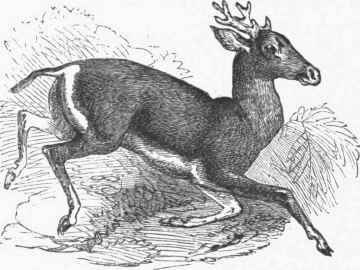
The deer has been hunted by the Indians for ages with the bow and arrow; the white man hunts it with the rifle in the rocky districts, chases it with hounds in the open country of the south, or kills it when dazzled at night by a bright light in the woods. The deer are growing scarce in all but the unsettled parts and inaccessible swamps and thickets of the United States, and will soon become extinct unless stringent laws are made and enforced against killing them out of season; they are found, however, in every state of the Union, in Canada and the British provinces, in Texas and in Mexico; in California this is replaced by the black-tailed species. Those found in the mountains are larger and shorter-legged than those of the swamps of Carolina and the Atlantic seaboard. It is generally believed that the G. Mex-icanus (Licht.), G. nemoralis (H. Smith), and G. gymnotis (Wiegm.), all from Mexico, are only varieties of the common Virginian deer. A different species, however, is the black-tailed or Californian deer (G. Richardsonii, Aud. and Bach.; G. Golumbianus, Rich.). The male is a little larger than the common deer, but shorter and stouter in form; the horns are twice forked, the first fork being 10 in. from the base, the antlers somewhat like those of the European stag; the ears are of moderate size, the head shorter and the nose broader than in the first species; the hoofs are narrow and pointed; the lachrymal openings large, and close under the eye; the tail short and bushy.
The general color is reddish brown above and white beneath, with no light patch on the buttocks; the chest blackish brown, which encircles the shoulder like a collar; a dark line from under chest to middle of belly; the tail dark brown, becoming black at the top, and white below. The length to root of tail is 5 1/3 ft., tail 9 in.; height at shoulders 2 1/2 ft.; width of horns between superior prongs 1 2/3 ft. First noticed by Lewis and Clarke near the Columbia river, it has become recently well known to the Californian miners; it seems to replace the common deer to the west of the Rocky mountains. The flesh is tender and of good flavor. Less graceful than the common deer, and more bounding in its movements, it is said to be very swift; it also breeds earlier in the season. It is found from California to the Russian possessions. The Columbian black-tailed deer (G. Lewisii, Peale) may be merely a variety, according to season or locality, of the last named. The long-tailed deer (G. leucums, Douglass) is smaller than the Virginian, with the head and back fawn-colored, mixed with black; sides and cheeks paler; white beneath; tail brownish yellow above, reddish near tip, and cream-white below.
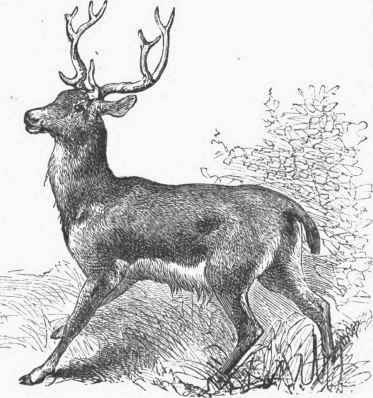
The form is elegant, lachrymal opening small, limbs slender, hoofs sharp-pointed, and tail long; the fur dense, coarse, and long, with a tuft on the belly between the thighs. The length is only 4 to 5 ft. to root of tail; tail 13 in. In appearance and manner of jumping it resembles the roebuck; the flesh is excellent. According to Richardson, this species is not found on the east side of the Rocky mountains beyond lat. 54°, nor to the eastward of lon. 105°; Douglass says that it is the most common deer in the districts adjoining the Columbia river; it is also met with on the upper Missouri and Platte rivers, and in Washington territory. The mule deer ((7. macrotis, Say) is intermediate in size between the wapiti and the common deer, and is a noble-looking animal, the only drawback being its long ears; the horns are twice forked; the lachrymal aperture is long, the hair coarse and crimped, the hoofs short and wide, and the tail almost without hair beneath. The general color of the hair above is brownish gray, shading into fulvous, the chin without any dark markings; the forehead dark brown, and the dorsal line nearly black; below grayish white; a yellowish white spot on the buttocks; tail pale ferruginous, with a black tuft at the end; the glandular openings on the sides of the hind legs are very long.
In the female, the form and length of the ears resemble so much those of the mule that the origin and appropriateness of the common name are very evident. The length of a female measured by Audubon and Bachman was 4 5/6 ft. to the root of the tail, and the tail to end of " hair 10 in.; the height at the shoulders 3 1/4- ft., at the rump 3 1/2 ft.; length of ears 7 in.; the weight 132 lbs. The male would be considerably larger than this. Their habits are more like those of the stag than of the common deer; they fly far from the settlements, and when started run a mile or two before stopping. The female brings forth one or two young in the month of June. This species ranges along the eastern sides of the Rocky mountains, from 54° N. to northwestern Texas; it is found on the upper Missouri and Platte rivers and in Oregon, not extending to the Pacific. - In the genus coassus (Gray; subulo, II. Smith), the horns are simple, straight, and round, like those of a deer of the first year, and inclining backward; the ears are short, broad, and almost naked; tail short; face rather convex; the fur short, elongated into a tuft on the forehead; legs without any external metatarsal tuft, but with a pencil of hairs on the inside of the hocks; the suborbital pit is small and shallow.
This genus, which includes the brockets, is confined to tropical South America; they are of small size, living in woods and jungles. The pita brocket (G. rufus, F. Cuv.) is of a shining red color, with the crown and neck gray; the young are spotted with white, and the females are of a lighter red, with more gray. They inhabit the low, moist woods, and are polygamous, there being about ten females in company with one male; they are very fleet for a short distance, but are soon tired out. The height at the shoulders is about two feet. The apara brocket (G. nemorivagus, F. Cuv.) is about 26 inches long, and resembles a sheep more than a deer. The lower parts of the head and lips are whitish; the inside of the fore legs, and from the lower breast to the buttocks, pale cinnamon-colored; the neck and rest of the body grayish brown. The eyebrowed brocket (G. superciliaris, Gray) differs from the pita in the deeply arched muffle and the white stripe over the eyes. The large-eared brocket (G. auritus, Gray) resembles the Asiatic muntjac in color, and the ears are large, broad, more than half the length of the head, with two lines of hairs. All these species inhabit Brazil and the eastern coast.
On the western coast is another species, the venada deer (G.pudu, Mol.), with ears thickly covered with hair, a deep suborbital pit, and large molars; the fur is rufous, blackish in front and behind; the ears and tail are very short. It inhabits Chili.
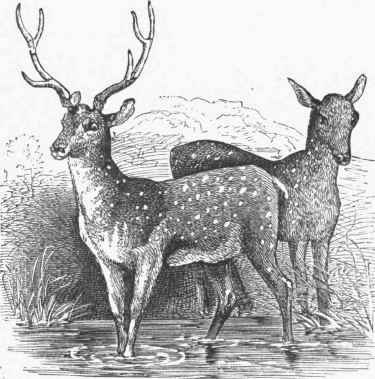
Spotted Axis (A. maculata).
Guazupuco Deer (Blastocerus paludosus).
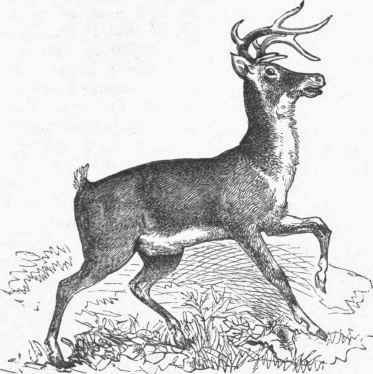
American Deer (Cariacus Virginianus).
Californian or Black-tailed Deer.
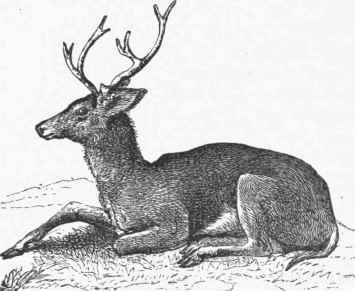
Mule Deer (Cariacus macrotis).
Continue to:


My Books

