


Dragon
Description
This section is from "The American Cyclopaedia", by George Ripley And Charles A. Dana. Also available from Amazon: The New American Cyclopædia. 16 volumes complete..
Dragon
Dragon, an animal often alluded to in the Bible, supposed by some to be the crocodile, and by others to refer in some passages to a species of giant serpent, or to a wild beast like the jackal or wolf. According to Robinson's Calmet, it is not improbable that St. John had in mind the enormous boa of Africa and the East when he described the symbolic great red dragon. - In mythology, the dragon is a fantastic animal, variously represented as of immense size, with wings, thorny crests, powerful claws, and a snaky tail and motion. He figured in the ancient conceptions of the Orient and of the classical nations, was a familiar subject in the middle ages, is still an emblem of universal use among the Chinese, and seems to have existed almost everywhere except in nature. The pterodactyl and ramphorhynchus of the meso-zoic age, though probably extinct long before the era of man, would have furnished excellent foundations for the dragon of tradition.
Dragon #1
Dragon (draco, Linn.), an iguanian lizard of the subfamily of acrodonts, or those having the teeth implanted in the bony substance of the jaws, to which they firmly adhere by the base of the roots. The head is triangular, flattened, and covered with small irregular scales, sometimes ridged; the small circular and tubular nostrils open at the end of the obtuse snout; the tongue is thick and spongy, with a round single extremity; the anterior teeth are three or four, and resemble incisors; behind these the median ones are conical, like canines, and there are generally two pairs in each jaw; the posterior teeth, or molars, are tricuspid and compressed; under the neck is a long dewlap, and on each side a trianglar cutaneous fold placed horizontally, all three having in their thickness a process from the hyoid bone; there is generally a small cervical crest.
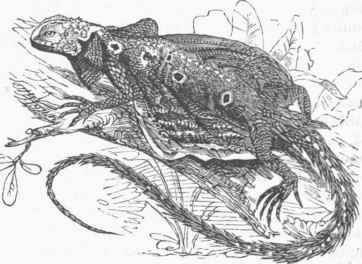
Draco fimbriatus.
While some species have no external ear, in others there is a small circular membranous tympanum. The neck is slightly compressed; the body has a central dorsal depression, and is covered above and below with small imbricated ridged scales. Dragons are at once distinguished from all other reptiles of this order by the horizontal expansion of the skin of the sides into a kind of wing, supported chiefly by the first six false ribs, which are extended horizontally outward. This flying membrane is semicircular, about as wide as the arm is long, free in front, but attached behind to the interior part of the thigh; in a state of rest the animal keeps it folded like a fan along the body, and when leaping from branch to branch spreads it like a parachute to sustain it; it cannot be moved as an active organ of flight, like the wing of a bird or the membrane of the bat. The fore and hind limbs, each with five toes, are of about the same length, the latter being flattened, with the posterior border fringed with serrated scales; there are no femoral pores; the tail is very long, slender, wide and flat at the base, round at the end, with rhomboidal imbricated scales, strongly ridged beneath.
Among the species with a visible tympanum, and the nasal openings directed laterally, are: 1. The fringed dragon . (D. fimbriatus, Kuhl), with the thighs fringed behind with triangular scales, and with longitudinal white lines on the wings; the general color above is an olive gray with shades of brown in transverse bands, and whitish below; this is the largest species described by Dumeril and Bibron, the total length being about 11 in., of which the body is only 3; it is peculiar to Java. 2. The flying dragon (D. Daudinii, Dum.), from Java, grayish above with black spots, and the wings marbled with the same; total length about 9 in. Several other species are described from the East Indies. There are two species which have the tympanum concealed under the skin, constituting the genus dracunculus of Wiegmann; these are the lined dragon (D. lineatus, Dau-din) of Amboyna and Celebes, about 6 1/2 in. long, with the back ash-colored, and the wings grayish brown with longitudinal white lines; and the Philippine dragon (D. spilopterus, Wiegm.), from the neighborhood of Manila, about 8 1/2 in. long, with red wings spotted with black or brown, and throat yellow with black dots.
Dragons live almost entirely in trees and feed upon insects, which they catch with great dexterity.
Continue to:


My Books

