


Ear
Description
This section is from "The American Cyclopaedia", by George Ripley And Charles A. Dana. Also available from Amazon: The New American Cyclopædia. 16 volumes complete..
Ear
Ear, the organ of hearing. Anatomists divide it into the external, the middle, and the internal ear. The first consists of the visible external organ, a cartilaginous and fleshy structure, of the form best adapted to collect the atmospheric vibrations, and the meatus or tubular opening leading to the tympanum. The tympanum is a firm fibrous membrane stretched across this opening, whose office, as its name implies, is to communicate vibrations like the head of a drum. The middle ear is a cavity about the form and size of a kidney bean; from its lower point a tubular canal descends to the side of the pharynx, where it terminates in a trumpet-like expansion; this canal is called the Eustachian tube. Across the middle ear is stretched a chain of three small bones, connected with each other by cartilage and tendon. These are the malleus or mallet, the incus or anvil, and the stapes or stirrup, each named from some fancied resemblance. The office of this chain, which is attached to the tympanum at one end, and to the membrane covering the foramen ovale at the other, is to transmit the vibrations of the air; to aid in this, they are controlled by three minute muscles, which serve to regulate the tension of the membrane of the tympanum, and the pressure of the stapes against the membrane of the foramen ovale.
The internal ear, also called the labyrinth, to which the external and middle ear are but the anterooms, consists of the vestibule, the three semicircular canals, and the cochlea. The vestibule is an irregular cavity shut out from the middle ear by the membrane covering the foramen ovale, and communicating with the semicircular canals by five openings, two of these canals being joined at one end. The cochlea, as its name implies, is a bony structure resembling in form a snail shell; internally it is divided by a lamina, bony, ligamentous, and muscular, into two cavities called the scala vestibuli and the scala tympani, which communicate at the top of the cochlea, in a curved channel called the heli-costrema. The modiolus, or bony axis of the cochlea, has numerous orifices, through which pass the filaments of the auditory nerve. The whole internal ear is lined with a delicate serous membrane, containing a fluid called perilymph. Within the vestibule and the semicircular canals, we find the membranous labyrinth; in the vestibule it consists of two membranous sacs, one called the utriculus and the other the sacculus, communicating with each other and extending in slender tubes through the semicircular canals, of which they only occupy about one third; in the vestibule and in the ampullae of the semicircular canals these sacs receive the nervous filaments, and are thus connected with the serous membrane lining the labyrinth, but everywhere else they are free, and separated from it by the perilymph, while their cavities contain a similar fluid called endolymph.
In the vestibular portion is found a crystalline powder, proved by chemical experiment to be carbonate of lime, and denominated otolithes; the office of this is supposed to be to communicate the vibrations to the nervous surfaces. The filaments of the auditory nerve terminate by loops, or minute points, in the sacculus, the utricuius, the ampullae of the membranous semicircular canals, and the membranous lamina which divides the cochlea. In the process of hearing, the vibrations of the atmosphere, caused, we will say, by touching one of the keys of a piano, pass toward the external ear, where they are collected and concentrated by its peculiar form and structure; thus concentrated, they pass along the canal to the tympanum, where they produce a vibration; this vibration is communicated by the chain of bones to the membrane covering the foramen ovale, by which it is passed to the fluid contents of the vestibule and to the sacs, and thus reaches the nervous surface, which is expanded over the whole labyrinth, and produces the sensation of sound.
The internal and middle ear are situated wholly within the temporal bone, which is here much thicker and harder than elsewhere, in order to protect the delicate and complicated structure from injury. - In the article Deaf and Dumb we have spoken in general terms of the causes which induce deafness; but we may say here that while congenital deafness is usually the result of deficiency or malformation of some portion of the organ, thus preventing the transmission of the vibration or sound wave, accidental deafness usually arises from mucous secretions, the result of inflammation, clogging or thickening the membranes of the middle ear, or ulceration attacking the little bones and causing their discharge; inflammation of the serous membrane of the labyrinth; or paralysis of the auditory nerve. As may be supposed, the cure of complete deafness is exceedingly rare. - The sense of hearing, like most of the senses, is capable of a much higher cultivation than is generally given to it. The blind, to whom touch and hearing make up in part for the loss of vision, acquire remarkable powers of hearing. They will hear a footstep or the opening of a door at a distance at which ordinary persons cannot distinguish a sound.
In some brain affections there is more or less morbid sensitiveness of hearing; and in that condition of the nervous system brought on by long continued and intense excitement, and which often terminates in insanity, the same phenomenon is observed. - The form of the external ear varies materially in different races of men, and still more in the animal tribes. In the Caucasian race it is of moderate size, well formed, and neither very prominent nor pressed closely to the head. In the Malay and Mongolian it is large, ill-proportioned, the lobe naturally long, and the whole ear standing out prominently; in the Indian race the conformation is similar to the Mongolian, though less prominent; in the negro the ear is flat, broad, and adheres so closely to the head as to give the idea of having been fastened there by a bandage. Of the inferior animals, the mammalia only have an external ear; in birds it is merely a small orifice; in fishes, when it exists, it is covered by the skin, as it is also in reptiles. The variety in its form in mammals extends even to different varieties of the same animal.
The drooping ear of the King Charles and other spaniels contrasts forcibly with the erect prominent ear of the foxhound and the Esquimaux dog; and both differ greatly from the short open ear of the bulldog. The horse has a sensitive and well formed ear, though of small size; while the ass, with no better powers of hearing, is supplied with long aural appendages which seem most adapted for fans. The elephant has a small ear as compared with his great size, though the flap of skin which protects it is of considerable dimensions. The carnivora generally have small but very quick ears, and they usually possess erectile power, which enables them to throw them into shapes in which they will most readily catch the sound wave. The mole, though his ear is hardly discernible in the fine fur which covers it, is yet very quick of hearing. Of all the mammals, the bat tribe possess the largest ears in proportion to the size of their bodies, the pliyllostomus and the megadenus in particular being provided with these appendages so large as to form nearly one third of the superficial extent of their bodies.
Among savage and half-civilized tribes the idea prevails that the lengthening of the lobe of the ear by heavy ornaments, and the enlargement of the perforations made for attaching them, both add greatly to the beauty of the wearer. In the Burmese statues of Gaudama he is represented in a sitting posture, and the lobes of his ears extend to the level of his lap. Among the African tribes the perforation in the ear is enlarged so that a stick an inch or more in diameter may be thrust through it, and some of them use the ear instead of a pocket to carry small articles.
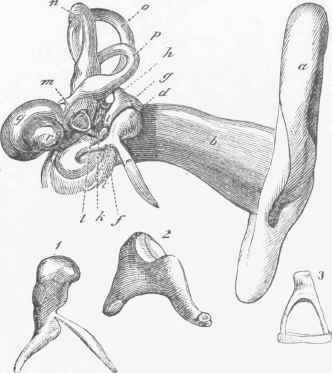
The Parts of the Auditory Apparatus. - a, external ear; b, auditory meatus; c. membrane of the tympanum; d. head of the malleus; e, bony process, and, f; handle of the malleus; g, incus; h, i. short and long processes of the incus; k, I, articulation of incus and stapes; m, stapes; n. o, p, semicircular canals; q, cochlea; r, apex of the cochlea; 1, 2, 3, malleus, incus, and stapes, separated from each other and highly magnified.
Continue to:


My Books

