


Eland
Description
This section is from "The American Cyclopaedia", by George Ripley And Charles A. Dana. Also available from Amazon: The New American Cyclopædia. 16 volumes complete..
Eland
Eland, a name applied by the colonists of the Cape of Good Hope to the impoofoo (bosela-phus oreas, II. Smith; oreas carina of some authors), an antelopean ruminant, resembling the bovine group in stature, shape, dewlap, and high shoulders. The general color above is a grayish yellow, with rusty and purplish shades shining through it; the lower parts cream yellow; the forehead with long, stiff, yellowish brown hairs; face brownish red, chin white, eyes chestnut; a slight brownish yellow mane, along the back becoming reddish brown; muzzle black; hoofs brownish black, edged above with brownish red hair; the tail is brownish red, with a tuft of yellowish brown; the mane of the dewlap is yellowish brown, pencilled with brownish red. This is the color of the male, which has a small head, a neck tapering above, but bulky toward the chest; the body is thick and heavy; the limbs are elegant and slender; the eyes full and soft, and the expression of the face is gentle and ovine; the horns slope slightly back from the crown, being very thick at the base, with two spiral turns having an obtuse ridge, and the upper two thirds straight, tapering to a point; the ears are long, narrow, and pointed, hairy on both sides; the hair is rather thin, except on the neck, mane, dewlap, and tuft of tail.
The length from nose to base of tail is about 10 1/3 ft., the head being 17 in.; the horns are nearly 3 ft. long; the height at the shoulder is 5 3/4 ft., and at the crupper 2 in. less; the length of the tail 2 1/2 ft., and of the dewlap at its base 20 in. The female is of a pale sienna yellow, deadened with pale brown above; below dirty white, with a cream-yellow tinge; the figure is more delicate and elegant than that of the male, the limbs are more slender, the mane is shorter, the dewlap narrower, the tail less tufted; and the horns are straight, slender, somewhat spiral at the base, with a rudimentary ridge on the spire. The young are of a tint between reddish orange and yellowish brown. This is probably the largest of the antelopes, equalling the horse in height, and weighing from 7 to 10 cwt. It ranges the borders of the great Kalahari desert in herds varying from 10 to 100; rare at present within the limits of Cape Colony, it was found in abundance in the wooded districts of the interior by R. Gordon Cumming. The flesh is most excellent, and is greatly esteemed.
When young and not over-fed the eland is not easily overtaken by the Cape horses; but in good pastures it grows so fat that it is easily run down; it is said that when pursued it invariably, if it can do so, runs against the wind, which gives it an advantage in outrunning a horse. The hide is very tough, and much prized for shoes and traces. Like other antelopes, it seems to be independent of water, frequenting the most desert localities far from streams and rivers; except in the breeding season and when pursued, the males generally keep in groups apart from the females. A variety of this species is called bastard eland by the colonists; it is smaller than the other, dark brownish gray, with a white space between the fore Legs. The name of eland, or elk, is applied to this as well as to several other species of deer and antelope by the Dutch colonists of Africa and the Indian archipelago, and is apparently indiscriminately given to any large hollow-horned ruminant; the animal called eland by recent travellers and hunters in south Africa is in most cases the first described species, and probably sometimes the second, as both are found in the same districts, though the herds do not intermingle; they may be the same animal at different ages.
These animals are gentle and readily domesticated; but though strong, the shoulders do not possess that solidity which renders common domesticated cattle so valuable. The first specimens brought alive to Europe were received in England in 1842; they all died except one, but others have been imported and the herd has increased rapidly. The first one was killed for the table in 1859; it was five years old, and weighed 1,176 lbs., " huge as a short-horn, but with bone not half the size." The meat resembles beef, with a venison flavor, and has a fineness of fibre and a delicacy of fat which place it high on the list of choice and nutritious articles of food. They are to be seen now in many of the zoological gardens of Europe.
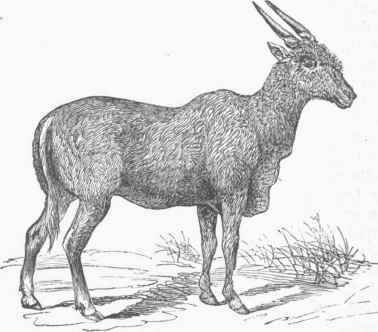
Eland (Oreas canna).
Continue to:


My Books

