


Goat
Description
This section is from "The American Cyclopaedia", by George Ripley And Charles A. Dana. Also available from Amazon: The New American Cyclopædia. 16 volumes complete..
Goat
Goat , (capra, Linn.), a hollow-horned ruminant, of the subfamily ovinoe, which also contains the sheep. The genus is characterized by a convex forehead, nose for the most part straight in its upper outline, and the absence of lachrymal sinuses and secreting glands between the hoofs; the horns, present in both sexes, but larger and more angular in the males, are of a dull yellowish brown color, compressed and nodose, with a sharp edge behind and before, curving backward, but not completing a circle, and the tips never coming forward; their curve, unlike those of the sheep, forms part of a circle, whose diameter is much longer than the head; their osseous nucleus is porous or cellular, communicating with the frontal sinuses; the chin is bearded, the tail very short and naked below, the hoofs as high on the inner as on the outer side, and the mammae, generally two, forming an udder; the nose is covered with hair, except a narrow naked space between the nostrils; the limbs are strong, with a callosity on the carpus. The dental formula is : incisors 0/8; canines none; molar6/6-6/6; in all 32 teeth. The hair is never very coarse, and sometimes remarkably fine, with a woolly down underneath.
The period of gestation is five months, and the number of young generally two; the female is capable of propagating at seven months, and the male at a year old; the age of the goat may be extended to 15 years, though they are generally old at 6. The males emit a powerful odor, and are libidinous and pugnacious. They ascend giddy heights, and spring with great precision from rock to rock where there seems hardly a possibility of their obtaining a foothold; their sight and smell are acute. The hunting of the wild species is both difficult and dangerous. The goats include the ibex of Europe, Asia, and Africa (see Ibex); the wild oegagrus, and the Jemlah goat or the jharal. There is no goat indigenous to America, the so-called Rocky mountain goat being in reality an antelope. - The common wild goat (C. [hircus] oegagrus, Pallas) inhabits the mountains of the Caucasus, Asia Minor, and Persia, and according to some the European Alps. It is higher on the legs than the domestic goat, and the horns are large in proportion to the size of the animal. The general color is grayish brown above, with a dark dorsal line and blackish tail; the colors are paler in the female.
Another wild species is the Jemlah goat (C. Jemlahica, II. Smith), with depressed, knobby, wrinkled horns, a solid, heavy skull, and robust limbs; the hair on the neck and back is abundant, long, and loose, and on the sides of the head very coarse; the tail is very short; the color is a dirty whitish fawn. It inhabits the district of Jemlah, in the elevated mountain chain of central Asia. The C. cossus and C. imberbis (De Blainville) are believed to be domesticated varieties of this species. The jha-ral of Hodgson is by Gray referred to the same species as the last, forming the genus liemitra-gus (Hodg.); they have four mamma). The domestic goat (C. hircus, Linn.) resembles the C. oegagrus more than any other wild species. The common goat of the mountainous countries of Europe much resembles the a?gagrus, and has in some places become so wild as to be difficult of approach; the ears are small and upright; the size of the body is smaller, the hair coarser, the horns more vertical and turning outward, and the colors more varied. The Persian goat resembles a small aegagrus; the hair is long and coarse. The Welsh breed is large, generally white, with long fine hair, and with vertical horns about 3 ft. long.
There are small hornless breeds of goats in South America, the West Indies, and the Pacific islands, supposed to have originated from Africa. The Angora has long soft hair, mostly white, long ears, upright yellowish horns, and a sheeplike look. The famous Cashmere (properly Thibet) breed have long, straight, silky hair, large pendent ears, and slender legs. The Ne-paul goat is black, of a high and slender figure, with an arched form of nose, and long, hanging, whitish ears. The goat of upper Egypt is of a brownish color and high stature, with long shaggy hair, arched nose, ample pendent ears, and the upper jaw so much shorter than the under that the lower incisors and chin are exposed. - Goat skins were probably among the first materials used for clothing among the northern nations. The milk of the goat is used for making cheese, and is prescribed as a medicine in debilitated constitutions and pulmonary diseases. In the malarious regions of Asia cow's milk is regarded as a predisposing cause of bilious fevers and diseases of the liver, and goat's milk is therefore substituted.
The flesh of the kid is esteemed as food; from the skin are made fine gloves, various garments, and the real Morocco leather; from the hair of one variety are manufactured the costly fabrics of Cashmere. (See Casii-mere.) - The Rocky mountain goat is referred to the genus capra by Desmoulins, Harlan, Sun-devall, Richardson, Bachman, and Van der Hoeven; but recent examinations go to show that in all its essential features and affinities it is an antelope, and belongs to the genus aplo-cerus (H. Smith). It resembles the goat and merino sheep in its figure and size; the horns are small, conical, smooth, nearly erect, and jet black. The outer hair is long, straight, and white, as fine and soft as that of the Cashmere goat; the chin is bearded; the external fleece hangs down all over the body and upper part of the legs; the under hairs are soft and silky like wool. It inhabits the highest and most inaccessible peaks of the Rocky mountains between the parallels of 40° and 65° N., and is most abundant in Washington territory; it is very difficult to procure; the mountain sheep (oris montana, Cuv.), or big-horn, has been often mistaken for it by travellers. - The goats are rarely found fossil, and belong nearly to the same epoch of creation as man, forming probably the first step by their domestication in his progress toward civilization.
The goat was one of the signs of the ancient zodiac (Capricorn); the mythological Pan, the god of shepherds and the supreme power over nature, was represented with the horns and legs of a goat; the oegis, or shield of Jupiter, was covered with the skin of a goat; this animal was sacred to several ancient divinities, and even under the Jewish dispensation was emblematical of atonement.

Domestic Goat (Capra hircus).
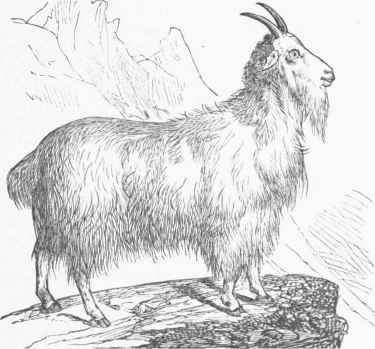
Rocky Mountain Goat (Aplocerus montanus).
Continue to:


My Books

