


Greece
Description
This section is from "The American Cyclopaedia", by George Ripley And Charles A. Dana. Also available from Amazon: The New American Cyclopædia. 16 volumes complete..
Greece
Greece , a country of southeastern Europe, occupying the central and southern portions of the large and irregular peninsula which extends into the Mediterranean between the Ionian and the AEgean seas. By its own inhabitants, both in ancient and modern times, the country has been called Hellas; but the early population of Italy, gaining their first knowledge of the region from the Graeci (Tpai-koi), one of its northern tribes, formed from this tribal designation a name for the entire country (Groecia). From this have been derived the names given to it in most of the European languages (Fr. la Grece, Ger. Grie-clienland, Ital. Grecia, &c). In treating of the political and physical geography of Greece, we shall devote the first portion of this article to the description of the ancient country, reserving for a subsequent division an account of the modern kingdom. - Many difficulties attend the definition of the northern limits of ancient Greece, the amount of territory included in the possessions of the country varying greatly at different periods.
Considering Greece proper as excluding Macedonia, lllyria, and Thrace, but including Thessaly and the greater part of Epirus, it began about lat. 40° N., where a natural boundary was formed by a chain of mountains extending from the Thermaic gulf on the east, and terminating in the Acroce-raunian promontory, on the Adriatic, on the west. From this boundary the peninsula of Greece extends southward to lat. 36° 23'. Its greatest length, exclusive of the Acroceraunian projection, from Mt. Olympus in the northeast to Cape Ta?narum at the southern extremity, is about 250 m.; its greatest width, from the W. coast of ancient Acarnania to Marathon, N. E. of Athens, is about 105 m. The area of the ancient country, excluding Epirus, but including the island of Euboea, was about 21,-000 sq. m. The mainland of Greece, deeply indented at several points by gulfs and almost landlocked bays, and crossed by mountain ranges, is naturally divided into three principal regions, northern and central Greece and the Peloponnesus. Northern Greece, extending from the N. boundary to the point where the peninsula is narrowed by the opposite Ambracian and Maliae gull's, included Epirus and Thessaly, regions nearly equal in size.
Central Greece, that part extending from this point to the narrow isthmus of Corinth, comprised the divisions of Acarnania (at the western extremity), AEtolia (the next division toward the east), Ozolian Locris, Phoeis, and Boeotia, these three bordering on the gulf of Corinth; Epicnemidian and Opuntian Locris and Doris to the north of these; Attica, forming the eastern extremity of the whole peninsula; and Megaris, on the narrow land N. E. of the isthmus of Corinth, and between the Corinthian and Saronic gulfs. The Peloponnesus, including all of Greece S. and W. of the isthmus of Corinth, comprised Achaia and Sicyonia, on the Corinthian gulf; Corinthia, on the isthmus and the Corinthian and Saronic gulfs; Argolis, Laconia, Messenia, and Elis, all coast countries; and in the centre, completely surrounded by these, Arcadia. The exact boundaries of all the Greek states were frequently varied by war and political changes, but the divisions named above retained their identity throughout the period of the country's ancient history. The islands which lie in the Ionian and AEgean seas, and in the Mediterranean, within a short distance of the coasts of the peninsula, formed an important part of the ancient Greek possessions.
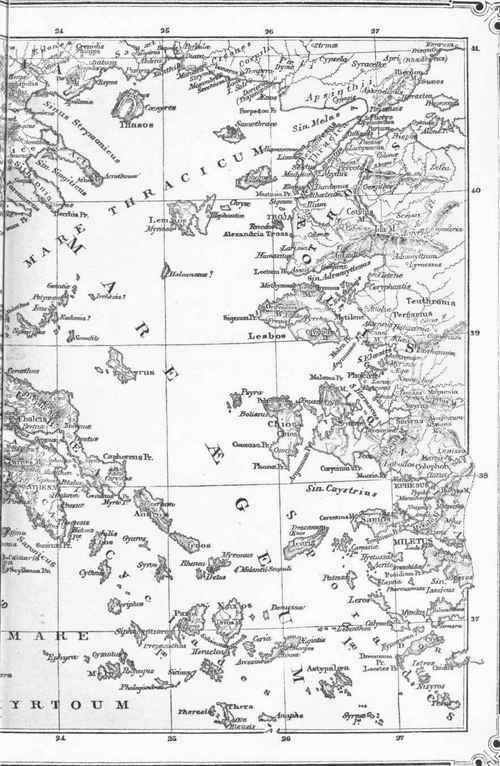
Of these islands, the largest is Euboea, about 100 m. long and 6 to 30 m. wide, lying E. of central Greece. S. E. of this lie the Cyclades, the large group which surrounded the famous holy island of Delos. E. of the Cyclades, and along the Asiatic coast, extend the Sporades. The islands of Crete and Rhodes lie further S. in the Mediterranean sea. Between Attica and Argolis, in the Saronic gulf, are Salamis and AEgina. Along the W. coast of Greece, in the Ionian sea, extend Corcyra, Paxos, Leucas, Cephallenia, Ithaca, and Zacynthus, which with Cythera, at the S. extremity of Laconia, are now known as the Ionian islands. - The surface of Greece is mountainous through almost its whole extent. The continuous range already mentioned as forming the N. boundary of the ancient country, including Mt. Olympus and the Cambunian and Ceraunian mountains, is crossed at its centre by the great chain of Pindus, which, running nearly N. and S. through the middle of northern Greece, formed a natural boundary between ancient Epirus and Thessaly. Near its S. end it divides into two branches, one stretching S. E. through central Greece, bearing the names of (Eta, Parnassus, Helicon, Cithaeron, and Hy-mettus, and finally terminating at the extremity of Attica; the other extending S. W. under the names of Corax and the Ozolian mountains, and terminating near the W. end of the Corinthian gulf.
The mountains of the Peloponnesus, also very numerous and closely connected, nevertheless belong to an entirely different system from that of the Pindus; instead of stretching in long ranges through the peninsula, they are clustered in knots and groups around a lofty central mass, which rises in northern Arcadia to the height of nearly 8,000 ft. The principal peaks of the whole country are as follows: in northern Greece, Mts. Olympus (0,754 ft.), Ossa (6,407), and Pe-lion (5,000); in central Greece, Mts. Parnassus (highest summit, 8,0G8), OEta (7,071), Helicon (about 5,000), Cithaeron (4,620), and Par-nes (4,103); in the Peloponnesus, Cyllene (7,788), Erymanthus (7,207), Taygetus (highest peak, 7,004), Artemisius (5,814), and Lycaeus (4,659). The mountain system, the chief ranges of which have been thus described, had a very important effect upon the political as well as the physical divisions of ancient Greece. By dividing with natural walls the habitable and arable plains and less rugged portions of the country one from another, it prescribed the boundaries of states almost as definitely as could have been done by the most exact treaties. - The rivers of Greece are generally unimportant, save on account of their historic associations. . Many of the streams are entirely dry during the summer months; none are navigable at any season.
In northern Greece the principal rivers are the Achelous, rising in the Pindus in N. E. Epirus, and flowing S. through Epirus and central Greece into the Ionian sea, and the Peneus, also rising in the Pindus, and flowing E. through northern Thessaly into the Thermaic gulf. In central Greece are the Ce-phissus in Phocis and Boeotia, and the Asopus in Boeotia. In the Peloponnesus are the Al-pheus in Arcadia and Elis, and the Eurotas in Laconia. Small lakes are numerous, and there are several of noteworthy size: Nessonis and Boebcis in Thessaly, Trichonis in AEtolia, Copais in Boeotia, and Stymphalus and several others in Arcadia. - The climate of Greece, which is generally temperate and pleasant, would appear to have been more generally healthy in ancient times than of recent years. Such of the classic authors as allude to it, speak of it as peculiarly bracing and invigorating, and do not notice the malarial tendencies which now render the summer months unhealthy except in the higher regions. The denser population and the universal cultivation of the land in ancient times probably in part prevented this evil. The mineral and vegetable productions of the country will be noticed in treating of the modern kingdom.
Of the fauna of the peninsula it is also unnecessary to speak here, as the races of domesticated animals are the same in modern times as among the ancient peoples; while the few kinds of wild animals (wolves, wild boars, and bears) did not differ from those common to the southern parts of Europe. Traditions seem to indicate that lions may have been found in the country at a very early period. - The questions of the origin and race characteristics of the ancient inhabitants of Greece are inextricably connected with the early history of the country; they are treated to some extent in the articles on the different divisions, and will be further noticed in the historical portion of this article. Trustworthy estimates of the numbers of the population, even at the best known periods of Grecian history, are altogether wanting. - The early history of Greece is involved in obscurity, and confused by tradition and fable. Whether the first emigrants from Asia found in Greece aboriginal tribes whom they subdued or with whom they united, or whether they found the land unoccupied, there are no means at present of deciding.

The earliest authentic traditions represent the new comers as arriving among autochthonous populations, and bringing with them religion and the arts from their primeval home. The Greeks were fond of tracing their origin hack to a common ancestor, Hellen, the son of Deucalion and Pyrrha, the survivors of the deluge; and the great divisions of the race, the Dorians, AEolians, Ionians, and Achaeans, claimed to be descended from Dorus and AEolus, sons of Hellen, and Ion and Achaeus, sons of Xuthus, the third son of Hellen. According to the popular belief, AEolus succeeded Hellen as king of Phthia in Thessaly, and his descendants spread over central Greece as far as the isthmus of Corinth, and occupied the W. coast of the Peloponnesus. The Dorians, from which race the Spartans of the historic time were descended, were confined to Doris, between Thessaly and Phocis; the Ionians, the progenitors of the Athenians of the historic period, occupied Attica and the north of the Peloponnesus; the Achaeans in the heroic age occupied Mycenae, Argos, and Sparta, in the Peloponnesus, and the original abode of the Hellenes in Thessaly. The first inhabitants of Greece were called Pelasgians by the Greeks themselves, and were considered by them as a different race from the Hellenes, with a different language.
Whether the Pelasgians themselves came in from Asia, at a period beyond the reach of tradition, cannot be satisfactorily determined. The most consistent hypothesis is that which considers the Pelasgic populations as representing the body of the primitive inhabitants of Greece, and as having formed the basis of the subsequent nationalities. We may consider the Hellenic as representing the later and more civilized accessions, which, blending with the Pelasgic, developed that peculiar type of intellectual character which distinguished the Greek from every other ancient race. It was believed that Egyptian and Phoenician immigrants, arriving at a very early period, and bringing with them arts, culture, and religious rites, from countries of a much more ancient civilization, contributed largely to this result. Thus Cecrops, according to the traditions, brought civilization from Sais in Egypt to Athens; and the name of Cecropia, borne by the Athenian Acropolis, commemorated this. Argos was founded by Danaus, who fled from Egypt with his fifty daughters, to escape the persecutions of the fifty sons of AEgyptus. Pelops led a colony from Asia Minor, and gave the name of Peloponnesus to the S. peninsula, Cadmus came from Phoenicia to Thebes, and introduced the Phoenician art of writing.
It is quite possible that all these legends may have their origin in historical facts. It is certain that there was a frequent intercourse by sea in the earlier periods between the Greeks and Phoenicians; and the Greek alphabet, at whatever time it was introduced, is apparently of Phoenician origin. E. Curtius, a high authority, has recently elaborated the theory of the early Ionians. (See Ionians.) The heroic age of Greece is the legendary period in which flourished a race of men represented as being descended from the gods, and who are called heroes, a term implying the possession of a nature superior to that of common mortals, as Hercules, Theseus, and Minos. In this period were placed by the poets a series of expeditions and exploits, famous in the literature of Greece, as the voyage of the Argonauts in search of the golden fleece, the war of the seven chiefs against Thebes, the war of the Epigoni, and, last and most famous of all, the siege and capture of Troy, and the return of the heroes, which form the conclusion of the heroic age. Here, too, we may reasonably suppose that historical facts furnished the germ of the legends; but as the whole treatment of them is poetical, it is impossible to separate fact from fiction with any certainty or even probability.
The poems of Homer contain all that we know of the manners and society of the heroic age; and the general delineations of heroic society, as given in them, may be received as representing substantially what was believed by the Greeks themselves in the subsequent period. Among the later legends are those of the migrations of the Boeotians from Thessaly into the country called from them Boeotia, said to have taken place GO years after the fall of Troy; and the conquest of the Peloponnesus by the Dorians, placed 20 years later. They were said to have been led by the descendants of Hercules, who claimed the possession of the country as an ancestral right. This enterprise gave rise to the Dorian states of the Peloponnesus, and is known in history as the return of the Hera-clidae. The establishment of Greek colonies in Asia Minor belongs to the period following the Trojan war. The migrations appear to have continued through several ages, and were, partly at least, owing to movements and disturbances among the populations of Greece. In the course of time Greek colonies were spread over the whole W. coast of Asia Minor, and numerous cities were founded.
The N. portion of the coast, with the islands of Tene-dos and Lesbos, was occupied by the AEolians; the Ionians took the central part, with the islands of Chios, Samos, and the Cyclades; while the S. W. corner, with the islands of Rhodes and Cos, was settled by the Dorians. The AEolian migration was the earliest, but the Ionian was the most important. There were eleven AEolian cities in historical times. The Ionians formed twelve states united by the worship of Poseidon at the Pan-Ionic festival. The Dorians had six colonies, which formed the confederation of the Doric Hexapolis. We have no trustworthy chronology for whatever of historical events may form the basis of these traditions; but there can be no question of the facts of such migrations having taken place, and we may assume the date of about 1000 B. C. as closing the period within which these movements occurred. - The authentic history and chronology of Greece commence with the beginning of the Olympiads, 770 B. 0. At this period we find Greece divided into a number of small states, under separate governments, united into confederacies for permanent or occasional objects, but with no central government to control the whole.
The Grecian world was, however, bound together by language, blood, common religious rites and festivals, social institutions and laws, which distinguished it from the barbarian nations and races about it. The language was divided into dialects, but with sufficient resemblance to each other to be easily understood by all. In the religious systems, particular deities were specially worshipped by particular tribes and at particular places, but the general principles were everywhere the same. Religious rites were periodically celebrated, at festivals in which associations of neighboring states participated, under the general name of amphic-tyonies, or at the great national games. The amphictyonic council, held alternately at Delphi and at Thermopylae was partly political and partly religious. The Olympic, Pythian, Nemean, and Isthmian festivals tended strongly to keep alive the sentiment of Hellenic unity. The establishment of oracles, enjoying authority over the Hellenic world, was another bond of union. Notwithstanding these national ties, the several states of Greece could never be brought into a voluntary political union under a government having the right and power to interfere with the cherished autonomy of each individual state.
Excepting in great crises of their history, such as, in the legendary times, the Trojan war, and in historical times the Persian invasion, their patriotism was local, and they never acted for a common object. Indeed, they had no common designation, as Thucydides truly remarks, until gradually the name of the Hellenes supplanted the rest. - In the early historical times the Dorians had become masters of the E. and S. parts of the Peloponnesus by invasion and conquest from the north. At the beginning of the Olympiads, Sparta, afterward the leading Doric state, was of inconsiderable importance, and her territory hardly more than the valley of the Eurotas; but her military and civil institutions, as established by the constitution of Lycurgus, gradually raised the state to a foremost place among the commonwealths of Greece. The date of the Spartan lawgiver is doubtful, but it is generally placed within the century preceding the era of the Olympiads. His ordinances, called rhetroe, wrought great changes in the constitution of society, and produced results that acted powerfully on the course of Greek history. (See Lycurgus, and Sparta.) Sparta became the mistress of the greater part of the Peloponnesus by subduing the Messenians, Arcadians, and Argives. The two wars against the Messenians were the most important and obstinate; they have also a special literary interest, on account of the poems of Tyrtaeus. The first Messenian war grew out of private quarrels.
It occurred about 743 B. C., and, having lasted about 20 years, ended with the complete subjection of the Messenians, who were compelled to abandon their country, and were reduced to the condition of helots or slaves. About 38 years later (685), the Messenians, under the lead of the heroic Aristomenes, took up arms, and were supported by the Argives, Arcadians, Sicyonians, and Pisatans; while the Corinthians lent aid to Sparta. At first the fortunes of war were adverse to the Spartans; but though they suffered several bloody defeats from Aristomenes, they persevered until the Messenians became a second time the serfs of the Spartans (608). In the course of the following century the Spartans extended their conquests over the greater part of Arcadia, and annexed the large Argive territory of Cynuria. In the middle of the 6th century B. C. Sparta had become the most powerful of the states of Greece. She was distinguished politically from the others by retaining the form of a royal government, royalty having become extinct everywhere else at an early period of the Olympic era. In some of the states the king became an archon for life; in others the royal house was set aside, and one of the nobles selected, under the title of prytanis, or president, and holding office for a limited time.
This was substantially a change from monarchy to oligarchy, since the powers of government were limited to the members of the old nobility, who possessed the greater part of the land. These oligarchies were overthrown in many of the Greek states by the rise to power of able and ambitious men, called by the Greeks tyrants. The early significance of this word was limited to the irregular methods by which power was attained, and not extended to the severity with which it was administered. Though the actual government of the tyrants was oppressive for the most part, yet some of them were among the wisest men and the best rulers of the Greeks. The period of the tyrannies was about 150 years, from 650 to 500. The most celebrated of these rulers were the tyrants of Sicyon, whose rule lasted 100 years, ending with Clisthenes (560); those of Corinth, beginning with Cypselus, including the great Periander, and ending with Psam-metichus, about 581; and Theagenes, tyrant of Megara. A similar political condition prevailed in most of the other Grecian states in the 7th and 6th centuries.
In Athens, in the legendary period, the kingly power terminated with Co-drus, and was succeeded by the office of archon, at first limited to the royal family and held for life, then held for ten years, and finally thrown open to the whole body of the nobles, the number of archons increased to nine, and the period of office reduced to one year. With this last change the authentic history of Athens commences, about 683 B. C. (See Athens.) The legislation of Draco dates about 624, and the archonship and legislation of Solon 594.
The adoption of his constitution, and the subsequent modification of it by Clisthenes, reacting upon the original tendencies of the Ionian race to a free intellectual and political development, produced the results in letters, art, philosophy, political science, and popular eloquence, which so brilliantly distinguish the history of the Athenian commonwealth. But even in Athens a tyranny arose. Pisistratus was twice expelled, but he and his family ruled Athens with moderation, and administered the government through the Solonian institutions, until the assassination of Hipparchus converted his surviving brother Hippias into a despotic oppressor. The tyranny of the Pisistratidae lasted about 50 years. The expulsion of Hippias was followed immediately by the popular changes in the constitution introduced by Clisthenes. The progress of Athens under the impulse of such wise and equal institutions excited the jealousy of Sparta, who made several unsuccessful attempts to overthrow the democracy. Besides the colonies in Asia Minor already mentioned, the Greeks extended their colonial system to Italy, Sicily, Gaul, Spain, Africa, and, in the north, to Epirus, Macedonia, Thrace, and the coasts of the Euxine. The Asiatic colonies were the oldest, and among them literature and the arts first developed themselves.
The settlements in Italy and Sicily began about 735 B. C. The settlements in Egypt and Gyrene were commenced about a century later. About 700 the island of Corcyra was settled by Corinthian colonists, and other settlements were soon afterward made on the neighboring islands and the opposite coast; so that at the beginning of the 6th century the Hellenic race, in extent of territory and resources, was far the most powerful in the European world. - We have now reached the period when the Hellenic and barbaric races were preparing for an organized conflict. The Greeks of Asia Minor had been subjected by Croesus, king of Lydia, and were afterward ruled by Cyrus, the founder of the Persian empire. Darius, son of Hystaspes, ascended the Persian throne in 521 B. C. The revolt of the Ionian colonies from the Persian rule commenced effectively about 501, and the mother country was appealed to for aid. The Athenians voted to send a squadron of 20 ships, which, Herodotus says, "were the beginners of evil both to Greeks and barbarians." In the following year Sardis was captured and burned by the Greeks under Aristagoras, and the revolt extended far and wide. Measures were speedily taken to suppress it.
The capture of Miletus and the defeat of the Ionian fleet at Lade completed the subjection of Ionia (494). This event put an end to the ancient prosperity of Ionia. Darius made preparations to follow up its reduction by the conquest of Greece itself. Placing a large armament under the command of Mar-donius, his son-in-law, he sent him across the Hellespont; but the destruction of the accompanying fleet, while attempting to double the promontory of Athos, by a hurricane, and the slaughter of a large portion of the land force by the Brygians, a Thracian tribe, forced him to return to Persia. This was the first Persian expedition to Greece (41)2). The Persian monarch, stimulated by Hippias, the exiled despot of Athens, made preparations on a large scale, and in 400 assembled a mighty army in Cilicia, and a fleet of GOO galleys, with horse transports. The command was given to Datis and Artaphernes. Embarking with their forces, they sailed directly across the AEgean, reduced the Cyclades, took Eretria in Euboea after a siege of six days, razed the city, and put the inhabitants in chains.
In a few days they crossed to Attica, and landed on the plain of Marathon. The Athenians, warned of their approach, made preparations to receive them, and though opposed by a force more than five times as great as their own, and aided only by 1,000 Plataeans, they attacked the Persian army in the open field, Miltiades commanding, and won over it one of the most famous victories in history. (See Marathon.) The Persians fled to their ships, which were stationed in lines near the shore. They lost 6,400 men, the Athenians 192. The resentment of Darius, when he received the news of the defeat at Marathon, knew no bounds. He resolved to collect the forces of his empire, and to lead them himself against Athens. Three years were occupied in making preparations on a gigantic scale; but his death postponed the threatened invasion. Xerxes, his son and successor, influenced by Mardonius, who was eager to retrieve his reputation, resolved to prosecute the plan of conquest, and to collect forces on a still more magnificent scale. Four years more were occupied with preparations.
Troops from 4(5 different nations were assembled; a large fleet furnished by the subject maritime nations was collected; immense stores of provisions were deposited at stations along the intended line of march; a bridge was constructed across the Hellespont, and a canal cut through the narrow neck that joins the peninsula of Athos to the mainland. The bridge having been swept away by a storm, Xerxes caused two to be built in its place, one for the army and one for the baggage and beasts of burden. The preparations were completed in 481, and in the spring of -180 the march began, from Sardis to the Hellespont, where the army crossed the bridge, and approached Greece along the coast of Thrace. According to Herodotus, the military and naval forces amounted to 2,317,610, besides the accessories from the native tribes; so that when Xerxes reached Thermopylae his army consisted of more than 2,500,000 fighting men, or including attendants, if Herodotus is to be believed, of more than 5,000,000. Though these statements are incredible, the extensive preparations made for years give us reason to believe that the army of Xerxes was one of the largest ever assembled.
To make arrangements to resist this mighty invasion, a congress of deputies from the Greek states was summoned to meet at the isthmus of Corinth. The Athenians and Spartans attempted to unite them for the common defence; but the terror inspired by the Persian hosts was so great that many submitted at once, and others refused to take part in the congress. The only people N. and E. of the isthmus who dared to defend the country were the Athenians, Phocians, Plataeans, and Thespians. The Athenians gave the command of the forces by sea and land to the Spartans, although they furnished two thirds of the fleet. It was at first decided to make stand against the invaders at Tempe, the celebrated and beautiful valley between Mts. Olympus and Ossa, through which the Peneus flows; but this was found impracticable. The pass of Thermopylae, a narrow defile between the mountains of OEta and the Maliac gulf, was finally occupied by Leonidas, the Spartan king, with a detachment of 300 Spartan citizens and several thousand other Peloponne-sians. These, with the troops of the Thespians, Thebans, and Phocians, in all about 5,000 men, prepared to hold the pass against the innumerable host of the Persians. The heroic struggle which followed is one of the best known incidents of Grecian history (see Thermopylae); but it was unsuccessful, and nothing now intervened to prevent the march of the Persians upon Athens. The naval battle of Ar-temisium, at the 1ST. extremity of Euboea, took place about the same time as that of Thermopylae The Greek fleet on the following day received a reinforcement of 53 Athenian ships.
Another battle was fought, in which the Persians lost the greater number of ships and men; but the Greeks, unable to renew the combat, and learning that Xerxes was in possession of Thermopylae, sailed down the Eu-boean straits, rounded the headland of Sunium, and anchored in the straits of Salamis. The Athenians, dismayed at the prospect of the march of Xerxes upon the city, decided to remove with the help of the fleet to the neighboring island of Salamis. A few only remained in possession of the Acropolis, awaiting the Persians. On their arrival the Persians took post on the hill of Mars, and with some difficulty succeeded in taking the Acropolis and dislodging its defenders. The city was given a prey to the flames. The fleet at the same time made its appearance in the bay of Pha-lerum. The dissensions among the Grecian commanders came near producing fatal results, but Themistocles, partly by his personal influence, and partly by stratagem, prevented the separation of the fleet. The banished Aristides joined the fleet and communicated the information that the Persians were in possession of the N. W. entrance into the bay of Eleusis, thus completely surrounding the fleet of the Greeks, still lying in the bay of Salamis. Nothing was left but to fight.
Early in the morning the Greeks advanced from the shore of Salamis to attack the Persian line, stretching along the opposite coast of Attica as far as the eye could reach. The result of the battle was a great victory. The Greeks lost 40 ships, and the Persians 200, besides those which were taken with their crews. Xerxes, who surveyed the battle from a throne erected on the W. slope of Mt. AEgaleus, immediately consulted his personal safety by flight, through Boeotia and Thessaly, to the Hellespont, and crossing over to Asia by the aid of his fleet (his bridge of boats had been washed away), he returned to his capital. Mardonius was left in command of the army, but thought it prudent to postpone further operations until spring. On the same day with the battle of Salamis (according to Herodotus), the Sicilian Greeks, commanded by Gelon, gained a great victory over the Carthaginians, under the command of Hamilcar, at Himera. Before opening a fresh campaign in the spring, Mardonius made an attempt to detach the Athenians from the cause of Greece. Failing in this, he marched upon Athens, and occupied it a second time (479), compelling the citizens to move again to Salamis. Ambassadors were sent to Sparta, and after some delay a considerable force was sent into the field by the Lacedaemonians and the Peloponnesian states.
Upon learning these measures Mardonius withdrew into Boeotia, and took up a position on the left bank of the Aso-pus near the town of Plataea. The Greek army, now amounting to 110,000 men, moved from Eleusis, and after several days of manoeuvring, with skirmishes of cavalry between the outposts, fought the battle of Plataea, defeated the Persians, stormed their camp, and took an immense amount of booty. Mardonius was slain. At the same time the Persian fleet was utterly defeated at Mycale, a promontory near Miletus, by the Spartan Leotychides and the Athenian Xanthippus, who had crossed the AEgean sea in pursuit. These decisive events put an end to the Persian invasions of Greece. In the following year a fleet was sent, under the command of the Spartan regent Pausanias, to expel the Persians from Cyprus and the ports in Thrace, including Byzantium, which they still held. The expedition was successful, though it gave rise to the treacherous action of Pausanias, which, if it had not been promptly discovered and punished, might have cost the Greeks much that they had gained.
The noble conduct of Athens during the Persian wars gave her at their close a commanding position in the affairs of Greece. A league was formed, entitled the confederacy of De-los, because the deputies were to meet in synod there, at the temple of Apollo and Artemis, the general object being to secure the common defence against Persian aggression by the maritime power of Athens. The members of the league were to pay an annual amount, the assessment of which was intrusted to Aristides, whose integrity of character had given him the surname of the Just. The officers charged with the administration of the common fund were appointed by the Athenians, and bore the name of Hellenotamiae. The city was rebuilt on a larger scale than before, and rapidly became the leading maritime and commercial power of Greece. It was strongly fortified, and the harbors of Piraeus and Munychia were protected by a wall along their shores, and chains supported by towers at their entrance, and the fleet was annually increased by the addition of 20 triremes, under the advice of Themistocles; the constitution was also made still more popular.
The rising prosperity of the Athenian state, even at this early period, began to excite the jealousy of Sparta, which attempted to interfere, but was checked by the superior craft of Themistocles. In 465, however, an expedition against Thasos presented the opportunity for a hostile manifestation on the part of the Spartans. The Thasians applied to the Lacedaemonians, who agreed to make a diversion in their favor by invading Attica; a promise they were only prevented from keeping by an earthquake in 464, which laid their capital in ruins, destroyed more than 20,000 citizens, and encouraged the helots to revolt. The Messenians, taking advantage of these calamities which had befallen their ancient oppressors, fortified themselves on Mt. Ithome, and held out more than two years, when the Lacedaemonians finally dislodged them with the assistance of their allies. Athens continued to increase in power, while Sparta was declining. The foreign policy of Pericles, now chief of the Athenian state, carried out the political principles of Themistocles, and aimed to render this the leading power of Greece. In 458-457 he began the long walls, which connected Piraeus and Phalerum with Athens, thus enclosing the city and the ports in one uninterrupted series of fortifications.
The Spartans, whose jealousy of Athens was still further increased, endeavored to check her power by marching into Boeotia and increasing the power of Thebes; and in consequence of intrigues of the oligarchical party in Athens, they sent an army to Tanagra, on the borders of-Attica. A battle followed, in which the Lacedaemonians had the advantage, but were not decisively victorious. In 456 the battle of OEnophyta was fought, ant1 Thebes and other Boeotian towns fell under the dominion of Athens. Phocis and Locris came next. In 455 the long walls were completed, and AEgina reduced to the condition of a tributary ally. In 452 the Lacedaemonians concluded a five years' truce with Athens, which was soon after followed by the pacification known as the "peace of Cimon." (See Cimon.) The custody of the common fund at Delos was now transferred to Athens, which had rapidly become the imperial head instead of an equal member of the league. The height of her power may be dated about 448. In the following year she lost her ascendancy in Boeotia, Phocis, and Locris, and a revolt broke out in Euboea and Megara. Euboea, however, was soon reduced by Pericles; but Athens never recovered her other possessions, while a formidable confederacy was organizing against her in the Peloponnesus. In 445 the Athenians concluded a truce with Sparta and her allies for 30 years.
Pericles still pursued his policy of aggrandizing and embellishing Athens; but for a time he had a powerful opponent in Thucydides, the leader of the conservative party, whose banishment soon afterward left Pericles almost the undisputed master of the state. It was at this period that the city was adorned with the grand works of statuary, architecture, and painting, which made her not only the glory of Greece but the school of the world. Pericles enlarged the empire of Athens by colonization, from the shores of the Euxine to Italy. He increased the sum of the contributions to more than double the original amount. The Athenians now considered themselves the sovereign head of the league. All the important questions, all public suits, and all private suits in which an Athenian was one of the parties, were decided at Athens; and the city began to be called "the despot." The Peloponnesian war had its remote origin in the jealousies that had long been growing between Sparta and Athens, which were strengthened by the antagonism between the Ionian and Dorian institutions, the former represented by Athens and the latter by Sparta; but the immediate occasion of the commencement of this ruinous conflict was a quarrel between Corinth and her former colony Corcyra, in relation to Epidamnus, a colony established by the latter on the coast of Illyria. The Corcyraean fleet defeated the Corinthians in a battle near Ac-tium, in 435. The Corinthians spent two years in preparing to avenge this disgrace; and the Corcyraeans applied to Athens for aid.
Under the counsels of Pericles, who foresaw that war was inevitable in the end, a defensive alliance was concluded with Corcyra, and a fleet of 10 triremes was despatched for the support of that island in case of its territory being invaded. A naval battle took place off the coast of Epirus in 432, in which the Corinthians were victorious. At first the victors resolved to renew the attack and effect a landing at Corcyra; but the appearance of 20 Athenian sail in the distance caused them to change their purpose, and they returned to Corinth with about 1,050 prisoners, 800 of whom were sold as slaves, and the remainder, who belonged to the first families of Corcyra, were kept as hostages. The Corinthians, offended with the part taken by the Athenians in these affairs, assisted the Potidaeans, their colonists, now tributary to Athens, who had been stirred up by Perdic-cas, king of Macedon, to revolt against the imperial city. A general meeting of the Peloponnesian confederacy was called at Sparta, and deputies from the several states appeared (432). Their charges against Athens were answered by an ambassador who happened to be resident there at the time on other business; but a large majority of the assembly voted for war.
Before carrying the vote into execution, the Spartans made several demands upon the Athenians: 1, the banishment of the Alemaeonidae, among whom Pericles himself was included; 2, the withdrawal of the Athenian troops from Poti-d;ea, the restoration of independence to AEgina, and the repeal of a decree against Megara; 3, a recognition of the independence of the other Grecian states. Pericles in a powerful speech argued that no concessions could avert the war, and an answer in accordance with his views was returned. Hostilities were commenced the next year by an attack of the Thehans upon Plataea. The war, being thus openly begun, soon drew into its vortex nearly all the states of Greece. On the side of Sparta were ranged the whole Peloponnesus (except Argos and Achaia), the Megarians, Boeotians, Phocians, Opuntian Locrians, Ambraciotes, Leucadians, and Anactorians. The Dorian cities of Italy and Sicily were expected to furnish a fleet, and it was even contemplated to invite the Persian king to send a Phoenician squadron against Athens. The allies of the Athenians were the Chians, Lesbians, Corcyraeans, Zacynthians, and afterward the Cephallenians; the tributary cities on the coasts of Thrace and Asia Minor, and the islands N. of Crete, except Melos and Thera. Archidamus, the Spartan king, leading a force of from 60,000 to 100,000 men, marched from the isthmus, where they had assembled immediately after the attack upon Plataea, crossed the Attic border, and entered the Thri-asian plain early in the summer of 431. Pericles collected the inhabitants of Attica within the walls of the city, and abandoned the country to the ravages of the invaders, while he sent a fleet to lay waste the coasts of the Peloponnesus. It was not before the end of the summer that Archidamus retired from Attica and disbanded his army.
The second invasion of Attica by the Lacedaemonians took place the next year. The sufferings of the people were terribly increased by the plague of Athens, of which Thucydides, one of the few of those attacked who survived gives an accurate and powerful description. The demoralizing effects of the despair produced by this mysterious disease were worse than the physical sufferings. It was estimated that not less than a fourth of the population was carried off. In this extraordinary and calamitous state of affairs an outcry was raised against Pericles, as the author of the public misfortunes. On his return from a naval expedition against the Peloponnesus, he was accused by Cleon, a rising demagogue, of peculation, brought to trial, and condemned to pay a fine. But the popular feeling veering about, he regained his influence, and was reelected general. Soon after, however, he was attacked by the disease, which had already carried off his sister and his two sons Xanthippus and Paralus, and died of a lingering fever, which supervened upon the plague, and, in the weakened state of his constitution, proved fatal. The death of Pericles struck a deadly blow to the Athenian cause. The men who seized the control of the state were greatly his inferiors in moral character and all statesmanlike qualities.
In the second year of the war the Lacedaemonians made some attempts and did some harm to the Athenian possessions by sea. In the following winter Potidaea capitulated, having been instigated to revolt by the Lacedaemonians, and the territory was occupied by colonists from Athens. Two invasions were made in 429; and the memorable siege of Plataea, which ended two years later, commenced. After the surrender the Lacedaemonians cruelly put to death every man who fell into their hands, and utterly destroyed the city. In the same year Phormio gained several naval victories for Athens in the Corinthian gulf. In 428 Attica was again invaded. Mitylene, the capital of Lesbos, revolted, and a fleet was despatched against it. The aid of the Lacedaemonians was invoked, and succors were promised; but delays occurring in sending them, the party of the Mityleneans favorable to Athenian supremacy opened negotiations with Paches, the Athenian commander, and a capitulation was agreed upon. The leaders of the revolt were sent to Athens, where a remarkable debate was held on the question of putting the whole body of the Mityleneans to death.
Cleon's savage proposal of a general massacre was at first carried by a small majority, and a trireme was despatched with orders to Paches to put it immediately into execution. But the cooler second thoughts of the people in the assembly of the following day led to a reversal of the decree; a second trireme, rowed by oarsmen stimulated by the promise of large rewards, being sent with counter orders, happily arrived in season to arrest the execution of the decree. To this period belong the bloody feuds at Corcyra, of which Thucydides has drawn a masterly picture. The year 420 was marked by calamities of another kind - by floods, earthquakes, and the reappearance of the plague at Athens. In 425 the Athenians established a garrison at Pylos, the modern Navarino; an act which recalled the Pelopon-nesian fleet from Corcyra, and the army from Attica, where they had been only 15 days. An assault was made, led by Brasidas, with the intent to expel the Athenians, but it was not successful; and while the Lacedemonians were preparing to renew it, the Athenian fleet entered the port, and in the battle that ensued gained a decisive victory.
The Athenians now blockaded the Lacedaemonians, shut up on the little island of Sphacteria. The besieged were reduced to such straits that an armistice was solicited to enable the Lacedaemonians to send to Athens and sue for peace. The Athenian assembly, under the influence of Cleon, insisting on extravagant terms, the war was resumed. Demosthenes, the Athenian general, not succeeding as quickly as was hoped in reducing the garrison, sent to Athens for further assistance, communicating at the same time intelligence of the actual state of the siege. Cleon vehemently attacked the conductors of the war, and boastfully declared that if he were general the island would be captured without delay. Unexpectedly to him, the people took him at his word. Unable to decline the honor thrust upon him, Cleon departed to the scene of his command; and, by availing himself of the preparations Demosthenes had already made, he was able to keep his promise, and arrived at Athens with the Spartan prisoners in 20 days after his departure. The Athenian fleet, after the victory, proceeded to Corcyra, and witnessed another series of political massacres, without attempting to prevent them.
In 424 the Athenians were defeated at Delium, and met with severe losses in Thrace, while Ni-cias was reducing Cythera and garrisoning its principal towns. The Lacedaemonians added to the customary atrocities of war the murder of 2,000 helots whom they pretended to emancipate. The Athenians sent expeditions against Megara and Boeotia, the former of which was only partially successful, and the latter a disastrous failure - the defeat of Delium, already mentioned. These reverses, especially the defeats in Thrace, disheartened the Athenians. In 423 a truce was concluded for a year, with a view to a permanent peace. But the negotiations were interrupted by the revolt of Scione to Brasidas, and hostilities in that quarter were renewed. In 422 Cleon was despatched to the north, with a fleet and army; but he showed his incompetency to encounter Brasidas, and fell in a disgraceful retreat before that general from Amphipolis, where Brasidas himself also fell. In 421 the peace of Nicias was concluded, followed by an alliance offensive and defensive between Athens and Sparta. An attempt was soon made to form a new confederacy under the leadership of Argos, excluding Athens and Sparta. Difficulties sprang up between these two states, which were fomented by Alcibiades, who had now risen to influence in Athens, and bore a private grudge against Sparta; he advocated a league with Argos, and resorted to tricks and intrigues to carry his point.
Accordingly in 420 a treaty for 100 years was made with Argos, Elis, and Mantinea. In 418, in consequence of these events, and the insolence of Alcibiades, the Lacedaemonians sent an army into the territory of Argos, and the battle of Mantinea crowned the Spartan arms with victory over the Athenian and Ar-give forces. Civil discords and revolutions and counter revolutions followed at Argos. In this same year the Athenians conquered the island of Melos, and, on the proposal of Alcibiades, put the men to death, sold the women and children into slavery, and established an Athenian colony on the island. - The feuds that distracted Greece broke out with baneful effect in the Sicilian and Italian colonies. This led to the intervention of Athens. In 427 Gorgias of Leontini was sent to Athens to ask succor for his countrymen. A squadron of 20 ships was immediately sent, and in 425 another of 40; but the Sicilians were alarmed, and the expeditions were without effect. Another application was made in 422, but unsuccessfully. In 416 Segesta, having a quarrel with Selinus, sent an embassy for aid, the Syracusans having taken sides with the Selinuntines. Alcibiades supported the demands of the Seges-tans, in opposition to the policy of Nicias and his party.
It was decided to send a fleet of 60 triremes, under the command of Nicias, Alcibiades, and Lamachus, in the expectation not only of assisting Segesta and Leontini, but of extending the power of Athens over all Sicily. Three months were spent in making preparations on a grand scale, and the greatest enthusiasm prevailed. Just as the armament was on the point of sailing, the superstitious terrors of the Athenians were roused by the mutilation of the Hermae, or square pillars surmounted with the head of Hermes, standing in the streets and public squares, and the public suspicion fell upon Alcibiades as the author of the sacrilege. This crime, together with the profanation of the Eleusinian mysteries by a private representation, was charged upon him by Pythonicus, in the public assembly. But instead of an immediate investigation, his political enemies caused it to be postponed till his return; and the fleet departed from the Piraeus (415). The rendezvous was appointed to be held at Corcyra, whence the combined fleet of the Athenians and their allies sailed for the Ja-pygian promontory, and thence to Rhegium, where they awaited the return of the last-sailing triremes which had preceded the main body to Segesta. The reports brought back were not very encouraging, and there was a difference of opinion among the generals.
Alcibiades was met at Catana by a summons to return to Athens, and take his trial on the charge of profaning the Eleusinian mysteries. The state ship Salaminia brought the order; but on the way home Alcibiades escaped. The trial went on according to Athenian usage, and though absent, he was condemned to death. After some months' delay Nicias commenced operations against Syracuse, and having gained a victory retired to Catana, and afterward to Naxos, into winter quarters. The Syracusans occupied the winter in preparations for defence. In the following spring (414) the siege of Syracuse was commenced. Just as the Syracusans were on the point of surrendering, Gylippus the Spartan arrived in Sicily with a small force, and landing at Himera, on the N. coast, levied an army, and marched upon the city. This changed the face of affairs, and put to flight all thoughts of surrender. Two naval battles were fought in the great harbor. In the first the Athenians gained the advantage, but they were defeated in the second.
Meantime, the Lacedaemonians at home had ravaged the Argive territory, and the Athenians had sent a fleet against Epidaurus. In 413 the Lacedaemonians invaded Attica and established themselves in Deeelea, acting under the advice of Alcibiades, who had passed over from Italy to the Peloponnesus. Yet the Athenians resolved not only to ravage the coast of Laconia, but to send reenforcements to Sicily. They accordingly despatched 75 triremes, under the command of Demosthenes, with 5,000 heavy-armed and a large body of light-armed troops. After several unsuccessful attempts upon the outer positions, and when sickness broke out among the troops, it was found necessary to withdraw from the great harbor; but an eclipse of the moon, occurring on the appointed night, prevented their departure. This fatal delay gave the Syracusans an opportunity of attacking them by land and sea. Gylippus suffered a repulse by land; but the Athenian fleet was defeated, and Eurymedon the commander slain. The entrance to the harbor was blocked up. A terrible battle was immediately fought, the Athenian fleet driven ashore, their crews leaping out, and flying to the camp for refuge.
Escape by sea was now cut off; the ships were all abandoned to the enemy; and in attempting to retreat by land, the divisions of the army, greatly reduced by their sufferings, were successively surrounded and made prisoners. The captives were set to work in the stone quarries of Achradina and Epipolae, and Nicias and Demosthenes were doomed to death. The calamitous close of this expedition overwhelmed the Athenians with sorrow and despair, and the popular fury vented itself on those who had proposed or encouraged the enterprise. The occupation of Decelea by the Lacedaemonians still harassed the city, keeping it almost in a state of siege. The consequences soon began to be felt in the defection of the allies and subjects, who were encouraged and aided by Sparta in throwing off the yoke. Alcibiades was actively engaged in stirring up the spirit of revolt. But the Athenians were not long in taking measures to remedy as well as they could these terrible disasters. They appointed a committee of public safety, under the name of probuli, commenced a new fleet, and fortified Sunium. Acting under the advice of Alcibiades, the Lacedaemonians sent a fleet in aid of the Chians. The movement was successful, and other cities and islands on the Asiatic coast followed the example of revolt.
The Athenians now appropriated the fund of 1,000 talents reserved by Pericles to fitting out a fleet against the Chians; but the revolt continued to extend, embracing Teos, Lesbos, and Miletus. The Sa-mians remained faithful, and Samoa became the headquarters of the Athenian fleet. Several victories soon crowned the changing fortunes of Athens. By this time Alcibiades, whose manners also were offensive to the Spartans, excited their distrust by his intrigues with the Persians. At length he brought matters to such a pass that the Athenians, pressed by the necessities of their condition, agreed to restore him, and to change the constitution to an oligarchy, on condition of aid from Persia. A revolution was effected, and the government of the 400 established, with the power of convening a select body of 5,000 citizens whenever they saw fit; but the expected aid from Persia was not received. The 400 opened negotiations with Agis, the Spartan king. But dissensions broke out, a counter revolution was partially successful, and the democratic constitution was maintained in Samos. The Lacedaemonians failed to seize the opportunity of striking a blow by taking the Piraeus, but the Athenian fleet was defeated at Eretria in Euboea. The old constitution was finally restored, and several leaders of the oligarchical party, among whom was Antiphon the orator, were put to death.
From this period, although the Lacedaemonians still held possession of Decelea, the war was mainly carried on by sea. An attempt was made by Mindarus, the Lacedaemonian commander, to effect a revolt of the Athenian dependencies in the neighborhood of the Hellespont. Thrasyllus the Athenian followed him, and the battle of Cynossema, in which the Athenians were victorious, was fought (411); the shattered remains of the Lacedaemonian fleet were wrecked off Mt. Athos. Another battle was soon after fought near Abydos, which was decided in favor of the Athenians by the arrival of Alcibiades from Samos. A third battle was fought near Cyzicus the next year, and, the Spartan running his ships ashore, Mindarus was slain, the fleet taken, and the Athenians became again masters of the Propontis. The Lacedaemonians now offered peace; but the Athenians, elated by their recent victories, and influenced by the harangues of Cleophon, an influential demagogue, rejected the terms. In the two following years the Athenians recovered Selymbria and Byzantium, chiefly through the active services of Alcibiades; and in 407, after an exile of eight years, he was fully restored, the sentence against him was annulled, and he was placed with unlimited powers at the head of all the forces of the republic, by land and sea.
In the mean time Cyrus, the younger son of Darius II., was sent down as satrap to the provinces of Lydia, Phrygia, and Cappadocia, and the able Lysan-der was sent from Sparta to take command of the Lacedaemonian fleet. They resolved to act in concert. Alcibiades sailed from Athens to Andros, where he left a part of the fleet under Conon to prosecute the siege, and proceeded to Samos. He attempted to raise money by force; and while absent from Samos on this business his pilot Antiochus, contrary to his orders, hazarded a battle, and sustained a defeat. These events, and the profligate conduct of Alcibiades, lost him the confidence of the Athenians, and he was deprived of his command. Ten new generals, the chief of whom was Conon, were appointed to supersede him. A battle was fought between Conon and Callicratidas, the successor of Lysan-der, in the harbor of Mitylene, in which Conon lost 30 ships; but the Athenians, learning this disaster, despatched with incredible speed 110 triremes, and a great battle followed near the little islands called Arginusae, in which the Lacedaemonians lost 77 vessels (406). The generals were brought to trial at Athens on a charge of not collecting the bodies of the dead for burial, and six of them were executed in a moment of popular frenzy.
Socrates, who happened to be one of the presiding officers at the public assembly, protested against the proceeding and refused to put the vote; but the next day a more pliant officer went through the form, and the great crime was consummated. Callicratidas having perished in the battle, Lysander was reinstated in the command in 405; and proceeding to the Hellespont, he took up his station at Abydos. The Athenians, hearing of this movement, also sailed to AEgospotami near Lampsacus, which Lysander was besieging. After five days of manoeuvring, the momentous battle was fought which put an end to the war by the ruin of Athens. Conon escaped with only 8 or 10 ships, out of 180; 3,000 or 4,000 Athenian prisoners were put to death, with the generals. It was in September, 405, that Lysander received the submission of the Athenian cities, and established in them oligarchies of ten (decarchies). He reached Athens in November, and the Pelo-ponnesian army marched into Attica, encamping near the city, on the grounds of the academy. After three months of dreadful sufferings by famine, the Athenians surrendered; and in March, 404, Lysander took formal possession of the city.
The conditions of the surrender were executed; the walls and fortifications were dismantled to the music of the flute; the arsenals were destroyed, the ships on the stocks burned, and all the fleet except 12 triremes carried off by Lysander. I The government of the thirty, called the thirty tyrants, was established, and Lysander, sailing to Samos, soon reduced that island, and then returned to Sparta loaded with honors. The government of the thirty soon made themselves feared and hated, establishing by their tyrannical and bloody acts a reign of terror. It is said that 1,500 persons were executed without trial. Alcibiades was included in the list of exiles; but he was put to death by Pharnabazus, the Persian satrap, in compliance with orders transmitted from Sparta to Lysander. The state of feeling in Greece soon began to turn against the Lacedaemonians. They had shown a grasping disposition, and Lysander, puffed up by his military successes, was haughty and tyrannical. Thra-sybulus and other Athenian exiles ventured to seize the fortress at the pass of Phyle, on Mt. Parnes, and the thirty were repulsed in an attempt to dislodge them.
The thirty, feeling their position insecure, resorted to still more atrocious and bloody means of perpetuating their power; whereupon Thrasybulus marched down to Piraeus and occupied the hill of Munychia. The thirty, with the whole force at their command, attacked them; but Thrasybulus fell upon and defeated them, and slew 70, with Critias their leader. A new government of ten was established at Athens, and the aid of the Lacedaemonians was invoked. Pausanias, having superseded Lysander, led an army into Attica, and after several unimportant combats terms were agreed upon (403); the exiles were restored; the democracy was reestablished, with all the old administrative bodies; the acts of the thirty were annulled, and the old laws revised, and inscribed on the walls of the Poecile Stoa, in the full Ionic alphabet of 24 letters, then for the first time introduced into the public records. In 401 occurred the episode of the Anabasis, or expedition of Cyrus the Younger, which is connected with the history of Greece by the circumstance that his army consisted in part of Greek mercenaries, and that Xenophon the historian served as volunteer, and conducted the Greek troops back to the sea, after the battle of Cunaxa. - The period following the downfall of Athens is that of the Spartan supremacy, which lasted 34 years, from 405 till the battle of Leuctra, 371, although her maritime power was greatly diminished by the battle of Cnidus, in 394. The conquest of Elis in 402 extended her power in the Peloponnesus; but she soon entered upon a course of degeneracy and decay.
The intrigues of Lysander, and the large sums of gold and silver introduced into the country, tended to change and corrupt the ancient character of the Lacedaemonians, and to produce great inequalities in the condition of the citizens. Troubles soon broke out in Asia Minor, and a Lacedaemonian force under Thimbron was despatched to protect the Ionian cities against Tissaphernes, the Persian viceroy of Asia Minor. He was succeeded by Dercyllidas. In 397, after several encounters, an armistice was agreed upon; but Pharnabazus, the rival of Tissaphernes, seized the opportunity to organize a fleet, which was placed under the command of Conon, who since the defeat at AEgospotami had lived under the protection of Evagoras, prince of Salamis in Cyprus. Agesilaus invaded Asia with a powerful army in 390, and in 395 marched upon Sardis. Tissaphernes was put to death, through the influence of the queen mother Parysatis, and his successor Tithraustes made an armistice of six months with Agesilaus, who in the mean time was appointed to the command of the Lacedaemonian fleet in addition to that of the army. A new fleet of 120 triremes, under the command of Pisander, was sent out by the Lacedemonians the following year.
In August, 394, the great battle of Cnidus was fought, in which more than half of the Lacedaemonian fleet was destroyed, and Pisander fell. In the mean while discontents in Greece itself with the Spartan power were eagerly fomented by Persian agents, and hostilities breaking out between Sparta and Thebes, Athens was called in by the latter. Lysander was slain in an action at Haliartus (395), and Pausanias was obliged to retreat. An alliance was formed against Sparta between Athens, Corinth, Argos, and Thebes, and many other states soon joined it. A meeting was held in 304 at Corinth, and in this alarming state of affairs Agesilaus was recalled from Asia. The battle of Corinth, in which the Lacedaemonians gained the victory, was fought in July, 394, nearly at the same time with the battle of Cni-dus. Agesilaus received the news at Amphi-polis, on his way from Asia; and on the frontiers of Phocis and Boeotia he heard of the defeat and death of Pisander at Cnidus. Pressing forward, he met the confederate army at Coro-nea, where a terrible conflict took place, ending in a victory, though not a decisive one, for Agesilaus. The defeat of Cnidus cost the Spartans the maritime supremacy they had acquired at AEgospotami. The Spartan harmosts (governors) were expelled from the islands.
In 393 the coast of Laconia was ravaged by Conon and Pharnabazus; the long walls of Athens and the fortifications of Piraeus were rebuilt, and Athens had regained something of her former power, by laying again the foundations of maritime supremacy. The war continued during the following year, in the neighborhood of Corinth, the Spartans making their headquarters at Sicyon, and ravaging the Corinthian plain, besides gaining the advantage in several skirmishes. The triumphant career of the Spartans was interrupted by the victories of Iphi-crates, an Athenian commander of a body of mercenaries. Agesilaus returned stealthily to Sparta, and many places in the Corinthian territory were retaken by his aid. The Lacedaemonians sent Antalcidas to negotiate with the Persians, in the hope of regaining their good will; and Tiribazus secretly furnished the Spartans with money, and treacherously seized Conon, who now disappears from history. In 389 a fleet of 40 triremes was despatched from Athens to Asia Minor, under Thrasybulus; but after reestablishing the Athenian supremacy in several places on the Hellespont, he was surprised and slain at Aspendus. Anaxibius was sent from Sparta to succeed Dercyllidas as governor of Abydos, and Iphicrates was despatched from Athens. He attacked Anaxibius among the passes of Ida, defeated his army, and slew him with 12 other harmosts, thus giving the Athenians again the mastery of the Hellespont. But the .AEginetans began to infest the trade of Athens, and the Lacedaemonians, under Teleutias, took Piraeus by surprise, and carried off a considerable amount of booty.
In 387 the treaty of Antalcidas was concluded, on terms that were denounced by the Athenian writers a few years later as most disgraceful, but the deputies from the states felt obliged to yield their assent. In substance it provided that the cities of Asia and the islands of Clazo-menae and Cyprus should belong to Persia, and, with the exception of Lemnos, Imbros, and Scy-ros, which were to remain to Athens, all the cities should be independent. Sparta now commenced a series of aggressions in Boeotia. Pla-taea was rebuilt for a Spartan outpost. Manti-nea, against which Sparta owed a grudge, was reduced, dismantled, and placed under an oligarchy. In 383 the affairs of Olynthus, the centre of a powerful confederacy at the head of the Toronaic gulf, attracted the attention of Sparta; and Eudamidas was despatched to the defence of Acanthus and Apollonia, but his army was not sufficiently strong to take the field at once against the Olynthians. Another force was collected by Phoebidas, the brother of Eudamidas, and marched to Thebes, where they treacherously got possession of the Cad-mea or citadel.
The indignation which this act excited induced the Lacedaemonians to disavow it, and to dismiss Phoebidas; but they continued to occupy the citadel with a garrison, and Thebes was enrolled as a member of the Lacedaemonian confederacy. The war with Olynthus was closed in 379, with the capitulation of the city, and the dissolution of the league of which she was the head; a great misfortune, as the event proved, to Greece. In 378 a revolution was brought about at Thebes, chiefly by the young Pelopidas, who was living in exile at Athens, and who arranged a conspiracy with some of the leaders of the patriotic party at Thebes, which was carried into successful execution. The garrison capitulated, the exiles returned, and the revolution shook the influence of Sparta throughout Greece. Athens set vigorously to work to organize a new confederacy, and Thebes enrolled herself as one of the earliest members. A congress was held in Athens, and a large army and fleet voted. The war with Sparta was zealously prepared for. At Thebes the famous "sacred band" was formed, and Pelopidas and Epaminondas were actively engaged in organizing the war.
Agesilaus marched from Sparta into the Boeotian territory, and laid waste the country, to the gates of Thebes; in the following year he conducted a second expedition, in which he received an injury that withdrew him from active service. The next expedition was accordingly conducted by Cle-ombrotus; he was forced to retreat by the Thebans, who had seized the passes of Cithaeron. In 370 a Lacedaemonian fleet under Pollio was defeated by Chabrias the Athenian near Nax-os; and Timotheus, another Athenian, son of Conon, sailed to the west of Greece, and gained over to Athens Cephallenia, Corcyra, and many of the Epirotes and Acarnanians. Dissatisfac-tion and jealousy sprung up among the con-federates of Athens. Thebes was extending i her dominion over the neighboring states, and in 375 Pelopidas gained a victory over the Lacedaemonians at Tegyra. In 374 the The bans had completely expelled the Lacedaemonians from Boeotia, and menaced Phocis. The Athenians made with Sparta a peace which was immediately broken, and the successes of the Athe-nian army on the western coast of Greece so alarmed the Spartans that in 372 Antalcidas was again despatched to solicit the aid of Persia. Fresh negotiations were opened, a congress was held in Sparta in 371, and. the peace known as the peace of Callias was ratified by all except Epaminondas, the representative of Thehes. Hostilities between the Thebans and Lacedaemonians commenced almost immediately, and. the great battle of Leuctra established the ascendancy of Thebes, while striking a destructive blow at the power of Sparta. Jason, the despot of Pherae, joined the Thebans; but, instead of renewing the attack, he used his influence in effecting a truce by which the Lacedaemonians were allowed to withdraw from Boeotia. The Athenians, dreading the power of Thebes, now formed a new coalition, including most of the Peloponnesian states.
In 370 Epaminondas entered the Peloponnesus, laid waste the valley of the Eurotas, built Megalopolis, which he peopled with Arcadians, and the town of Messene, on Mt. Ithome, recalling the exiled Messenians. Sparta applied to Athens for help, and an alliance was formed to prevent the Thebans from invading the Peloponnesus. But Epaminondas forced his way through the Onean mountains, and joined his allies, though nothing of importance was accomplished, when both armies dispersed and returned home. In 368 Pelopidas led an expedition to Thessaly against Alexander, the despot of Phe-ra3; thence he marched into Macedonia, and made an alliance with Ptolemy, the regent, who gave hostages for the observance of the treaty, among whom was Philip, afterward the king of Macedon. Soon after this the Arcadians were defeated by the Lacedemonians. Epaminondas entered the Peloponnesus again, in order to bring the Acha?ans, hitherto confederates of Sparta, into the Theban alliance. He succeeded; but a counter revolution was soon after effected, and the Achaean cities went back to Sparta. In 367-'6, accompanied by deputies from their allies, Pelopidas proceeded to Susa on an embassy to the Persian court, and Thebes was declared to be the head of Greece, in spite of the opposition of the Athenians and Arcadians; but the Persian rescript was not received with favor even by the allies of Thebes. Pelopidas having been seized by Alexander of Pherae, in a mission to Thessaly, an army was despatched for his rescue; and the troops, being in danger from the pursuit of the Thessa-lians and Athenians, called Epaminondas, who was serving in the ranks, to the command, and under him were safely brought back to Thebes. Epaminondas was restored to the command of the army by the people, and immediately undertook another expedition for the release of Pelopidas, which was entirely successful.
The Athenians meantime sent a fleet into the AEgean sea under command of Timotheus, and took Samos, Potidiea, Pydna, Methone, and perhaps Olynthus. Thebes, jealous of the growing power of Athens, resolved to try her fortunes on the sea. Epaminondas told his countrymen that they must not be content until they had transferred the Propyhea of the Acropolis to the Theban Cadmea. He appeared in 363 with a fleet of 100 triremes in the Hellespont; but ho accomplished little, and this was the only maritime expedition undertaken by the Thebans. About the same time Pelopidas, leading an army against Alexander of Pherae, defeated him at Cynoscephalae, but was himself slain in the moment of victory. Alexander was compelled to limit himself to Pherae, and to become a subject of Thebes. A war in the mean time was waged between Elis and Arcadia, and the presidency of the Olympic games was transferred from the Eleans to the Pisatans (364). The Eleans asserting their rights by force, the temple of the Olympian Jupiter was converted into a fortress. The Eleans were repulsed, but they afterward struck the 104th Olympiad out of the catalogue.
In 362 Epaminondas undertook his last invasion of the Peloponnesus, in consequence of the acts of the Arcadians. He attempted to surprise Sparta; but though he entered the city, finding that his movements were anticipated, he retired. The hostile forces now concentrated in the plain between Tegea and Mantinea. A battle was fought, in which the Theban commander gained a great victory over the Mantineans and Lacedaemo-nians, but, while fighting in the foremost ranks, lost his own life. Peace was immediately afterward made, in accordance with his dying advice. - We now come to the Macedonian period, which closes the brilliant independent existence of the Grecian commonwealths. The wars of which we have given a rapid sketch exhausted the resources and demoralized the character of the Greeks, and prepared the way for any powerful neighbor to build up an empire on the ruins of Hellenic independence. For many years the princes of Macedon, claiming to be of Hellenic lineage, had been growing in power, though in the midst of barbarism.
Philip, son of Amyntas II., was sent in his youth as a hostage to Thebes, and there acquired a taste for Greek literature, and learned the art of war as improved by Epaminondas. At the age of 23 (359) he became king of Macedon. In 358 he took Amphipolis after a siege, and thus came into collision with Athens, to winch Amphipolis formerly belonged. He secured the good will of the Olynthians by taking Potidaea and bestowing it upon them. In the same year (350) Philip gained the prize in the chariot race at Olympia, and a victory over the Illyrians. Athens was occupied in the mean time with the social war - a war with her former allies, which commenced in 358, and ended in 355. The sacred war broke out near the same time between Phocis and Thebes, in the midst of which Philip began to interfere in the affairs of central Greece, assuming the character of defender of the god at Delphi. The Thessalian army was defeated near the gulf of Pagasse in 352; but his march against Phocis was arrested at Thermopylae by an Athenian force posted there.
He then turned his arms northward to Thrace and the Chersonesus. It was at this time that Demosthenes, penetrating the ambitious designs of Philip, came forward as his opponent; but little was done to check a danger which seemed so distant and uncertain, notwithstanding the orator's vehement appeals. In 350 Olynthus, alarmed at the encroachments of Philip, sent envoys to Athens to demand assistance; and their demand was supported by Demosthenes, in the three Olynthiac orations; but a strong party headed by Phocion opposed him. Philip prosecuted his schemes almost uninterruptedly until Olynthus fell into his power (347), betrayed by two of the leading citizens, Lasthe-nes and Euthycrates, and the Chalcidian peninsula became subject to Macedon. Demosthenes now put forth strenuous efforts to organize a confederacy of the Grecian states, but without success. Overtures were then made for reconciliation with Thebes, to which the sacred war had become burdensome and exhausting; and Philip, observing this tendency of things, and unwilling that such a combination of powerful states should take place, made advances to Athens. Ambassadors were despatched to Philip, among whom were Philocrates, the author of the measure, Demosthenes and AEschi-nes, the orators, and Aristodemus, the actor.
Some of the ambassadors were gained over to Philip's interest by bribery, as was charged by Demosthenes; and Philip immediately sent envoys to Athens, who arranged a treaty. A second embassy was sent from Athens to receive from Philip the oath of ratification, with instructions to proceed at once to him wherever he might be. Instead of this, they went to Pella, and remained there until his return from Thrace, where he was engaged in an expedition against Kersobleptes, an ally of the Athenians. The treaty was finally ratified at Pherae, after nearly three months' delay; but the Phocians were excluded, and Philip immediately passed the defile of Thermopylae, and all the towns of Phocis at once surrendered. Philip then proceeded to Delphi, and called an assembly of amphictyonic deputies, who decreed that all the Phocian cities except Abas should be destroyed, and that they should repay by yearly instalments the treasures they had plundered from the temple, estimated at 10,000 talents, or about $10,000,000. The two votes formerly held by the Phocians in the amphictyonic council were transferred to the king of Macedon; Sparta was deprived of her rights there; and Philip was to share with the Thebans and Thessalians the right of presiding at the Pythian games.
These events occurred in 346. Macedon was now the leading power in Greece. Philip commenced a series of intrigues in the Peloponnesus, which Demosthenes endeavored to counteract by his personal presence, but with no result. Philip now began his preparations for an attack on the Persian empire, which he had probably long meditated, by marching against Thrace (342), and menacing the Athenian possessions in the Chersonesus, which brought his forces into conflict with Diopithes, who, not limiting himself to the defensive, invaded the places in Thrace which had submitted to Philip. The Macedonian king complained of these proceedings, but Diopithes was defended by Demosthenes, and retained in the command. In 341 Philip continued his movements, captured Se-lymbria, and attacked Perinthus, but not succeeding in taking it immediately, left a part of his army to continue the siege, and marched upon Byzantium. He addressed a letter to the Athenians, charging them with violating the peace. Demosthenes persuaded them to equip a fleet, which was unfortunately placed under the command of Chares, and the expedition was a failure.
Phocion was then appointed in his place, and, sailing with 12 triremes, forced Philip to raise the siege of Byzantium and Perinthus, and to withdraw from the Chersonesus. In 339 the amphictyonic council declared war against the Amphissian Lo-crians, for encroachments on the sacred lands of the temple at Delphi. Cottyphus was first appointed to the command of the amphictyonic forces; but failing in the object of the appointment, the amphictyons gave the command to Philip. Early in 338 he commenced his march; but instead of proceeding directly to Amphissa, he seized Elatea, a town in Phocis, which commanded one of the principal approaches to Boeotia and Attica. This movement, when known in Athens, produced great excitement and alarm. An assembly was summoned the next morning. Acting under the advice of Demosthenes, an embassy was despatched to Thebes, of which Demosthenes himself was the leading member; they met ambassadors from Philip, who was anxious to prevent a union between the two cities. The earnest and eloquent representations of Demosthenes carried the day, and an alliance was made.
The united armies of Thebes and Athens took the field, and, after gaining the advantage in two skirmishes, fought a decisive battle on the plain of Chaeronea. The fortunes of the day were decided by a charge made by the young Alexander upon the Theban sacred band, which was cut to pieces. The allied army was utterly defeated - an event fatal to the independence of Greece. At Athens the greatest consternation prevailed, but vigorous measures were taken to put the city in a state of defence, and Demosthenes was appointed superintendent of the fortifications. Philip showed great moderation toward the Athenians, offering them favorable terms of peace, and dismissing their prisoners without ransom. The Thebans were more severely dealt with; the exiles were restored, the government was transferred to them, and a Macedonian garrison was placed in the Cadmea. Philip called a congress of the states at Corinth, at which war was declared against Persia, and he was made commander-in-chief. In the autumn he returned to Macedonia to make preparations for his eastern campaign; but his departure was delayed by domestic events, and in the spring of 336 he was assassinated, after sending forward a body of troops.
Alexander, then 20 years old, immediately succeeded to the throne, and announced his intention to follow in his father's footsteps; but the occasion of Philip's death was seized by the Greeks for an attempt to throw off the Macedonian supremacy. Alexander's vigor and rapidity of action disconcerted the movement. He advanced rapidly toward Thebes, and the Athenians despatched envoys to deprecate his anger. A general congress was assembled at Corinth, and Alexander was appointed to his father's place as commander-in-chief of the expedition against Persia. Returning to Macedonia, with the intention of commencing his march to the East, he was prevented from carrying his plans into immediate execution by the disturbed state of the Thracians and Triballians. He marched against them, and quickly reduced them to obedience; but his absence in the north tempted the Greeks, especially the Athenians and the The-bans, into another insurrection. Alexander suddenly appeared in the neighborhood of Thebes, defeated the insurgents, took the city, sold the inhabitants into slavery, and levelled the houses, except that of Pindar, preserving only the Cadmea for a Macedonian garrison, He demanded that the ten leading orators of Athens should be surrendered to him, and was only induced to desist from this requirement by the intercession of Phocion. Having settled the affairs of Greece, and leaving Antipater as regent, in the spring of 334 he set out on his march for the Hellespont. (See Alexander the Great.) In the distribution of Alexander's vast dominions among his generals on his death (323), Antipater and Craterus were to share the government of Macedonia and Greece, in the name of his half-brother Philip Arrhidaeus and of the child of Roxana, should that be a son, as associated kings, while Perdiecas and Leonna-tus were to act as regents in the East; arrangements which were of short duration, and were followed by numerous other partitions of power and provinces.
During Alexander's absence from Greece attempts had been made to throw off the Macedonian yoke. The Spartans took up arms, but were defeated near Megalopolis by Antipater (331). In 325 Harpalus arrived in Athens with treasures he had stolen from Alexander; but though he attempted to bribe the leading politicians, he did not secure the protection of the state as he had expected. The news of Alexander's death made a great change, and the party opposed to Macedon in Athens immediately rose to the supremacy. An extensive confederacy was formed, an army was assembled near Thermopylae under the command of Leosthenes, and Antipater, who had thrown himself into Lamia near the Ma-lian gulf, was closely besieged. He was reduced to such straits that he sent an embassy to Athens to sue for peace; but the Athenians refused to listen to any terms short of unconditional surrender. Leonnatus had come from Hellespontine Phrygia with an army of 20,000 foot and 2,500 horse. Antiphilus, who had succeeded to the command of the allied army after the death of Leosthenes at Lamia, met him in Thessaly, defeated his army, and slew the leader.
Antipater soon after joined the defeated army, and, being reenforced by Craterus with a considerable force from Asia, defeated the allied army near Crannon (322). The allies now sued for peace; but Antipater would only treat with the separate states, and all except Athens speedily laid down their arms. As Antipater marched upon Athens, Phocion was sent in the hope of securing favorable terms. Antipater required that a certain number of the orators, including Demosthenes and Hyperides, should be surrendered, that a property qualification should be required for the franchise, and that a Macedonian garrison should be received into Munychia. On the motion of Demades, the Athenians condemned the orators to death; but they escaped from Athens before the arrival of the Macedonians. They were torn from the sanctuaries in which they had taken refuge by Archias, an officer of Antipater. Demosthenes put an end to his life by taking poison in the temple of Neptune, on the island of Calaurea; Hyperides was barbarously put to death at Athens. In the East, quarrels broke out between Perdiccas, who had become the principal regent, and the other generals of Alexander, who assailed him on all sides. In 321 he marched against Egypt, and was there assassinated by some of his own officers.
Antipater was now declared regent, with the government of Macedonia and Greece. He died in 319, and was succeeded by Polysperchon as regent, who proclaimed the independence of the Grecian states, and despatched his son Alexander with orders to compel the Macedonian garrison to evacuate Munychia. Phocion took refuge with him, but was sent back in chains to Athens, where in 317 he was put to death with every circumstance of outrage and indignity. Polysperchon being unsuccessful in an expedition in the Peloponnesus, the Athenians joined the alliance of Cassander, Antip-ater's son, who established an oligarchy at Athens under the government of Demetrius Phalereus. He became master of Macedonia, and in 315 restored Thebes, which had been in ruins since its destruction by Alexander. In the same year a war broke out in the East, but in 311 a peace was concluded, which was violated the next year by Ptolemy, governor of Egypt. In 307 Antigonus, who then held almost all Asia Minor and Syria, sent his son Demetrius, afterward called Poliorcetcs (besieger of cities), to Athens with a powerful fleet.
Demetrius Phalereus was forced to surrender, and returned to Thebes. The ancient constitution was restored, and Demetrius and his father were honored by the addition of two new tribes, the Demetrius and Antigonias. In 306 Demetrius, being called away from Athens, gained a great victory over Ptolemy at Salamis in Cyprus. Antigonus in Asia Minor, Seleucus in Babylonia, Ptolemy in Egypt, and Lysim-achus in Thrace now assumed the title of king. Demetrius Poliorcetes again returned to Greece, while Cassander was besieging Athens. Cassan-der retired, and Demetrius was again received with honors. The struggle between Antigonus and his rivals was brought to a close by the battle of Ipsus in Phrygia (301), in which Antigonus was defeated and slain; after this the Athenians refused to receive Demetrius. Cassander became master of Greece; Seleucus and Lysimachus divided the kingdom of Antigonus, the former receiving the lion's share, part of Asia Minor and the whole of Syria. In 300 Demetrius ravaged the Thracian Cherso-nesus, and formed an alliance with Seleucus, marrying his daughter, and then made another attack upon Athens, driving out the tyrant Lachares. Soon afterward Demetrius conquered Macedonia, distracted by the rival pretensions of the sons of Cassander. He attempted to recover the Asiatic provinces of his father; but Macedonia was invaded by Pyrrhus, king of Epirus, and Lysimachus, and Demetrius was obliged to fly.
He died in Syria in 283. The further wars between the successors of Alexander hardly belong to the history of Greece. - In the midst of the Macedonian domination an important movement took place in Achaia, a narrow strip of country on the northern coast of the Peloponnesus. A league, chiefly for religious purposes, had existed from ancient times among the cities of this region, and though it had been suppressed by the Macedonians, Aratus of Sicyon revived it in 251, with a political organization under a chief entitled the strategus, or general, a secretary, and a council of ten demiurgi, the sovereignty residing in a general assembly composed of citizens who had reached the age of 30, which met twice a year at AEgium. The confederacy rapidly increased in extent and power, but in 227 was involved in a war with Sparta. Aratus was then strategus. He invited assistance from Macedon, then ruled by Antigonus Doson. In 223 he compelled the Spartan king Cleomenes to withdraw to Laconia. In 221 Cle-omenes was defeated by Antigonus in the battle of Sellasia. The AEtolians, who had long been united in a league of tribes, made incursions into the Peloponnesus, and coming into collision with the Achaeans under Aratus, near Caphyae, the latter were defeated.
This led to an alliance between the Achaeans and Philip, the young king of Macedon. in 220. After gaining several victories, he made a peace with the AEtolians in 217. The war between Rome and Carthage now attracted the attention of the Macedonian king, who in 210 concluded a treaty with Hannibal, and went so far as to meditate an invasion of Italy. While laying siege to Apollonia he was attacked by the Roman consul, M. Valerius Laevinus, and compelled to retire. Having differences with Aratus with respect to some of his proceedings in Greece, he caused him to be taken off by poison in 213. In 211 the Romans made an alliance with the AEtolians, and declared war against Philip. They took several islands, which they surrendered to the AEtolians in the course of the year. In 209 the Achaeans again solicited the aid of Philip. They were at this time led by Philopoemen, the "last of the Greeks," and in 208 he was elected strategus of the league. In 207 he defeated the Lacedaemonians at Mantinea; and as the Romans, having made peace with Philip in 205, retired from Greece, the country was left in a state of tranquillity for several years.
In 200 they declared war against him, and a Roman fleet relieved Athens, which he was besieging; but in retiring he committed great ravages in the suburbs of the city. In 198 the Achaean league joined the Roman alliance, under the influence of the consul T. Quintius Flamininus. In 197 Philip was defeated in the battle of Cynoscephalae, and peace was made in the following year, the Macedonians being compelled to renounce their supremacy, and to pay 1,000 talents for the expenses of the war. The Greeks assembled at the Isthmian games received the announcement of their new liberty with shouts of joy; but their dissensions continued, and soon broke out in fresh conflicts. The AEtolians having persuaded An-tiochus the Great of Syria to come with an army into Greece, he was defeated at Thermopylae in 191, and the AEtolians were obliged to ask for peace, and to submit to the most humiliating conditions. Philopoemen in the mean time had joined Sparta to the Achaean league; but that city proving intractable, he marched upon it, razed the walls, and compelled the citizens to adopt a democratic constitution. In 183 Philopoemen was taken prisoner by the Messenians, who had revolted from the league, and put to death.
In 179 Philip died, and was succeeded by Perseus, who found large preparations made for a renewal of the war with the Romans. In 171 the Romans declared war against him, and the consul L. AEmilius Paulas was sent to Macedonia in 168. The war was ended by the battle of Pydna and the surrender of Perseus, who was carried to Rome to adorn the triumph of his captor. Commissioners were sent from Rome to arrange the affairs of Macedonia; but it was a quarrel between Athens and Oropus which finally gave the Romans an opportunity to bring all Greece into subjection, by destroying the Achaean league. The Oropians complained to the Roman senate; the Romans appointed the Sicyonians arbitrators, and they having condemned the Athenians to pay a fine of 500 talents, the latter sent an embassy of three philosophers, Diogenes the Stoic, Crito-laus the Peripatetic, and Carneades the Aca-demic, who succeeded in reducing the fine to 100 talents. Still fresh aggressions occurring, the Oropians appealed to the Acha?an league, which, at first declining to interfere, was finally involved by the intrigues of several leading men, among whom was Diaeus the strategus, in a quarrel with Sparta. The latter appealed to Rome, and in 147 two commissioners were sent to Greece, who decided that Sparta, Corinth, and the other cities except those of Achaia, should be independent.
This decision led to acts of violence; and finally Metellus, marching into Greece, defeated Critolaus the strategus in Locris. Diaeus succeeded him; but another Roman force under Mummius landed on the isthmus of Corinth and defeated him in a battle fought near the city. Corinth was taken in 140; the city was burned; the works of art with which it was filled were transported to Rome; ten commissioners were despatched to settle the condition of Greece, and the whole country became a Roman province under the name of Achaia. - The Romans at first used their power with such moderation as to excite the admiration of Polybius, who was one of the 1,000 Achaeans sent to Italy. The religion and the municipal institutions of the Greeks were treated with respect. Their eminence in literature and the arts qualified them to bo the teachers of the Romans, who sent their youth to Athens to complete their education under the instruction of the scholars and philosophers of this city, which long retained its preeminence. It was not until the Mithri-datic war that the Greeks made an attempt to throw off the Roman power. The losses sustained by Greece in this unhappy period were never repaired.
The Cilician pirates soon after ravaged Greece; they were destroyed by Pom-pey. The civil wars that overturned the Roman republic desolated Greece; but the empire at length established peace throughout the civilized world. Greece continued to be the school of letters and art. She was still crowded with temples and statues, the products of the best ages. Her schools of philosophy and rhetoric flourished; the forms of public life were maintained, and but little change was made in the municipal administrations. But the dignity and influence of official position gradually sunk in the public estimation under a foreign supremacy. Augustus established military colonies. His successors generally treated Greece with respect, and some of them distinguished her by splendid imperial favors. Trajan even greatly improved her condition by his wise and liberal administration. Hadrian and the Antonines venerated her for her past achievements, and showed their good will by the care they extended to her works of art, and their patronage of the schools. About the middle of the 3d century A. D. hordes of Goths appeared on the frontiers, and soon after covered the Hellespont and the AEgean. Athens was gallantly defended by Dexippus the historian.
Among the influences that essentially modified the condition, intellectual and moral, of the people of Greece, was that of Christianity, which was introduced by the apostles themselves, and, from the time of St. Paul's discourse on the Areopagus, had been gaining upon the ancient paganism. The ecclesia became the church, and the liturgia passed over from the public political offices of the Athenian state to the Christian service. In 330 the seat of the Roman empire was removed to Constantinople, an event which brought Greece into closer relations with the Roman administration, though the local governments were still allowed to exist. The emperor Julian attempted to check the growth of Christianity, and to restore the ancient rites, but with little success. In 395 the separation of the eastern and western empires took place; and as the Greeks naturally belonged to the eastern, they now exercised a more powerful influence on the government. About this time the name Hellenes began to be limited to the adherents of the ancient religion. In the reign of Justinian (527-5G5) the philosophical schools of the Greeks in which doctrines adverse to Christianity were taught were closed; but much was done for the protection of Greece from foreign invasion.
The western empire fell in 470; but the eastern Roman empire continued, becoming more and more properly Byzantine. (See Byzantine Empire.) During this period the events which exercised the most important influence upon the condition of Greece were the immigrations of the Slavs and other races, commencing early in the 6th century. In the early part of the 8th century they occupied a large part of the country, and held possession of the coasts, displacing to a considerable extent the Greek population. But in the course of time they retreated, and the country was mainly restored to the descendants of its ancient inhabitants. Yet to this day the effects of these Slavic settlements are witnessed in the physical character of the people in some districts, especially of the Peloponnesus. Numerous traces of them are detected in Slavic names of persons and places, and in Slavic words still found in the language of the common people. But the theory advanced by the German Fallmerayer, that the Greek people wholly disappeared from Greece, and that the present inhabitants are Slavs, will not stand investigation. No important change occurred from this time until the conquests by the Normans. Robert Guiscard landed in Corfu in 1081. Bohemond invaded Illyria soon after.
In 1146 Roger, king of Sicily, mastered Corfu, and, marching through the mainland, plundered Corinth, Thebes, and Athens. In the fourth crusade, commencing in 1203, Constantinople was taken by the Latin princes, who also divided Greece among them. The marquis of Montferrat became sovereign of Salonica (Thes-salonica); Achaia and the Morea (Peloponnesus) became a principality under Guillaumede Champlitte and Geoffroi Villehardouin; a dukedom was established in the archipelago with Naxos as its seat; but the most remarkable of these Frankish establishments was the dukedom of Athens, existing from 1205 to 1456. All these Frankish governments were swept away by the Turks, who, having captured Constantinople in 1453, in a few years thereafter extended their conquests over Greece, and incorporated it into the Turkish empire. It was organized into pashalics, mussemlics, agalics, and vaivo-dalics, all subject to a supreme magistrate called Rumeli valesi, or grand judge of Rou-melia. Some of the more mountainous regions were never thoroughly subject to the Turks, but maintained a rude independence. Under the Turkish system of administration the country sunk gradually to a most miserable condition.
The Greek islands, being left more to themselves, suffered less from the rapacity and barbarism of their masters. But there were several causes which tended to preserve the Greek nationality even under this foreign and most oppressive domination. The domestic institutions and the religion of the Turks were objects of such abhorrence to the Christian Greeks that no amalgamation of the two races could take place. The Greeks cherished an inextinguishable devotion to their church, the foundation of which they traced directly to the times of the apostles, while the hymns and liturgies were the work of the most eminent Christian fathers. In this state of mutual repulsion, and of barbarous oppression of the superior by the inferior race, nearly four centuries passed away, with only a few spasmodic efforts to break the yoke of the tyrant. But the Turkish sultans, almost from the beginning of their establishment at Constantinople, were obliged to employ Greeks, chiefly Fanari-otes, in several important branches of the public service. (See Fanariotes.) Greek mercantile houses were established not only in the Levant, but in the principal cities of Europe, and the eminent abilities of the race were shown by their great success in every department of commerce.
In western Europe, a revival of the taste for Greek literature was brought about by the presence of learned Greeks who fled from Constantinople at the time of its capture. In the last half of the 18th century the spirit of nationality and the desire of independence received a strong impulse throughout the Hellenic race. Education was everywhere promoted; a secret society was formed, called the Hetoeria, the object of which was the emancipation of the country. Eminent writers - Rhigas, and later Coray - appealed to the glorious recollections of Greece, and excited a universal enthusiasm for freedom. These preparations continued in the first quarter of the 19th century; and the insurrection, long looked for, broke out in 1821. The attempt of the IIeta3rists under Alexander Ypsi-lanti in the Danubian principalities met with a speedy and disastrous end (June); the Suliotes of Epirus, encouraged by Ali Pasha of Janina, rose in vain; and the attempted risings in Candia (1821) and Scio (1822) were stifled in the blood of the inhabitants.
But the revolt which broke out in the Peloponnesus early in the first year was more successful; Patras, Tripolitza, and other places were taken; central Greece joined the movement; Hydra, Ip-sara, Spezzia, and other islands of the archipelago furnished daring mariners; and the struggling people found heroic chiefs in Bozza-ris, the Mainote bey Mavromichalis and his sons, Canaris, Miaulis, Colocotronis, Odysseus, and others, and statesmen in Mavrocordatos, Colettis, Negris. In 1822 a provisional constitution was framed by a national assembly held at Epidaurus, and a proclamation of independence solemnly published to the world. The contest was carried on in the most barbarous manner by the Turks. The bloodshed at Constantinople, the execution of the patriarch, the massacres of Scio, excited for the Greeks the deepest sympathies, procuring for them the aid of enthusiastic Philhellenes, Byron among others. On the other hand, the Greeks here and there imitated the atrocities of their oppressors. At Missolonghi (1822-'6) and numerous other places they showed themselves worthy of their Hellenic ancestors.
The battle of Navarino, Oct. 20, 1827, in which the combined squadrons of England, France, and Russia annihilated the Turco-Egyptian fleet, was the decisive event; in the following year Ibrahim Pasha was forced by Marshal Maison to evacuate the Peloponnesus, and Russia began its Turkish war under the command of I)ie-bitsch. The sultan was compelled to come to terms. Count Capo d'Istria, a distinguished Greek statesman, then in the service of Russia, had been chosen president, arriving in Greece in the beginning of 1828. Hostilities virtually ceased the following year. The great powers now occupied themselves with the settlement of Greece. They selected Prince Leopold, afterward king of Belgium, as sovereign of the emancipated state; he at first accepted the offer, but, owing to a difference on the question of boundaries, renounced the unoccupied throne a few months afterward. In October, 1831, President Capo d'Istria was assassinated at Nauplia, and six months of anarchy followed. The great powers then fixed upon Otho, the second son of the king of Bavaria, a prince then (1832) only 17 years old.
He assumed the government, under the direction of a regency, and arrived at Nauplia in 1833. The boundaries of the kingdom of Greece were determined by a treaty between the great powers and the Porte in 1832. The seat of government was first established at Nauplia; but in 1835 it was transferred to Athens, where the king, after his marriage with the princess Amalia of Oldenburg, established his court. After attaining his majority in 1835 he governed in his own name, by ministers responsible to himself, aided by a council of state. The treaty said nothing about a constitution, though the Greeks expected one, and were disappointed not to receive it immediately. The government of the king was despotic in principle, but mild and equitable so far as depended on himself. Ten years after Otho's accession the popular dissatisfaction reached its height, and the palace was surrounded on the night of Sept. 14, 1843, by the army and the people, demanding a constitution. After some hesitation the king yielded, and a political revolution was effected without violence.
A national assembly was convoked, and a constitution, the result of its labors, was laid before the king on March 4, 1844. It received his sanction on the 16th. During the ten years following its adoption, Greek politics were in a state of almost constant confusion, in which partisan contests were fostered by foreign intrigues. The history of the first decade of constitutional government in Greece is a record of little more than party struggles for supremacy, turbulent elections, ministerial cbanges, and insurrections, which in one or two instances attained formidable proportions. The chief feature of this period of political disturbance was the constant struggle for power between the national party and the various foreign elements, which in the peculiar position of Greece were able to control its government in a very great degree. There were frequent changes of ministry, and the material interests of the country suffered. In 1847 a diplomatic difficulty, arising from an alleged discourtesy of the Turkish ambassador at Athens, threatened to involve the government in a war with Turkey. In the next year a series of grave differences with England, arising out of demands made by her upon Greece for damages sustained by British subjects under various circumstances, threatened a far more disastrous result.
The complications arising from these claims, and especially from the claim of a certain Pacifico, a Jew who was a British subject, continued for several years to disturb the relations between the two countries. In January, 1850, they had assumed so threatening an aspect that a British fleet appeared off the Piraeus, and, the demands of the English ambassador not being complied with, proceeded to blockade Athens and to make many arbitrary seizures of Greek shipping. The mediation of the French was sought, but England refused it; and Greece was compelled to yield to her demands in order to avoid an actual war. In 1852 the failure of the grape crop produced much suffering among the people. In 1853 a severe earthquake caused serious loss of life and property in many parts of the kingdom. Banditti infested the Peloponnesus and central Greece, and several popular disturbances took place. At the outbreak of the Crimean war Greece took a decided stand in favor of Russia; but the threats of England and France compelled the government to pledge itself to neutrality, and Piraeus was guarded by English and French fleets, which were not removed till 1857, after many protests of the Greek government.
In 1859-'61 the question of the annexation of the Ionian islands, which had long been under the protectorate of Great Britain, was the most important and exciting feature of Greek politics. The opposition manifested by the people of the islands to English rule had for several years been manifested by popular demonstrations and even insurrections; and, in the already excited state of public feeling against England, these received the encouragement and sympathy of the Greeks. But the powerlessness of Greece was too manifest to permit her undertaking a war; and the matter ended, after long diplomatic negotiation, in the continuance of the former relations. In the mean time the general hostility felt toward the German king and the royal family had increased to such a degree that open demonstrations were made against them when they appeared in public. Dossios, a student who attempted to assassinate the queen in September, 1861, was openly defended by many of the people; and threats were everywhere uttered against King Otho. An attempt at conciliation made by him in January, 18G2, when he promised the adoption of a series of liberal measures, failed through his unwillingness to go as far as the popular voice demanded.
After several minor insurrections elsewhere, a revolution broke out in Athens on Oct. 22, 1802. It was speedily successful through the apathy of the army in the royal cause; and on the 23d a provisional government was established by the leaders of the popular party. They immediately decreed the deposition of King Otho, and the calling of a national assembly. The king, who was absent on a voyage to the ports of the Peloponnesus, received the news of what had occurred as he reached the Piraeus on his return. Without landing, he held a council with the diplomatic representatives in Athens on board his ship, and in accordance with their advice he issued a proclamation on the 24th taking leave of Greece, but without making a formal abdication; and shortly after he returned in an English frigate to Germany. On Dec. 1 a decree was issued by the provisional committee ordering the election of a new king by universal suffrage. Several candidates for the throne had been brought forward by the great powers, Prince Alfred of England and the duke of Leuchtenberg being among the chief.
At the first ballot Prince Alfred was elected by an immense majority, but he was afterward withdrawn by England on account of an existing agreement that no prince of either of the three special protecting powers of Greece (France, England, and Russia) should accept the throne. At the same time England expressed, in effect, its willing-ness, provided a king should be elected to whom the English government could not object, to abandon its protectorate over the Ionian islands, and to give them up to Greece. The national assembly called by the provisional government met at Athens on Dec. 22, and confirmed the deposition of the Bavarian dynasty (Feb. 16, 18G3). On March 30 Prince George of Denmark was unanimously elected by the assembly, and the election was confirmed by the great powers on July 13. Considerable disturbance bad meanwhile existed throughout the country; but when King George landed at the Piraeus in October he found the kingdom in a condition of at least outward quiet. On Oct. 31 he took the oath to support the constitution; and soon afterward the Ionian islands were formally annexed to his dominions (treaty of Nov. 14, 1863). Greek politics continued to be marked by dissension and partisan intrigue, involving constant ministerial changes and detriment to the general welfare.
In 1866 the Cretan revolution threatened to involve Greece in a conflict with Turkey on account of the assistance furnished to the Cretans by blockade runners and of the asylum given to fugitives, more than 30,000 of whom, chiefly women and children, took refuge in Greece. (See Candia.) The danger was finally averted, but the finances of Greece, owing to the defensive measures during the threatening period, were left in an embarrassed condition, and financial schemes have since formed the chief feature of Greek politics. Outside of partisan struggles, only one event has in the last five years excited attention in other countries. This was the massacre by brigands of four members of a party of English travellers, who in 1870 were captured near the plain of Marathon and carried into the mountains, while a messenger was sent to Athens to offer, on the part of the banditti, the alternative of a large ransom and amnesty for themselves, or the death of all the prisoners in their hands. The Greek government would not consent to treat with the robbers, as even the king himself does not possess that power under the constitution; and though every effort was made to rescue the Englishmen, they were put to death.
The affair was mismanaged through the interference of the British ambassador, who had attempted to treat directly with the brigands, offering them money and a frigate to take them to Malta; but they rejected these offers and insisted upon amnesty. England held the Greek government responsible for the massacre, on the ground that it was bound to suppress organized brigandage in its territory, and the matter threatened to lead to hostilities. But the danger was averted by negotiation and the payment of £10,000 by the Greek government to the family of Lloyd, one of the murdered travellers, and the subject was gradually suffered to drop. - The new kingdom on its establishment embraced, of the country constituting ancient Greece, the southernmost districts of Thessaly, central Greece, and the Peloponnesus. Of the islands, the Cyclades (with the exception of one), Euboea, and a few of the Sporades (in the wider signification) were embodied in the new kingdom; the Ionian islands remained under the protectorate of Great Britain till 1863, when they were ceded by treaty to Greece; all the other islands remained with Turkey, and the repeated insurrections, particularly in Candia, were without result.
After the incorporation of the Ionian islands, the area of the kingdom of Greece amounted to 19,353 sq. m. It is now divided into 13 nomarchies, as follows, the former Ionian islands being embraced in the three last named, with the exception of Cerigo and the adjacent islets, which have been united with the nomarchy of Argolis and Corinth:
NOMARCHIES, &C. | Square miles. | Population in 1S70. |
Attica and Boeotia..................... | 2,481 | 136,804 |
Euboea................................ | 1,574 | S2,54l |
Phthiotis and Phocis................... | 2,053 | 108.421 |
Acarnania and AEtolia................. | 3,025 | 121,693 |
Achaia and Elis........................ | 1,908 | 149.561 |
Arcadia... | 2,028 | 131,740 |
Laconia............................... | 1.678 | 105,851 |
Messenia............................. | 1,226 | 130,417 |
Argolis and Corinthia.................. | 1,44S | 127,S20 |
Cyclades.............................. | 926 | 123.299 |
Corcvra (Corfu)........................ | 42J | 96.940 |
Cephallenia (Cephalonia)............... | 302 | 77,382 |
Zacynthus (Zante) .................... | 277 | 44.557 |
Soldiers of army and navy.............. | 13,735 | |
Sailors, not present in the country...... | 7,133 | |
Total.......................... | 19,353 | 1,457,S94 |
- In the mountains but little vegetation besides alpine plants grows at a height greater than 5,500 ft.; but below this line the hillsides are clothed with luxuriant forests, principally of pine and oak. Lower down the walnut and chestnut abound; and below a height of 1,500 ft. is found as great a variety of valuable trees, shrubs, and plants as is afforded by any other part of the world. All the fruits belonging to the latitude grow vigorously and produce abundantly, and if cultivated with proper skill and care would afford a valuable surplus for export. Although the soil of Greece is good, agriculture has been greatly neglected. More than half the area is productive soil, of which 20 per cent. is arable land, 1 per cent. garden land, 4 per cent. vine land, 41 per cent. meadow and pasture, and 34 per cent. wood land. The most important products are olives and currants; the latter are chiefly cultivated on the coast of the Peloponnesus and on the islands of Corfu, Zante, and Cephalonia, which from 1866 to 1870 yielded an annual average product of 170,-000,000 lbs., the larger portion of which was exported to England. Wine culture yields annually about 18,000,000 gallons. Among the other products are tobacco, cotton, figs, lemons, and valonia.
Breeding of sheep, goats, and silkworms is also carried on to a considerable extent; several places on the coast have extensive fisheries. The culture of forests is greatly neglected, although the country has a peculiar kind of oak which is important for commerce. The number of horses is estimated at 100,000; of mules and asses likewise at 100.000; and in 1867 there were 109,904 cattle. 2,539,538 sheep, 2,415,143 goats, and 55,776 swine. The most important mineral products are the marble of Paros and the emery of Naxos, the latter a government monopoly. The famous Laurian lead mines in Attica, recently reopened by a Franco-Italian company, promised so large a yield as to lead to a conflict between the government and the company, but the difficulty was settled by the purchase of the foreign interest by a Greek company. The sea-salt works yield annually about 253,-000 cwt. of salt. - The commerce of Greece is considerable, owing to the favorable situation of the country. The imports and exports from 1869 to 1871 were as follows:
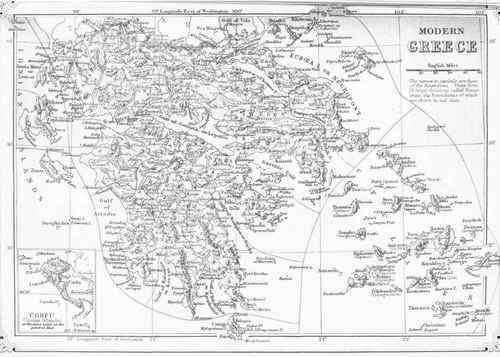
YEARS. | Imports. | Exports. |
1869 ......................... | $1S,215,000 | $12,073,000 |
1870............................ | 18,725,000 | 10,211,000 |
1871............................ | 20.947,000 | 14,043,000 |
The most important articles of import were: breadstuffs, $4,940,000; manufactures, $3,570,-000; skins, $1,669,000; sugar, $1,961,000; lumber, $808,000; animals, $530,000; cotton yarn, $453,000; coffee, $351,000; rice, $324,-000. The most important exports were : currants, $5,851,000; skins, $526,000; olive oil, $2,063,000; raw cotton, $221,000; figs, $700,-000; oranges, $106,150; tobacco, $137,030; wine, $152,000; silk cocoons and raw silk, $252,000; soap, $89,000; lead, $689,000. The merchant navy at the end of 1871 numbered 6,135 vessels, with an aggregate of 419,-350 tons; among which were more than 4,000 coasting vessels, and 12 steamers, with an aggregate of about 5,360 tons. The movement of shipping in 1870 and 1871 is shown by the following table:
ENTRANCES AND CLEARANCES. | Years. | Vessels. | Tons. |
Sea-going vessels........... | 1S70 | 16,757 | 2 504 004 |
Coasting vessels............ | " | 04.091 | 2 985.520 |
Sea-going vessels........... | 1S71 | 21,753 | 3.205.619 |
Coasting vessels............ | 105,612 | 3,960,790 |
The manufactures are few and unimportant. The prominent branches of industry are ship building, the manufacture of leather (chiefly on the island of Syra), silk and linen goods, sails and cordage, soap, liquors, and gold and silver embroideries. The first railway of Greece, connecting Athens with Piraeus and Phalerum, and having a length of 7 1/2 m., was opened in January, 1869. A road connecting the port of Piraeus with Lamia, which will be 138 m. long, was begun in December, 1872; and a charter had been given for building a road from Athens to Kalamata, to be 170 m. long. In 1870 there were 992 m. of electro-magnetic telegraph, with an aggregate length of wires of 1,116 m. Submarine cables are in operation between Athens, Syra, Scio, Constantinople, and Candia. The number of post offices in 1870 was 135. The monetary unit is the new drachma, which is equal to 19.3 cents; it is divided into 100 leptas. The standard of weight is a cantar, equal to 124.13 lbs. avoirdupois; it is divided into 44 oke, and subdivided into 400 old or 1,280 royal drams. The unit of long measure is the royal pit, equal to 1 metre or 3.2808 feet.
Land is measured by the stadion, which is equal to 0.62 of an English mile. - The constitution under which Greece is now governed bears date Nov. 17, old style (Nov. 29, new style), 1864. The throne is hereditary. The king attains his majority when 18 years old. Before his accession to the throne he must take the oath to the constitution, and within two months after the accession he must convoke the legislature. The successors to the present king, who is a Lutheran, must belong to the Orthodox church. The legislative power is shared by the king with a single chamber of representatives, called the boule, which is elected every fourth year; in the session of 1871 - '2 it consisted of 188 members. It meets annually on Nov. 1 (old style), and remains in session not less than three and not more than six months. It elects its own president and vice presidents. State officers, mayors, and military officers in active service, are not eligible; clergymen can neither be elected nor vote. The elections arc by ballot with the use of balls, and each candidate must be put in nomination by the requisition of at least one thirtieth of the voters of an electoral district. The right of voting belongs to all citizens who are 21 years of age and have a property, a trade, or any fixed occupation.
To be eligible as deputy, it is necessary to be 30 years of age and to own real estate. All citizens have equal rights and duties; nobility has been abolished. The executive power is exercised by the king through responsible ministers, of whom there are seven : of the interior, of finance, of justice, of education and ecclesiastical affairs, of war, of marine, and of foreign affairs. For administrative purposes, the 13 nomarchies are subdivided into 59 eparchies and 351 demoi (communes). At the head of these divisions are nomarchs, eparehs, and demarchs; the latter are, like the communal councils, elected for a term of four years. There is a court of cassation (the arcopagus) at Athens, four courts of appeal (at Athens, Nauplia, Patras, and Corfu), 16 courts of primary jurisdiction, the court of assizes, 175 tribunals of justices of the peace, and a number of military and marine courts. The finances of the kingdom are in a very unfavorable condition. In the budget estimates the revenue generally shows a small surplus over the expenditures; thus in the estimates for 1873 the revenue was estimated at $6,928,000, and the expenditures at only $6,832,000; but in reality the expenditures since 1866 have exceeded the revenue by about $2,700,000 annually.
Official returns giving the real income and expenses of the government have not been published since 1859. The funded debt amounted in July, 1870, to $65,000,000 (including the interest on the loans contracted in 1824 and 1825, which has not been paid, the former since July, 182G, the latter since January, 1827). The floating debt, according to semi-official returns, amounted in January, 1870, to $6,900,000, but there is also an unrecognized debt of several millions. By the new law of recruitment of 1867, the liability to military service is universal. The armed forces consist of the army and the national guard. The duty of serving in the army begins with the 20th year, and lasts 12 years (three years in the line, three in the first, and six in the second reserve). If necessary, all Greeks capablo of bearing arms, up to the age of 40, can be enlisted in the army. In the national guard, which is to be employed for the defence of the country in time of war, all citizens must serve from the 18th to the 50th year of age. The strength of the army in 1871 was 12,400 men on a peace footing, and about 48,000 men in time of war, including the volunteers; the national guard numbers about 90,000 men; and the total strength of the army on a war footing would therefore bo about 138,000 men.
The navy at the close of 1871 consisted of 2 iron frigates, 8 screw steamers, and 11 sailing vessels, with an aggregate of 200 guns and 2,500 men. The navy is manned by conscription from the inhabitants of the seacoast; but volunteering is greatly encouraged by the government. - In the population of Greece but a small foreign element is mingled. The number of those not speaking the Greek as their native tongue amounted in 1870 to only 67,941, of whom 37,598 were Albanese (Arnauts), 1,217 Ma-cedo-Wallachs, and 29,126 others. The immense majority of the population are connected with the Orthodox (Greek) church; the number of other Christians, chiefly Roman Catholics, in 1870, was 12,585; of Jews, 2,582; of all others, 917. The affairs of the Orthodox church are under the direction of a permanent holy synod at Athens, consisting of five members appointed by the king from the archbishops and bishops, and presided over by the metropolitan of Athens. All their resolutions must be confirmed by the king. The Orthodox church has 15 archbishops, the first of whom is the archbishop of Athens, who has the title of metropolitan, and 16 bishops. The archbishops and bishops are presented for their office by the synod, and confirmed and appointed by the king.
Exclusive of the Ionian islands, the church has about 3,200 secular priests, 1,600 monks, and 1,500 nuns. Formerly the number of convents was much greater, but in 1829 about 300 were closed and their estates appropriated for churches and schools. The Roman Catholic church has two archbishops (Naxos and Corfu) and four bishops. All religions are tolerated and have freedom of public worship. Instruction in Greece is compulsory for all children from 5 to 12 years; but the attendance at the primary schools is unsatisfactory, for in 1869 the 1,141 public and private primary schools numbered only 60,634 pupils, being 4.3 per cent. of the total population. The secondary instruction in 1870 embraced 15 gymnasia and 114 Hellenic schools (corresponding to the German Realschulen), with an aggregate attendance of 7,780 pupils; and 23 private institutions, with 1,589 pupils. The national university at • Athens has four faculties, the theological, law, medical, and philosophical, and in 1869 was attended by 1,205 students.
Of special schools, there are a polytechnic school at Athens, four theological schools of the Orthodox church, six nautical schools, one agricultural school, and one military academy at the Piraeus. - For an account of Greek art, see Architecture, Painting, and Sculpture. On the geography of Greece, see William Smith, "Dictionary of Greek and Roman Geography " (2 vols. 8vo, London and Boston, 1854-'7), and the works of Mannert, Leake, Rangabe, E. Curtius, Hett-ner, Blouet, W. G. Clark, Linton, Bayard Taylor, Wordsworth, Perigot, Joanne, and Manso-las. On ancient history and archaeology, see Grote, "A History of Greece" (12 vols. 8vo, London, 1846-'56; 12 vols. 12mo, New York); E. Curtius, Griechische Geschichte (1857-'67; English translation, London, 1868-'73); Cox, "History of Greece" (London, 1874); and besides the classical writers, the works of Goldsmith, Gillies, Thirlwall, Pococke, Gladstone, Heeren, Bockh, Manso, Droysen, Dunck-er, O. Muller, Hermann, Schomann, Wachs-muth, Kortum, Mitford, Clinton, Mure, and Felton. On mediaeval and modern Greece, see Brunet do Presle, La Grece romaine, byzan-tine, turque et regeneree (Paris, 1860); Tucker-man, "The Greeks of To-day" (New York, 1873); and the works of Fallmerayer, Prokesch-Osten, Villemain, Pouqueville, Finlay, Keight-ley, Emerson Tennent, Rizos-Nerulos, Sutsos, Gervinns, Tricupis, and Zinkeisen.
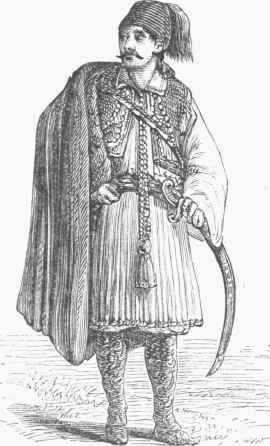
Modern Greek Costume.
Continue to:


My Books

