


Gurnard
Description
This section is from "The American Cyclopaedia", by George Ripley And Charles A. Dana. Also available from Amazon: The New American Cyclopædia. 16 volumes complete..
Gurnard
Gurnard , an acanthopterous fish belonging to the family of sclerogenidoe or "mailed cheeks," characterized by a prolongation of the suborbital bones forward across the cheek, and immovably articulated behind with the pre-oper-culum; the muzzle is also formed by a firm union of the frontal and other bones; and all these parts present a hard granulated appearance, often armed with spines. The gurnards belong to the genera trigla (Linn.) and priono-tus (Cuv.), the latter being peculiar to America. In the genus trigla, in addition to the family characters, the body is scaly; there are two dorsal fins, the first spinous, the second flexible; the pectorals are moderate, and beneath them and at the base are three detached articulated rays on each side; branchiostegal rays seven; head of a parallelopiped form; teeth small and villiform on the jaws and pharyngeals; lateral line straight to the caudal, where it forks, variously armed with spiny scales. The gray gurnard or grunter (T. gur-nardus, Linn.) grows to a length of 15 to 20 in., and rarely to 2 ft.; the body is more elongated and the snout longer than in most other species; the descending line of the profile is nearly straight; the snout is shovel-shaped, slightly emarginated, having on the top eight hard bony points; the head and shoulders granulated, and armed with spines; lateral line sharply serrated, and the dorsal scales rough.
The color above is gray clouded with brown, more or less spotted with black and yellowish white; below silvery. It is common on the English coasts, and is found from Norway to the Mediterranean; it keeps near the bottom, and feeds on crustaceans and mol-lusks, spawning in May and June; when taken from the water it makes a kind of grunting sound (whence one of its common names), which cannot proceed from the air bladder, as this has no duct communicating externally. Notwithstanding its hideous appearance, its flesh is white, firm, and wholesome; it is caught in deep water, biting at almost everything, even a red rag. The habits of this fish are easily studied in the aquarium. They may be seen with their pectorals close to the sides, and with no motion of the tail, crawling along the bottom by means of the free pectoral rays, which are placed successively on the ground like so many feet; their light weight, rendered less by their capacious air bladder, is thus moved with considerable rapidity forward, backward, or sideways in search of food.
These free rays are moved by a muscular apparatus independent of that supplying the common fin; to these rays are also distributed large nervous filaments, arising from a marked expansion of the upper part of the spinal cord, indicating that these organs are endowed with a delicate sense of touch. It stirs up the mud and sand with its shovel-shaped nose, and is enabled to detect its prey in the turbid water by means of these pectoral feelers. The large eyes, on the top of the head so as to catch all the rays of light, indicate an animal organized for living in comparative darkness. - The American gurnards of the genus prionotus are distinguished from those of the preceding genus by the larger pectoral fins, and by the villiform teeth on the palate bones. The banded gurnard (P. lineatus, Mitch.) grows to a length of 12 to 18 in.; it is reddish brown above, covered with numerous black dots, and the abdomen white; the color of the dead fish above the lateral line is slaty, and beneath there are several brownish bands, whence its name; the head is covered with bony plates, rough, and armed with spines; the upper jaw the longer. It is found on the coast of Massachusetts and the middle states. It is called also grunter and sea robin.
The web-fingered gurnard (P. pal-mipes, Storer), a much rarer species, grows to the length of about 18 in., and may be known by the dilated ends of the pectoral processes; the color is reddish brown above, with irregular darker shadings, and nearly white below. When alarmed, it buries itself in the sand by a rapid lateral movement of the body, leaving only the eyes and top of the head exposed; the flesh is occasionally eaten; it feeds principally on crustaceans. It is found from Massachusetts as far south as the Carolinas, and perhaps further. Other species are described.
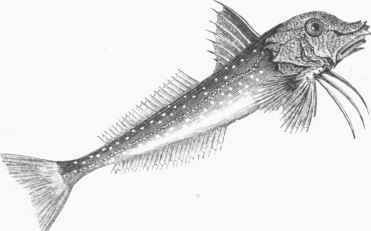
Gray Gurnard (Trigla gurnardus).

Web-fingered Gurnard (Prionotus palmipes).
Continue to:


My Books

