


Hare
Description
This section is from "The American Cyclopaedia", by George Ripley And Charles A. Dana. Also available from Amazon: The New American Cyclopædia. 16 volumes complete..
Hare
Hare , the name of the small rodents of the family leporidoe, and the genus lepus (Linn.), which includes also the rabbits. This has fewer species than most other families of rodents, and presents the exceptional characters of large openings of the skull, an imperfect condition of the palate, the nasal process of the superior maxillary perforated, large orbits meeting in the middle line of the cranium, small temporal fossa?, and an increased number of incisor and molar teeth; the scapular spine has a long acromion process, sending down a considerable branch at right angles; there are five toes on the fore feet and four on the hind; the ears are very large, as long as or longer than the head; the tail short and bushy, either rudimentary or carried erect; hind legs much longer than the anterior, and formed for leaping; the stomach is simple, or partially divided internally, and the caecum very long and divided into numerous cells by tendinous bands; a part of the inner surface of the cheeks is clothed with small hairs. Hares are found in all parts of the world except Australia, but most abundantly in North America, and are chiefly confined to the northern hemisphere, extending even into the polar regions.
There are only two genera of the family, lepus and lagomys; the latter will be described under Pika. The genus lepus has the following dental formula: incisors 4/2, and molars 6/5-6/5, a larger number than in other rodents; two small incisors are placed behind the principal pair, which are grooved in front, all being white, and not implanted as deeply as usual in the alveoli; the molars are rootless. There seems no osteological difference between hares and rabbits; the latter, however, are gregarious and make burrows in which the young are raised, while the former are more or less solitary, and merely make "forms" of grass on which they sit; rabbits are born blind and naked, but hares are said to have the eyes open and the body covered with hair at birth. The distinction being based chiefly on habits, there are hardly any species in America like the rabbit of Europe (L. cuniculus, Linn.), unless they be the gray rabbit (L. sylvaticus, Bach.) and the jackass rabbit (L. callotis, Wag-ler); and it is not certain that any other old world lepus has the habits and peculiarities of L. cuniculus.
The last three species will be noticed under Rabbit. The common hare of Europe (L. timidus, Linn.) has ears longer than the head, fringed anteriorly with long hair; the fur mottled with black and ochrey brown, with rufous tints on the neck and outer side of limbs; the abdomen, inner side of limbs, and tail white; upper surface of tail and ears black; length from tip of nose to root of tail, along the curve of the back, 23 in.; weight, 8 to 12 lbs. Black and white varieties sometimes occur, but the color is not changed in winter as in the varying northern hares. This species is found generally throughout Europe, except in the coldest parts. The timidity of the hare is proverbial, and its speed has made it a favorite object of the chase from the times of the Romans; the principal use of the greyhound is to pursue this animal. The eyes are lateral and prominent, and vision extends to objects on all sides at once; a very acute sense of hearing and smell and great speed are given for further protection against its numerous enemies; the palms of the feet are covered with hair; the nostrils are circular, almost hidden by a fold which may be closed; the upper lip is cleft; the opening of the ears can also be closed; the mammae are 10. They are able to reproduce at a year old; the period of gestation is 30 days, and from two to five are produced at a birth.
They remain quiet during the day in their form or seat, which is a mere depression in the ground near some bush, coming out toward evening in search of food; the color so much resembles that of the objects among which they rest, that, as if conscious of the resemblance, they will generally remain quiet in their form until they are almost trodden upon. This species readily takes to the water, and swims well; it sits upon its tarsi, and uses its fore paws in holding food and cleansing its fur, though, from its incomplete clavicles, less perfectly than in the claviculated rodents; it drinks lapping, and can bite severely. Early in spring the sexual appetite is very strong, and the animal acts so strangely that to be "as mad as a March hare" has become a proverb. Its intelligence is small, but its instincts in avoiding its enemies are remarkable. The hare and rabbit were ranked among ruminating animals by the Mosaic law, but were forbidden to the Jews because the hoofs were not divided; Moses probably called the hare a ruminant from the partial division of the stomach, and the evident lateral movement of the lower jaw.
The food of the hare is entirely vegetable, and its flesh is delicate, nutritious, and universally esteemed. - The varying hare (L. variabilis, Pall.) is smaller than the common species, with smaller and less black ears, shorter tail, and without the mottled appearance and white mark on the cheek of the latter; in summer the general color is rusty brown, finely pencilled with black and rufous yellow above, and impure white below; tail white, grayish above. In winter the fur is white, with ears black-tipped, the change of color being due to the cold of the season in the northern regions which it inhabits. It is found in northern Europe and Asia as far as the arctic ocean, but is wanting in central Europe except in Alpine regions. Twenty other species of hare are described by Waterhouse in Europe, Asia, and Africa. - Among the American species which grow white in the winter is the polar hare (L. glacialis, Leach), the largest of the family, exceeding a large cat; it measures about 2 ft. to the root of the tail, the latter being about 3 1/2 in., and the ears about 4 in.
The color in winter is pure white, with the ears black-tipped,before and behind, and the soles dirty yellowish white; in summer it is light brownish gray above, varied with black, rump and upper surface of tail dark plumbeous, ears glossy black with whitish posterior margin, and below whitish with a sooty tinge; the head is arched and wide, the ears broad, the tail short and hardly perceptible amid the dense hair; the fur is soft, fine, and full. This much resembles the European L. variabilis, and is distinguished chiefly by greater blackness of the ears; it is found in arctic America, and as far south as Newfoundland, in the most desolate and sterile regions; it feeds on berries bark, twigs, and evergreen leaves; it is not very shy, though difficult to take in its favorite snowy localities; its range probably extends from Greenland to Behring strait. Indians, trappers, and aretic travellers have often been saved from starvation by this animal. Its eyes are adapted for the twilight and auroral light of the polar countries, which, with the brightness of the pure snow, are always sufficient for its needs; its flesh is said to be delicious.
From the shortness of the arctic summer this species produces young but once a year, from three to six at a birth; the fur is softer than the finest wool; its summer pelage does not last more than three or four months. The weight, in good condition, is from 10 to 14 lbs. - The northern hare, sometimes called white rabbit (L. Americanus, Erxl.), is a little smaller than the last; the color in winter is whitish, but the hairs at the root are gray and pale yellow in the middle; in summer the general hue is reddish brown, pencilled with black above, and the under parts white, very much like that of the European hare. It is found in the eastern portions of America from Virginia as far north as lat. 68°; its favorite haunts are thick woods, where it is hunted with difficulty by dogs; its food consists of grasses, bark, leaves, young twigs, buds, and berries, and, in a domesticated state, of vegetables and fruits. This is the swiftest of the American species, and has been known to clear 21 ft. at a single leap; like other hares and rabbits, it is in the habit of beating the ground with the tarsi, when alarmed or enraged; it is fond of pursuing a beaten path in the woods, and is often snared in such places. Its flesh is not much esteemed.
Its enemies, besides man and dogs, are the lynx and other carnivorous mammals, hawks, owls, and even the domestic cat. It is more fierce than the rabbit, and will bite and scratch severely. The skin is very tender, and the fur little valued by furriers; the hind feet are used by the hatter in finishing his fabrics. - The swamp hare (Z. aquaticus, Bach.) is as large as the northern species, with long ears and tail; dark grayish brown above and white below; it is strong and swift; the fur is coarse and glossy; the feet are not densely clothed with hair, but the toes are slender, with small pads, pointed, and with visible claws. This species prefers low marshy places, in the vicinity of water, to which it is fond of resorting; it is an excellent swimmer, subsisting chiefly on the roots of the iris and other aquatic plants; when started, it suddenly leaps from its form, and makes for the nearest water, seemingly conscious that in that element all traces of its scent will be soon lost; it is fond of hiding beneath the roots of trees over-hanging the water, in hollows under river banks, and in decayed trees.
It is most abundant in the swampy tracts bordering on the Mississippi and its tributaries in the southwestern states; it has not been seen E. or N. of Alabama, according to Bachman. - The marsh hare (L. palustris, Bach.) is smaller than the rabbit, with short ears and tail; the legs are short and the feet are thinly clothed with hair; the general color above is yellowish brown, beneath gray; the eyes are remarkably small. It is found in the maritime districts of the southern states, especially in the neighborhood of rice fields. It is an excellent swimmer, and is perfectly at home in the miry pool and boggy swam]); it runs low on the ground, and is rather slow and clumsy in its motions. Its flesh is considered superior to that of the gray rabbit. Like other species of the genus, it is infested in the summer and autumn with the larvae of an oestrus, which penetrate the flesh and keep the animal lean from constant irritation. Its food consists principally of roots, bulbs, and twigs of plants growing in marshes.
It breeds several times a year, having from five to seven at a birth; the young are placed in a kind of nest, made of rushes and lined with hair. - Several other species of hare are described by Waterhouse and Baird.
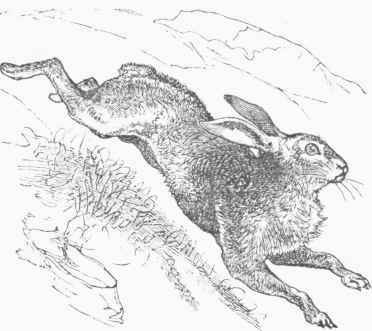
European Hare (Lepus tirnidus).
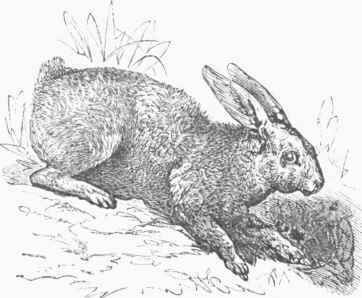
Northern Hare (Lepus Americanus).
Continue to:


My Books

