


Hawk
Description
This section is from "The American Cyclopaedia", by George Ripley And Charles A. Dana. Also available from Amazon: The New American Cyclopædia. 16 volumes complete..
Hawk
Hawk , a name indiscriminately applied to many birds of the falcon family, of the subfamilies accipitrinoe, buteoninoe, falconinoe, and milvinoe; indeed, to almost any bird of prey which is not a vulture, an eagle, or an owl. The duck hawk has been described under Falcon, the hen hawk under Harrier, and the fish hawk and goshawk under their respective titles; the white-tailed and swallow-tailed hawks are noticed under Kite, and the pigeon and sparrow hawks in their alphabetical order; and many are described under Buzzard. The well known American birds of this name which may be most appropriately noticed here are the following. Cooper's hawk (accipiter Cooperi, Bonap.) is about 20 in. long, with an extent of wings of 38 in,; the form is more long and slender than in the falcons and goshawk, the wings are short, and the tarsi and tail long; the general color above is dark ashy brown, darker on the head; the under parts are transversely barred with light rufous and white; throat and under tail coverts white. It is found generally in the eastern parts of temperate North America, less commonly in the west. The flight is very rapid, and near the ground; it is one of the boldest hawks, attacking birds larger than itself; the ruffed grouse, quails, pigeons, and hares are its favorite food.
The sharp-shinned hawk (A. fuscus, Gmel.) is a small species, from 11 to 14 in. long, with an extent of wings of 2 ft.; the upper plumage is brownish black, tinged with ashy; under parts light rufous, with transverse white bands; the throat and under tail coverts white, the former streaked with black; tail ashy brown, white-tipped, with about four brownish black bands. It is found throughout North America from Mexico to the arctic regions; it is one of the swiftest and boldest of the hawks, seizing upon birds and animals which it cannot fly away with; its flight is low and irregular, and its direction changed with great quickness; it preys also on reptiles. - The young of all the hawks differ greatly from the adults, having generally a much lighter and white-mixed plumage. The keenness of vision of these birds, sweeping with great rapidity, and often at a considerable height above their prey, is remarkable; to have a "sight like a hawk" has become a proverb. They usually fly low, irregularly, and with sudden change of course, for which their short wings and long tails are well adapted; the falcons, on the contrary, have longer wings and shorter tails, and fly with greater regularity and at considerable elevation, from which they descend with exceeding swiftness; the kites have both the wings and tail elongated, with a corresponding power of rapid and high flight, and the ability of very sudden descent and change of direction.
Hawks, and indeed birds of prey generally, are almost always shot at when they come within range of a gun, without any particular reason, except that they are hawks, and of a ferocious disposition; they do no great mischief beyond the occasional stealing of a chicken, hare, grouse, or pigeon, which otherwise would fall a victim to man's appetite; and they are of positive advantage to the agriculturist by destroying animals and birds injurious to vegetation, and noxious reptiles.
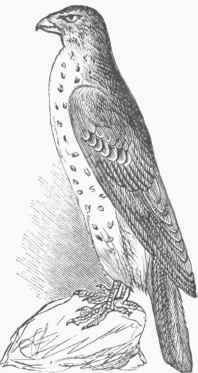
Accipiter Cooperi.
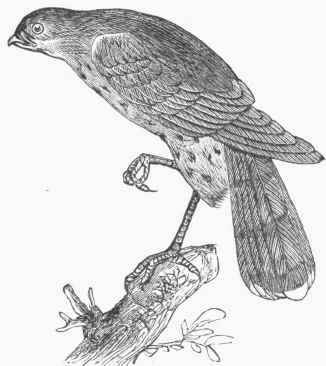
Sharp-shinned Hawk (Accipiter fuscus).
Continue to:


My Books

