


Iguana
Description
This section is from "The American Cyclopaedia", by George Ripley And Charles A. Dana. Also available from Amazon: The New American Cyclopædia. 16 volumes complete..
Iguana
Iguana (a lizard constituting the type of the family iguanidae. The family characters are: a body covered with horny scales, without bony plates or tubercles, not disposed in circular imbricated series, and without large square plates on the abdomen; there is generally a crest along the back or the tail; no large polygonal scutes on the head; the teeth sometimes in a common alveolus: and sometimes united to the free edge of the jaws; tongue thick, free only at the point, and without sheath; eyes with movable lids; toes distinct, free, and all unguiculated. The very numerous genera of this family have been conveniently divided into two subfamilies by Dumeril and Bibron, according to the manner in which the teeth are implanted. In the pleurodonts, all but one American, the teeth are arranged in a groove of the jaws, are attached to their inner surface, and are often curiously flattened and serrated on the free edge; in the acrodonts, all of the eastern hemisphere, there is no such groove, and the teeth grow upon the edge of the jaws. For the characters of the second subfamily, having 15 genera and about 60 species, see Dragon, Stellio, and the genus agama, below.
The pleurodonts comprise 31 genera and more than 100 species; anolis and basiliscus have been already noticed under those titles, and the only genus here described will be iguana (Laurenti). The characters of this genus are: a very large thin dewlap under the throat; cephalic plates flat, unequal, and irregular; a double row of small palate teeth; a crest on the back and tail; fingers and toes five, long, of unequal lengths, the fourth of the hind foot very long; a single row of femoral pores; tail very long, slender, compressed, and covered with small, regular, imbricated, ridged scales. The common iguana (I. tuberculata, Laur.) attains a length of 4 or 5 ft., of which the tail is about two thirds; it is found in tropical South America and the West Indies. The nasal openings are at the end of the obtuse muzzle; the teeth are about 50 in each jaw, with card-like ones on the palate in two series; the dewlap is about as deep as the head, triangular, having about a dozen serrations on its anterior border; along the neck and back is a comb-like crest of about 55 scales, highest in this species, extending on to the tail, where it becomes a simple serrated ridge; the femoral pores are 14 or 15, widest and opening in a single scale in the males.
The color above is greenish, with bluish and slaty tints, and greenish yellow below; on the sides are generally brown zigzag bands with a yellow border, with a yellowish band on the front of the shoulder; some are dotted with brown, with yellow spots on the limbs; the tail is ringed broadly with alternate brown and yellowish green. The flesh of the iguana is considered a great delicacy, though it is not peculiarly wholesome. It passes most of its time in trees, in which it is caught by slip nooses; it is said to be a good swimmer, and some of the subfamily, as amblyrhynchus, pass most of their time in the water, and even in the sea. - The iguanas of the eastern hemisphere, of the acrodont subfamily, are often called agamas, from one of the principal genera. The genus agama (Daudin) has a flat triangular head, neck, and sometimes the ears spiny, body covered with small imbricated scales, no dorsal crest, tail long, slender, and rounded, anal but no femoral pores, a longitudinal fold along the throat, and sometimes a transverse one; the teeth are united to the edge of the jaw, and may be distinguished into posterior or molars and anterior or canines and incisors; no teeth on the palate.
None of this subfamily are found in America. The common agama (A. colono-rum, Daudin) is the largest of the genus, being from 12 to 16 in. long, of which the tail is more than half; it is found on the Guinea and

Iguana tuberculata.
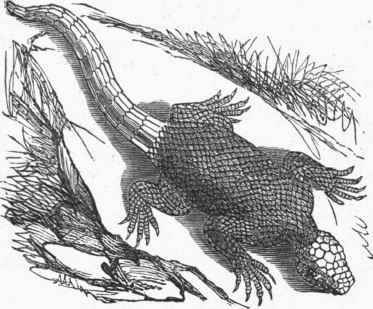
Agama colonorum.
Senegal coasts. The spiny agama (A. spinosa, Seba) is short and thick, with short tail and spiny scales; it is about 7 in. long, and inhabits the Cape of Good Hope. Some of the acro-donts in Asia and Australia are of very strange forms; the habits and general appearance are like those of the American iguanas.
Continue to:


My Books

