


Ormiz, Or Horninz
Description
This section is from "The American Cyclopaedia", by George Ripley And Charles A. Dana. Also available from Amazon: The New American Cyclopædia. 16 volumes complete..
Ormiz, Or Horninz
Ormiz, Or Horninz, an island of Persia, on the N. side of the strait of the same name, leading from the Arabian sea to the Persian gulf, about 5 m. from the coast; lat. 27° 5' N, lon. 56° 29' E.; area, about 15 sq. m.; pop. about 300. It is nearly circular, and the surface is almost equally divided between hill and plain. The S. and S. W. sides present a mass of hills from 300 to 400 ft. high, of remarkable geological character, consisting chiefly of rock salt worn into fantastic outlines and honeycombed by the rains, incrusted with bright-colored earths, and destitute of vegetation. On the N. and E. sides of the island the shores form a low plain, which projects on the north in a sharp point. On the end of this are the remains of the once important Portuguese fortress, a quadrilateral bastioned fort, 750 ft. long by 620 ft. broad, separated from the mainland by a moat now filled with sand. S. of it are the ruins of the Arab city of Ormuz, consisting chiefly of mounds strewn with pottery, many water cisterns, and a minaret 70 ft. high. On the S. E. end of the island are the remains of one of the palaces of the old kings.
The village near the site of the city is only a collection of mat huts, whose inhabitants export salt, salt fish, and a kind of red earth used in Calcutta for staining and seasoning wood. A few soldiers hold the fort as a military post for the governor of Bunder Abbas. (See Oman.) - Ormuz is probably the Ogyris of Strabo and the Organa of Arrian and Ptolemy. At a later period it was called Jerun. In the beginning of the 14th century Ayaz, king of old Ormuz, a town on the mainland which was known to the ancients as Har-mozia, suffering from the incursions of the Tartars, removed to the island and built there a new Ormuz, which eventually became the capital of a kingdom comprising a considerable part of Arabia and of Persia. In the 15th century it had acquired great prosperity, and was the entrepot of the commerce between India and Persia and of the trade of Samar-cand and Bokhara. At the beginning of the 16th century its reputed wealth and splendor attracted the cupidity of the Portuguese, and in 1507 Albuquerque sailed against it, but found the city defended by 30,000 men. In 1515 he returned with 27 ships, reduced it, and built the fortress. In 1543 the island paid to Portugal an annual tribute of 100,000 ducats.
Its commerce soon began to decline, the Portuguese allowing no ships to navigate those waters except under oppressive conditions; but it retained sufficient importance in the beginning of the 17th century to arouse the jeal-ousv of Shah Abbas of Persia, who, aided by the ships of the English East India company, captured the fortress in April, 1022, although it was defended by 300 guns and 2,500 men. The city was destroyed by the shah, who wished to transfer its trade to his new port Bunder Abbas, and a great part of its building material was transported thither. At a later period the sultan of Oman took possession of it. In 1851: the Omanite officials were expelled by the shah, but in 1856 they were allowed by treaty to occupy it for 20 years on payment of an annual tribute.
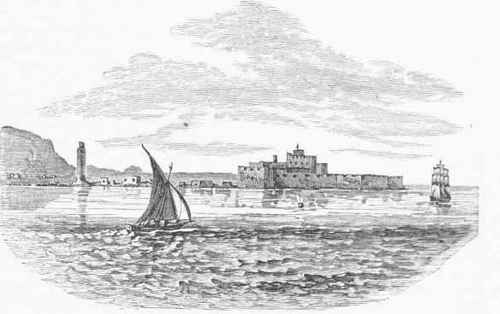
Old Portuguese Fort, Ormuz.
Continue to:


My Books

