


Osier
Description
This section is from "The American Cyclopaedia", by George Ripley And Charles A. Dana. Also available from Amazon: The New American Cyclopædia. 16 volumes complete..
Osier
Osier (Fr. osier; Gr. olcoc), the name of those willows the long and pliant shoots of which are used for basket making. In England the basket makers use the name exclusively for the rods of the white osier (salix vimi-nalis) and a few other soft kinds, while the harder and better rods produced by other species are known as basket willows, or simply willows. In English works 30 or 40 species and varieties of willow are named as producing useful osiers, some of which are naturally large trees, but are kept small by the treatment to which they are subject. Not only do different species and varieties furnish osiers of various qualities, but the product is affected by the kind of soil on which they grow, by the distance the plants stand apart, and by the treatment of the rods after they are cut. The points taken into account in judging of the quality of willows are toughness and elasticity; the smoothness of the surface, and its color when peeled; the readiness with which the rod may be split; the quantity of pith, and the length of the shoot in proportion to its thickness.
Though the wild willows are most frequently found along the margins of streams and in wet places, moist land is not required for their successful cultivation; in England it is found impossible to raise willows of good quality upon land which would need draining if other crops were to be put upon it. The land being thoroughly prepared, as for any other crop, the sets are planted at distances depending upon the variety of willow; some are placed as close as 16 by 8 in., and coarser kinds 20 by 12 in. The sets are pieces of twigs of the previous season's growth, about a foot long, and sharpened at the lower end. A frame of slats is used to secure regularity in planting; the slats are of the proper distance apart for the rows, and upon them are cut notches indicating the places for the sets. The planter, having his hand protected by a leather shield, thrusts the sets into the soil, one at each notch on the frame, pushing them into the ground in a slanting position, and quite out of sight. The object in planting so thickly is to induce a growth of slender upright shoots, without any side branches. The shoots produced the first season after setting are small and of little or no value, but they must be carefully cut, or the crop of the second year will be much injured.
The crop of the third year is expected to pay all the expenses, rent, taxes, etc, of establishing the plantation; and the land is kept in willows. 10 or 12 years, when the roots are ploughed and grubbed out and the land given to some other crop. The land must all the time be kept clear of weeds, and if it shows signs of exhaustion, manure must be applied. The willows are cut as soon as the leaves fall, with a heavy hooked knife; the cutting should be close to the ground, as stumps would be liable to the attacks of insects and diseases. The rods are tied in bundles, having a girth of 3 ft, at the larger end. The after treatment of the crop depends upon the use for which it is intended. If for peeling white, the bundles are set upright with their buts in 6 or 8 in. of water; and in the following spring, when growth begins, the bark peels off readily. If for peeling buff, as it is called, the bundles are set upright until sufficiently dry to be put under cover, or stacked and thatched over. To peel these dried willows, they are steamed or boiled; the baskets made from them are much firmer and more durable than those from the white rods.
The peeling is usually done by drawing the rods through an implement made of a half-inch iron rod something like a prolonged letter V. Several machines have been invented for peeling, some of which do the work very completely. In parts of Great Britain willows are an important crop, and it is estimated that there are, including Ireland, between 0,000 and 7,000 acres devoted to their cultivation; both France and Belgium produce large quantities of excellent osiers, and many tons of the coarser kinds are exported from Holland. While every few years some interest has been awakened in this country in regard to willow culture, it has never gained much foothold, although neither climate nor soil presents any obstacle to success. Nurserymen and gardeners find a small patch of osiers very useful to furnish bands for tying up bundles of trees, to supply straight slender stakes for plants, and for various other uses; to keep such trees in a productive state, they should be headed back each autumn to induce an abundant growth of strong straight wands.
In Europe osiers are also grown for hoop poles; for this purpose the plants are set about twice as far apart as for basket making, and allowed to grow two and three years before cutting. - The white or common osier of England is salixriminalis; it is the most rapid growing of all, producing on good land shoots 10 to 12 ft. long in one season; but it is the least tough of any of the basket willows, and brings the lowest price. It is naturalized in this country, and in the older states is not rare in wet meadows. The rose or purple willow (S. purpurea, also called S. helix and by several other synonymes) appears to be a variable species, some forms of which are highly esteemed and rank among the best small willows. The golden willow, a variety (var. vitellina) of the common white willow (S. alba), very frequent as a large tree in the older parts of the country, and readily recognized by the bright yellow color of its shoots, when treated as an osier is an excellent basket willow. The almond willow (S. amygdalina and S. triandra), called also the brown Norfolk, is much cultivated for basket work, and is regarded as the most pliable of all willows.
There is perhaps no genus of plants in which so much confusion exists as among the willows, and it is very difficult to assign the proper botanical names to the many kinds in cultivation, a difficulty increased by the fact that many of them are sports, or forms fixed by selection, of one species.
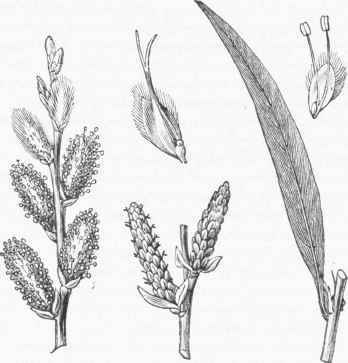
Common Osier (Salix viminalis). Staminato and Pistillate Catkins and Flowers.
Continue to:


My Books

