


Owl
Description
This section is from "The American Cyclopaedia", by George Ripley And Charles A. Dana. Also available from Amazon: The New American Cyclopædia. 16 volumes complete..
Owl
Owl, the general name of the nocturnal birds of prey constituting the family of strigidoe, of which there are 5 subfamilies, 13 genera, and about 150 species, more than 40 of which inhabit America. Owls may be recognized by their short and bulky form, with head disproportionately large, fully feathered, and often furnished with erectile tufts like the ears of quadrupeds; the eyes are very large, directed forward, more or less surrounded by a disk of radiating bristly feathers, and in most formed for seeing in twilight or at night, presenting a vacant stare when exposed to daylight; lores densely covered with bristly feathers directed forward, nearly concealing the short, strong, and hooked bill; ears large, with a kind of operculum or cover, enabling them to hear slight noises in the stillness of night; the wings are generally moderate, broad, and rounded, the outer edge of the primaries with separated barbs, adapted for vigorous and noiseless but not rapid flight in pursuit of living; prey in morning and evening twilight; the tail broad, and of various lengths; tarsi usual-lv short, strong, feathered to the toes except in the Asiatic genus ketupa; the inner toe the longest, and the outer capable of being turned back as in scansorial birds; the claws long, curved, and very acute.
The plumage is soft and downy; the female is the larger, resembling the male in colors; the expression of the face and eyes is cat-like; the eggs are two to rive, and White, and the young are covered with a tine down. The mouth is very wide, and the oesophagus capacious, leading directly to the stomach, without any dilatation or crop; the intestines are short, and with two large casca. Owls are solitary birds, retiring during the day to holes in trees, caves, or old buildings, where they roost and breed; most are nocturnal, but a few fly by day, in habits resembling the falconidce, especially the kites; the larger species feed on small quadrupeds (particularly mice) and birds, and the smaller on insects, such as moths and large beetles; if the prey be small, it is swallowed whole, or is torn to pieces if necessary, and the indigestible portions, such as feathers, hair, and bones, are disgorged from the stomach in small pellets. They are great benefactors to man by destroying mice and other noxious animals; but from their nocturnal habits and dismal screeching cry they are generally regarded with superstitious fear.
In the Scriptures the owl is almost always associated with desolation; painters, poets, and story tellers introduce it as a bird of ill omen, and as the companion of ghosts, witches, demons, and magicians; almost all uncultivated nations look upon it as an unwelcome visitor; the ancient Greeks and Romans, however, made it the emblem of wisdom, and sacred to Minerva, and indeed its large head and solemn eyes give it an air of wisdom, which its brain does not sanction. - In the first subfamily, the striginm, the size is never very large; the head is smooth and bulky, and the facial disk perfect; the bill rather long, eyes rather small, legs long and feathered to the toes. In the genus strix (Linn.) belong the barn owls; in this the wings are long, and the head without tufts; of the dozen species scattered over the world will be mentioned only two. The American barn owl (S. pratincola, Bonap.).) is 18 in. long, with an extent of wings of 3f ft. in the female; the male is an inch shorter and 2 in. less in extent.
The general color above is yellowish or grayish brown, finely mottled with light yellowish red, each feather having toward the end a central deep brown streak ending in a grayish white spot; quills and tail transversely banded with blackish brown; under coverts of wings and tail white; under parts pale brownish red, fading anteriorly into white, each feather tipped with a dark brown spot; the face white, tinged with red, with a ruff of light brownish red; the bill, toes, and claws light yellowish. It occurs throughout temperate North America, breeding at all seasons in the southern states; it is not found far from the sea, and frequents the borders of woods and open abandoned fields; it feeds almost entirely on quadrupeds, and sometimes digs up moles and mice like the burrowing owl; its flight is light, regular, and protracted, and it runs rapidly; according to Audubon it makes no cry, but utters a hollow hissing sound. The European barn owl (S. fiammea, Linn.) is considerably smaller than the American, being only 14 in. in length and 3 ft. in extent of wings; it is lighter colored, more yellowish, with gray and brown zigzag lines and wiiitish dots above; it is whitish below, and the ruff is white.
It is found abundantly in Great Britain and other temperate parts of Europe, in Asia, and in Africa, especially in cultivated districts in the neighborhood of fields and farm yards where it can find a plentiful supply of mice; though a single bird will destroy annually several hundred mice and moles, besides noxious insects, it is constantly persecuted for its alleged injury to game birds and the dove cote; it sometimes captures fish by dropping upon them in the water; its general note is a screech, hence it is commonly called screech owl in Great Britain; it rears several broods in a season between July and December. - In the second subfamily, the buboninoe, the facial disk is incomplete above the eyes and bill, and the large, broad, and flat head is furnished with a pair of long erectile ear tufts, which have given them the name of horned owls; legs and claws usually very strong. This subfamily is spread all over the world, except in Australia, and contains some of the largest as well as some of the smallest of the family. The genus bubo (Cuv.) is of large size and robust form; the large eyes and ear tufts have given them the name of cat owls; the wings are long, the tail short, the legs densely feathered, the bill short, and the claws very strong.
The American great horned owl (B. Virginianus, Bonap.) is from 20 to 25 in. long, with an extent of wings of 4½ to 5 ft., the bill along the ridge 2 in., and the ear tufts 3; the color is variable from dark brown to nearly white; the general color above is dark brown, every feather mottled with irregular lines of pale ash and reddish fulvous, the base of each being of the latter color; throat and neck white, breast with longitudinal black stripes, rest of under parts mixed white and fulvous with narrow transverse dark brown lines; iris yellow, bill and claws bluish black. It is found throughout North America, and probably also in South America, several varieties being described in different latitudes, in mountain and plain, on the seashore and in the interior; the flight is elevated, rapid, and graceful; it makes a great variety of sounds, barking like a dog, hallooing and leading astray the benighted traveller, saluting him by notes like the half suppressed screams and gurglings of a suffocating person, or deceiving him by a low "hoo-hoo-hoo-e" which seems a great distance off. It commits great havoc in the farm yard, seizing all kinds of domestic poultry, to which may be added grouse, ducks, hares, squirrels, and opossums, and even dead fish.
They begin to pair in February, making a bulky nest usually on a large horizontal branch, and rear only one brood of three to six in a season. It is a bold and powerful bird, bravely resisting when attacked. The European horned or eagle owl (B. maximvs, Sibb.), le grand due of the French, is about 26 in. long, with an extent of wings of 5 ft.; it is common in the forests of-Europe from the Mediterranean to Norway and Lapland, but is rare in Great Britain; it occurs also in Asia; its habits are the same as those of the American bird; the general color is ferruginous, varied with spots and markings of brown, black, and gray; in captivity it is fierce, hissing, snapping, and barking when irritated, but making no other noises. The genus scops (Sav.), or ephialtes (Keys, and Blas.), is characterized by small size, conspicuous ear tufts and large head, and long tarsi more or less covered with short feathers. The mottled or American screech owl (S. asio, Bonap.) is about 10 in. long and 22 in extent of wings; in the adults the plumage above is pale ashy brown with longitudinal brownish black lines, mottled with the same and cinereous, and below ashy white with similar stripes and lines; bill and claws horn color; in young birds the upper parts are pale brownish red, in some parts rufous, and below yellowish gray, hence called the red owl.
This is the most abundant owl in the Atlantic states, and is found over the whole of temperate North America, and even as far as Greenland; its food consists principally of beetles and field mice, which it seeks in the neighborhood of farm houses, orchards, and gardens, where it is rarely molested; its notes are mournful and tremulous, like the chattering of teeth, but loud enough to be heard for several hundred yards. The little horned owl of Europe (S. Aldrovandi, Ray) is about 8 in. long, of a light gray color variegated with brown, with longitudinal brownish black lines and transverse undulations; it is most abundant in southern Europe in wooded districts, where it feeds on insects and mice; it is also found in N. Africa and Asia, and rarely in Great Britain; it nestles in cavities in rocks and holes in trees, laying two to four eggs; it is gentle, and readily tamed; its notes are plaintive and monotonous, resembling "keu, keu," and are kept up regularly the night long. In the genus otus (Cuv.) the form is larger and more slender, the head moderate with more perfect facial disk, and the eyes rather small.
The American long-eared owl (0. WiUonianus, Less.) is about 15 in. long, with an extent of wings of 31/3 ft.; it is rather a handsome bird, very intricately marked, and may be generally described as of a buff color, mottled and spotted with brown and grayish white; it inhabits the whole of temperate North America, and even the shores of Hudson bay; it is strictly noctnrnal, proving upon insects and small mammals and birds; it deposits its eggs in the abandoned nest of other birds, in a fissure of a rock, a hole in a tree, or a hollow in the ground; its cry is plaintive, consisting of two or three prolonged notes repeated at intervals. The European long-eared owl (0. vulgaris, Flem.) bears a strong resemblance to the American species, and is one of the most abundant of the family in England, where it remains all the year round; it is intricately dappled with dark brown and black upon pale brown, and is a very handsome bird; it frequents old ivy-covered towers and trees, where it remains during the day; it rarely makes a nest of its own, using those of the crow or squirrel.
The American short-eared owl has been made, with others, into the genus bachyotus (Gould), characterized by inconspicuous ear tufts; this species (B. Cassini, Brewer) is about 15 in. long, with an extent of wings of 3½ ft.; the plumage is reddish buff, streaked longitudinally with dark brown, the tail being of the latter color barred and tipped with reddish buff; it is found in North America from Greenland to Cuba and from the Atlantic to the Pacific, in the eastern states in the winter preferring the vicinity of marshes and meadows; it is very fond of remaining on the ground, on which it advances by long leaps. The European short-eared owl (B. pedustris, Gould), 16 in. long and 40 in alar extent, much resembles the preceding species; it seeks its food by day, even in full sunlight, pursuing pigeons and domestic fowls into the farm yard, though feeding chiefly upon mice. In the Asiatic genus ketupa (Lesson) the long tarsi are covered with scales instead of feathers; the K. flavipes (Hodgs.) is somewhat diurnal, and plunges into streams in pursuit of fish and crabs. - In the third subfamily, the symince or gray owls, the head is large, with very small and concealed or no ear tufts; the facial disk nearly perfect, eyes small, wings rather short, and tarsi and toes generally fully feathered.
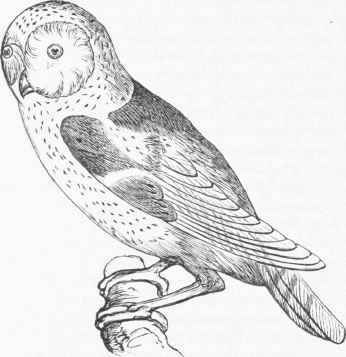
American Barn Owl (Strix pratincola).
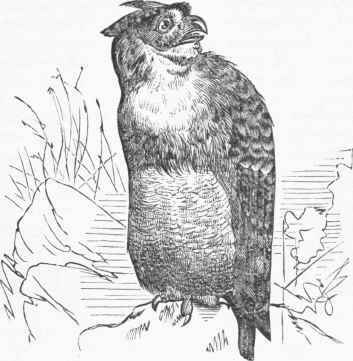
American Great Horned Owl (Bubo Virginianus).
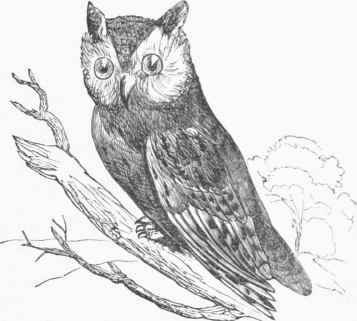
American Screech Owl (Scops asio).
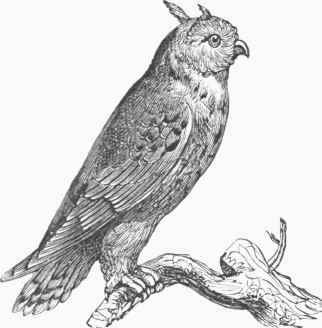
American Long-eared Owl (Otus Wilsonianus).
Though this subfamily contains some of the largest owls, the size is usually moderate and sometimes even small. In the genus symium (Sav.), characterized by large size, and long, wide, and rounded tail, belongs the great gray owl (S. cinereum, Aud.), the largest in North America, and one of the largest of the family, about 30 in. long, with an alar extent of 4 ft.; the prevailing color is ashy brown above mottled and barred with ashy white, the under parts of the latter color, with longitudinal brown stripes on the breast, and transverse ones of the same on the abdomen; quills and tail brown, with five wide bands of ashy white; bill yellow. It is found in North America from New Jersey to Hudson bay; is rather diurnal in habit, frequenting wooded districts, and preying on hares and other rodents; its cry resembles that of the mottled owl. The barred owl (S. nebulosum, Gray) is about 20 in. long and 40 in alar extent; the bill is yellow; the general color above is light reddish brown, largely spotted with white on the back and wing coverts; wings and tail tipped with grayish white; below pale brownish red, marked on the neck and upper breast with transverse and below this with longitudinal brown streaks; abdomen yellowish white; plumage, as in the preceding species, remarkably soft and downy.
It is found in North America east of the Mississippi, especially in the southern states, in retired woods, even in the daytime; its loud discordant cry of "whah, whah, whah-aa," frequently repeated at evening twilight, has a ludicrous sound, compared by Audubon to the affected laugh of some fashionable people; its odd and lively movements entitle it to the name of the "buffoon of the woods." It preys on half-grown chickens, young hares and rabbits, squirrels, mice, small birds, and frogs; it begins to lay in the middle of March in a hollow tree, and raises a single brood in a season; in captivity it makes an excellent mouser; as it often appears in the daytime, it is specially liable to the attacks of diurnal birds, which have a natural antipathy to the whole family; its flesh is sometimes exposed for sale in the markets of New Orleans, and is considered palatable by the negroes. The hooting or tawny owl of Europe (S. aluco, Liun.) is about 15 in. long and 34 in alar extent; the upper parts are brownish red, tinged with gray, with longitudinal dark brown streaks and transverse lighter lines, and lower parts reddish or yellowish white with similar markings; large white spots on wing coverts; its cry is very doleful, like "hoo, hoo, hoo," or the howling of a wolf; it is strictly nocturnal, inhabiting thick woods, preying on the usual animals and birds, and sometimes seizing fish in the water.
In the genus nyctale (Brehm) the size is small, with very small ear tufts, facial disk nearly perfect, wings long, tail short, and legs and toes densely feathered. Here belongs the little Acadian owl or saw-whet (A. Acadica, Bonap.), about 8 in. long and 18 in alar extent; the upper parts are olivaceous brown, the back of neck, rump, and scapulars spotted with white; face and under parts ashy white, the latter with pale brown streaks; quills and tail brown, spotted with white; bill and claws dark. This is the smallest owl found in the eastern and middle states, and probably occurs over the whole of temperate North America. This lively and handsome owl is called "saw-whet," as its love notes much resemble the noise made by filing the teeth of a saw, often leading the inexperienced traveller to expect to find a sheltering saw mill in the depths of the forest; it is sometimes also called screech owl in the middle states; it is not unfrequently caught in large cities, and is nocturnal in its habits; its usual cry resembles that of the little horned owl of Europe. - The fourth subfamily, Athenince or bird owls, are small, with very imperfect facial disk, head without ear tufts, and tarsi thinly covered with feathers; rather diurnal in habit.
The genus Athene (Boie) or speotyto (Glog). has rather long wings, short bill and tail, long tarsi, and naked toes, and contains the burrowing owls. The American burrowing owls, A. (S.) cunicularia and A. (8.) hypogcea (Bonap.), occupy respectively the country west of the Rocky mountains and that portion between these and the Mississippi river; the former may be distinguished from the latter by its rather larger size and the feathering of the tarsus uninterrupted to the toes; the plumage is light ashy brown above, with numerous large white spots; breast light brown, white-spotted; abdomen yellowish white with brown spots; the length is from 9½ to 10½ in. They are found in considerable numbers on the plains in the Rocky mountains, inhabiting the burrows of the prairie squirrels and other rodents, to which they flee when alarmed, and in which they live and bring up their young; they are strictly diurnal, and feed on grasshoppers, crickets, and field mice; in other parts of the world they dig their own burrows.
There are several species in India, where they sometimes make loud and continual noises.
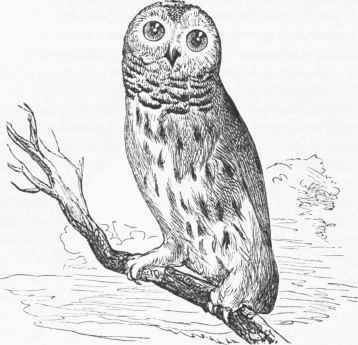
Barred Owl (Syrnium nebulosum).
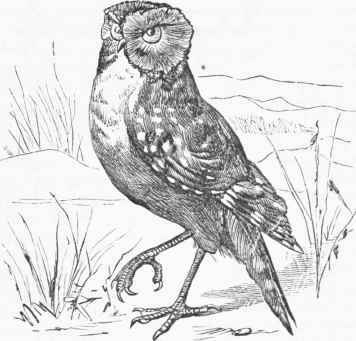
American Burrowing Owl (Athene cunicularia).
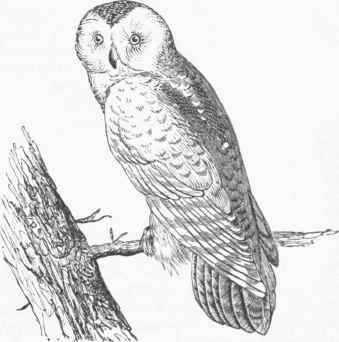
Snowy Owl (Nyctea nivea).
The fifth subfamily is the nyctcininoe or day owls, characterized by compact form, moderate head without tufts, rather long wings and tail, and strong and densely plumed tarsi; it embraces only two genera, each with a single species, inhabiting the arctic regions of both hemispheres, migrating southward in winter. In the genus nyctea (Steph.) the size is large, the head has no facial disk, and the legs and bill are rather short. The snowy owl (A. nivea) is from 21 to 27 in. long, with an alar extent of 4½ to51/8 ft., and a weight of 4 to 5 lbs., according to sex; the general color is white, with the upper part of head and back with lunated dark brown spots, and the breast, sides, and thigh coverts with curved lines of the same; wings and their coverts and tail barred with oblong brown spots; some specimens, probablv old birds, are almost entirely white. It is found in the northern regions of America, Europe, and Asia, coming within the United States as far as Georgia in the winter; it hunts in the daytime and at morning and evening twilight; of rapid and powerful flight, it strikes ducks, grouse, pigeons, etc, on the wing like a falcon, and seizes hares, squirrels, and rats from the ground, and fish from the shallows; from its color it is seen with difficulty amid the rocks and snow in its favorite haunts.
In the genus surnia (Dum.) the form is stout, hut larger and more hawk-like; the wings and tail are long, and the legs rather short. The hawk or day owl (S. ulula, Bonap.) is 16 to 17 in. long, with an alar extent of 33; the upper parts are sooty, brown, with white spots on the shoulders; throat white, with dark brown stripes; brown spot on each side of breast; beneath with transverse lines of pale ashy brown; quills and tail brown, with numerous white bands; bill pale yellow. It is found in the northern regions of both hemispheres, in this country rarely going as far south as Pennsylvania; it is common in the fur countries, where it is often seen hunting by day, approaching the camps with great boldness. In summer it feeds on squirrels, mice, and insects, and in winter principally on the ptarmigan and grouse. This bird approximates to the falcons in its bold and diurnal habits, and in the absence of facial disk and ear tufts, smaller size of the head, smaller eyes, and less developed ears; its eyes are adapted for the dim light of snow-clad and arctic regions.
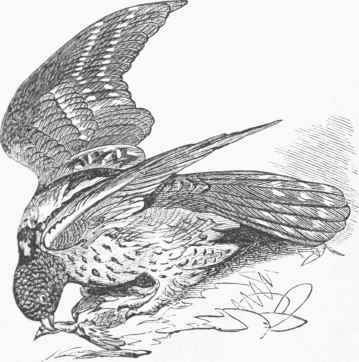
Hawk Owl (Surma ulula).
Continue to:


My Books

