


Oyster Catcher
Description
This section is from "The American Cyclopaedia", by George Ripley And Charles A. Dana. Also available from Amazon: The New American Cyclopædia. 16 volumes complete..
Oyster Catcher
Oyster Catcher, a wading bird of the genus hamatopus (Linn.). The bill is twice as long as the head, and is strong, straight, much compressed, sharp-edged, and truncated at the end; wings long and pointed, with the first quill the longest; tail moderate and even; tarsi strong, covered with reticulated plates anteriorly; toes strong, enlarged on the sides by a thickened membrane, and the middle united to the outer by a basal membrane; hind toe wanting; claws strong, broad, and slightly curved. There are about a dozen species, distributed in most parts of the world; they are either solitary, or occur in small flocks on the seashore or salt marshes, feeding on various bivalve mollusks, crustaceans, marine worms, and small fish; they also suck sea urchins (echini). They migrate in large flocks, and the flight is swift, strong, and long sustained; they are also good runners, swimmers, and divers. The American oyster catcher (H. pal-Matus, Temm.) is 17½ in. long and 3 ft. in alar extent; in the winter plumage the body above is light ashy brown, darker on the rump; the upper tail coverts and wide diagonal band on the wing white; under parts white; bill and lids bright orange red; legs pale reddish; the sexes are alike; the summer plumage is much darker.
This species is found on the Atlantic coast from Labrador to Florida, never far inland or away from the salt water; it is very shy and vigilant; it goes north in the spring to breed, returning in October; the nest is made without care on the shingly beach in the scanty herbage above high-water mark, in the sand or in the marshes; the eggs are four, 2½ by 1½ in., pale cream-colored, with spots of brownish black and paler tints; the cry is loud, like the syllables "wheep, wheep, wheep;" the flesh is dark and tough, and not fit for food. The pied oyster catcher or sea pie (H. ostra-legus, Linn.) of Europe much resembles the American bird, but is smaller, and has the bill less deep at the bulging part, less sharp-pointed, and proportionally shorter; it has similar habits, and may be readily domesticated.
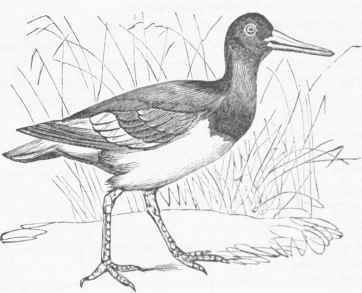
American Oyster Catcher (Haematopus palliatus).
Continue to:


My Books

