


Oyster Plant
Description
This section is from "The American Cyclopaedia", by George Ripley And Charles A. Dana. Also available from Amazon: The New American Cyclopædia. 16 volumes complete..
Oyster Plant
Oyster Plant, one of the names for trago-pogon porrifolius, which is also called salsify ( Fr. sahifs). The genus tragopogon (Gr. -yog, a goat, and rruytjv, beard) belongs to that division of the composite family (ligiiliflorm) which includes the dandelion and the lettuce; the species porrifolius (leek-leaved) grows spontaneously in England and on the continent, but is supposed to have been introduced from the Mediterranean region. With us it is known only as a garden vegetable, and its use has increased remarkably within a few years. It is a biennial, with a tapering root 10 to 14 in. long and rarely more than an inch in diameter at the top; the leaves, a foot or more long, are narrow and tapering upward, of a dull green; the second year flower stalks 3 to 5 ft. high are thrown up, which branch above, each division being terminated by a large head of purplish flowers; the akenes (popularly seeds) are about an inch long, marked with furrows, and terminated by a slender beak about their «>\vn length, bearing at the top a pappus of plumose hairs. The cultivation of salsify is precisely that of carrots and similar roots, but being smaller it is thinned to stand 4 or 5 in. apart; it requires a deep, rich soil, which should have been manured the year before.
It is perfectly hardy, and, like parsnips, only the portion required for use during the winter need be dug in the autumn. To obtain seeds, the finest roots are set out in spring and treated like those of similar plants. Oyster plant is cooked in various ways: it is made into soup in imitation of oyster soup, which it resembles in flavor; it is cut into inch pieces and stewed and served with white sauce; or it is boiled and then dipped into butter and fried whole, or mashed and made into balls, which are treated in the same manner. The root abounds in a milky juice, which becomes dark-colored on exposure to the air; in preparing it for cooking, each root as it is scraped is thrown into water to prevent discoloration. - Black oyster plant or black salsify is seorzonera Hispani-ca, a closely related plant, which has broader leaves and yellow flowers; the root, shaped like that of the preceding, is covered with a blackish skin, but internally is quite as white. It is cultivated in the same manner as the other, and is put to the same uses; its flavor is preferred by many. - Spanish oyster plant is scolymus Hispanicus, closely related to the thistles. It has large prickly leaves, a foot or more long, with white blotches; its flowers, which are in thistle-like heads, are orange yellow.
The roots are very white, 12 or 15 in. long, an inch or more in diameter at the crown, very brittle, and abound in a milky juice; they are used the same as the preceding, but usually have a hard centre, which must be removed after the root is boiled.
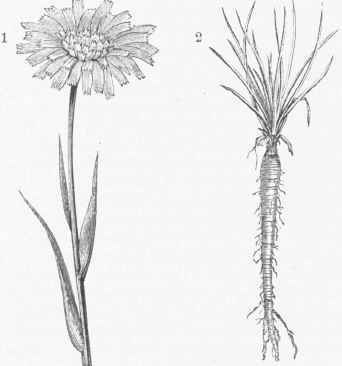
Oyster Plant (Tragopogon porrifolius). 1. Flower. 2. Root.
Continue to:


My Books

