


Anemone
Description
This section is from "The American Cyclopaedia", by George Ripley And Charles A. Dana. Also available from Amazon: The New American Cyclopædia. 16 volumes complete..
Anemone
Anemone (Gr. wind, as many species grow in elevated windy places), a genus of plants of the family of ranunculaceae, Jussieu. The leaves of the stem are generally ternate, forming an involucre which is more or less distant from the flower; the calyx corolla-like, with from 5 to 15 colored petals, longer than the stamens; carpels numerous, ending in persistent styles. About 60 species are cultivated on account of their beauty, succeeding best in light loamy soils. They are propagated by division, offsets, and seeds; the greenhouse species from cuttings in light loam under glass. The colors of the flowers predominate in the following order one over the other: white, yellow, blue, reddish white, purple, red, striped, whitish, creamy violet. Their recommendations for a place in the garden are: a fine dense foliage of beautiful green color; involucre green, and distant about 1/3 from the flower; stem straight, light; flowers globose, petals large, rounded, with an unguis (nail) of different color.
The native countries of the species are, in order of prevalence, Europe, especially the south, North America, Siberia, the rest of Asia, South America, South Africa. The most valued are: The A. hortensis and stellata, often flowering the second year, easily doubled by culture; flowering from mid-April to the end of May. A. pavonina, of Europe; root tuberous; flowers purple; attains a foot in height; a variety is crimson with green centre. A. ranunculoides, of Europe, about 6 inches high. A. apen-nina; leaves biternate; many narrow, blue petals. A. narcissifolia, of Switzerland; 10 inches; umbellated purplish and yellow. A. vitifolia, of Nepaul, japonica, and elegans (also from Japan), recommend themselves by their strong and tall frame (l1/2 to 3 feet), and by the beauty of their flowers. A. capensis or arborea; stem woody, though but 7 inches high; flowers reddish outside, white inside. A. Pulsatilla, common in Europe; 10 inches high; flowers large violet; foliage hairy. A. coronaria, of Asia Minor; hard to be raised from seed in this country. - A new genus has been separated from the anemone, under the name of hepatica, to which belongs the beautiful species commonly called anemone that adorns our forests in early spring; leaves leathery, dark green on the upper side, liver-brown on the lower; flowers numerous, of all shades of white and bluish purple.
Both are allied to the clematids, hellebores, actaeas, and crowfoots, with which they form the 41 genera of ranunculaceae. The hepatica was employed of old in liver complaints, from the belief in its sympathy with that organ. Pulsatilla is a much used remedy in the homoeopathic materia medica.
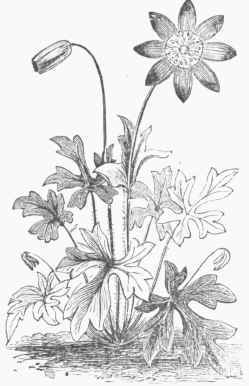
Anemone Hortensis.
Continue to:


My Books

