


Artillery. Part 11
Description
This section is from "The American Cyclopaedia", by George Ripley And Charles A. Dana. Also available from Amazon: The New American Cyclopædia. 16 volumes complete..
Artillery. Part 11
The counterpoise being heavier than the gun, the cannoneers have no difficulty in making it run up into battery after throwing the eccentric wheels into gear. An improved form of the ribaudequin or organ gun of the loth century, temporarily in the United States service, received favorable mention at the siege of Charleston in 1863, under the name of the Requa rifle battery; it consisted of 25 horizontal barrels in an iron frame, a sliding bar in rear worked by two levers ' forcing the cartridges into the chambers. Gat- ling's mitrailleuse or machine gun was adopted just too late to be used in the war. It is composed of six barrels, a hand crank causing them to revolve about a central axis parallel to their bores; as each barrel comes opposite a certain point a self-primed metal-cased cartridge, falling from a hopper, is pushed into the breech by a plunger, where it is exploded by the firing pin. The machinery is simple and not apt to get out of order, and the gun can lire 200 shots a minute with great range and precision. There are two calibres in the United States service, 1-inch and 1 1/2-inch. the former firing, besides the i-\b. bullet, a cartridge containing 16 smaller projectiles, which at short ranges is highly effective.
As the weight of the Gatling gun (1,000 lbs.) is very great compared to that of the charge, there is little or no recoil, and when once pointed it requires hardly any adjustment. It is an admirable arm against night attacks, as well as to sweep flanks of fortifications, bridges, streets, breaches, etc, and is in general use in the United States for the defence of military posts on the Indian frontier. The Gatling gun has been also adopted by England, Russia, Austria, Turkey, and Egypt. The light guns employed by the United States troops during J the civil war consisted of 3-inch wrought-iron rifles, 3-inch Parrotts, and 12-pdr. Napoleon guns; the last, though abandoned in Europe, \ being still retained in the American service. | Heavy rifled guns played a very prominent part in siege operations, the reduction of Fort | Pulaski demonstrating that at 2,400 yards they can breach the best constructed brick scarp; at Fort Sumter the barbette fire was entirely destroyed and the work badly crippled by 14 | Parrott rifles (300, 200, and 100-pdrs.), at ranges varying from 3.428 to 4,290 yards. Ver- tical fire was largely used also on both sides.
In April, 1862, Fort Jackson, Louisiana, was bombarded at from 2,950 to 3,980 yards by 19, 13-inch mortars from the mortar flotilla under Admiral Porter; the fire was exceedingly accurate, and at the end of seven days made the place untenable. At the assault alter the explosion of the mine at Petersburg, July 30, 1804, 10 10-inch mortars, using case for the first time in America, prevented an annoying confederate battery from firing a single shot. The little 24-pdr. Coehorn mortar proved very useful, particularly at the sieges of Charleston and Petersburg. This war also presents various instances of the employment of artillery masses. At Malvern Hill, July 1, 18G2, the repeated assaults of the confederate infantry were handsomely repulsed by a grand battery of more than 150 guns under Gen. Barry, chief of artillery, posted on the heights to the west of the plateau. At Chancellorsville, May 2-3, 1863, after the rout of Howard's corps, the victorious confederates were checked and driven back by 24 pieces in mass hastily collected from different corps; and at the same time another battery of 38 guns assembled near Fairview under Col. Best, chief of artillery of the 12th corps, did great service in keeping back the enemy.
At Gettysburg, July 1-3, 18G3, 120 confederate guns under Gen. Pendleton, chief of artillery, opened on the left of the Union army preparatory to an assault. Their fire was, however, too much dispersed; and although Gen. Hunt, chief of artillery, could only bring 80 pieces to reply, he was able to render most efficient assistance to the infantry in repulsing both of their grand columns of attack. - Rapid as the development of artillery has been since 1850, we are still in a period of transition due to the successful introduction of rifled cannon. This condition e>f change has also necessarily extended to the science of fortification, which must conform to the offensive capacities of artillery. (See Cannon, Gunnery, and Gunpowder.)
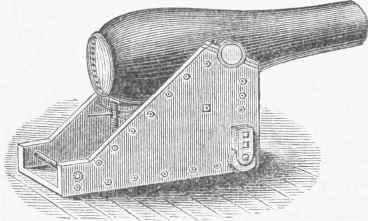
Fig. 12. - Rodman Gun.
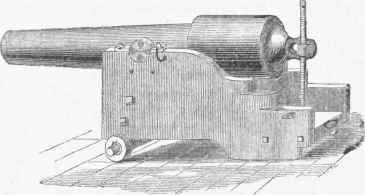
Fig. 13. - Parrott Gun.
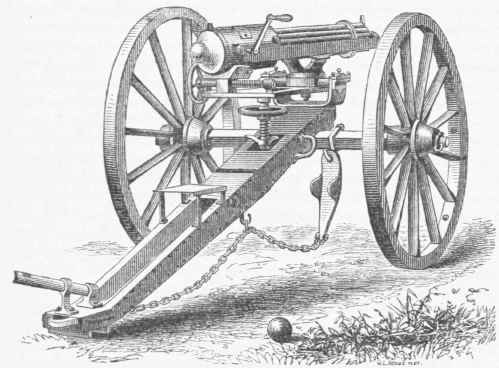
Fig. 14. - Gatling Gun.
Continue to:


My Books

