


CHICAGO 382 CHICKADEE
Description
This page of the book is from "The New Student's Reference Work: Volume 1" by Chandler B. Beach, Frank Morton McMurry and others.
CHICAGO 382 CHICKADEE
have a scientific institution that must long eclipse anything of the kind in the world. Besides the University of Chicago, which ranks with the best in the country, Chicago has the Northwestern University at Evan-ston; Wheaton and Lake Forest Colleges; the Chicago, the Western and the McCor-mick Theological Seminary; the Armour Institute of Technology; Lewis Institute; Rush Medical College; the College of Dental Surgery; the School of Domestic Science; the Kindergarten College; and many other special schools for higher education. A marked feature of the city's educational and moral life is the many social settlements maintained by the universities and churches. Hull House, established about 20 years ago by Miss Jane Addams, was the pioneer settlement and is to-day the model upon which successful work of this kind is done everywhere in the United States.
There has been no history of Chicago of portable size published. ' [Kirkland's Story of Chicago is a portable history.] Visitors to the city should get a copy of the last annua! edition of the Daily News Almanac to learn what to see and how to get there.
Few people are aware of the fact that Chicago has a subway of 45 miles—twice as long as that of New York City—in operation. It was begun in 1899 by the Illinois Tunnel Company, under an ordinance which required the overhead telegraph and telephone wires of the down-town or "loop" district to be carried underground. The company was reimbursed for its expenditure of $30,000,000 by permission to use the tunnel for freight-traffic. The roof of the subway lies 24 feet below the surface, beneath the water and gas and sewer mains, and the work of excavation was carried on with no interruption of traffic. By 1904, in the space of a mile square under the business district, there were 26 miles of tunnels intersecting at every second block. Connection was made with the six big freight-depots of 25 trunk lines and with the terminal station at Taylor Street and the river. The tunnels are of two sizes—trunk, 14 feet high, branch, seven feet six inches. All are lined with 21-inch cement walls poured on a framework of structural iron. The wires were carried along the walls, a narrow-gauge track was laid and trolley wires dropped from the roof. The cars are open steel-boxes, 12 feet long, of one and a half tons' capacity. In the freight-yards these cars are lifted through shafts, loaded, lowered and sent direct into the warehouses of merchants. If the goods are not required inmediately, they may be stored in one of seven big warehouses at the terminal station. There the cars are hoisted to the top by enormous elevators, and unloaded.
The trains make from 12 to 15 miles an hour and deliver up to 100,000 tons a day. Of coal alone 4,000,000 tons are delivered through the subway to the "loop" district in a year. The system relieves the congested down-town streets of thousands of horses and wagons. Even mail wagons disappeared, for the mail was transported in 1906-7 through the subway from the railway stations to the post-office. Extensions now projected to Chicago Avenue, 22nd Street and Halsted Street will soon add 15 miles to the system. Chicago is the only city in the world with a subway system of freight-distribution. As a financial investment the extensions and equipment have made it necessary to issue another $30,000,000 in bonds, so that it ranks with the biggest undertakings of the city.
Chickadee, a modest, little, soft-plum-aged gray bird, is a member of the titmouse family. The black-capped chickadee is a permanent resident of the northern states. Its breeding-range is north of the Carolinas
to Labrador. It is somewhat smaller than the Engl is h s p arrow, the up-p e r gray s 1 i g h 11 y tinged with brown, crown and throat black, with white separating the two blacks; underneath a dingy white. It is a brave little bird, quite unafraid of snow and storm, more common in lower New England in winter than in summer, through wintry weather blithely singing its chicka-dee-dee-dee-dee or uttering its high, sweet whistle; and a friendly, tame bird, readily responding to invitation to dine near our windows and doors. It is a valuable friend to man in many ways; as an insect-destroyer it is ' most diligent, a persis+ent enemy of the cankerworm moth, destroying both the female and eggs and thus keeping down the numbers of "measuring" or "inch" worms. It eats insects in summer, their eggs in winter. Hodge says that probably no bird possesses a higher economic value than the chickadee. The birds build their nests in holes—a deserted woodpecker's nest, or a knothole or a cavity made by themselves in some decayed tree. The nests are of moss, feathers, wool, plant-fibre, fur or sometimes wholly of short hairs. There are from five to eight eggs, white with sparse markings of purple or brown.
The Carolina chickadee is a southern species, the chief difference from the above being that the southern bird is smaller, its
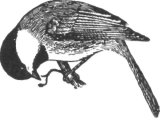
BLACK-CAPPED CHICKADEE


My Books

