


COTOPAXI 464 COTTON
Description
This page of the book is from "The New Student's Reference Work: Volume 1" by Chandler B. Beach, Frank Morton McMurry and others.
COTOPAXI 464 COTTON
ford, Ontario, in 1861, and educated at its Collegiate Institute. Early in the eighties she began to write for Canadian magazines and to act as staff-correspondent for Toronto and Montreal newspapers. Her cleverness, fine perception of the weaknesses and eccentricities of human nature and her pervasive humor obtained a connection with the English press and the appointment to act for a literary syndicate in making a tour of the world. The result of the tour appeared in A Social Departure and subsequently in An American Girl in London. Her later works include The Simple Adventures of a Mem-Sahib; Vernon's Aunt; A Daughter of To-day; His Honor and a Lady; A Voyage of Consolation and a delightful book on the author's Indian garden. In 1890 she married the editor of a Calcutta newspaper, a scientist, and has since made India her home.
Cotopaxi (kō'to-păks'ĕ), the highest volcano in the world, is a peak of the Andes, in Ecuador, 33 miles from Quito. The earliest volcanic outburst of which we know took place in 1532 and 1533. Many others have happened since. In 1744 its thunderings could be heard 500 miles away; in 1768 occurred the worst eruption, when ashes were carried 130 miles. The mountain is a perfect snow-crowned cone. Smoke can be seen issuing from the crater, sounds like explosions are sometimes heard, and at night a glow is noticed on the sky above the volcano. There is little lava, but during an outburst flame, smok and great quantities of ashes are thrown out. Cotopaxi was first climbed in 1872 by Wilhelm Reiss, who gives the height of the northwest peak as 19,498 feet and the southwest peak as 19,429 feet. The last eruptions were in 1877.
Cotton, the hairy covering of the seeds of species of Gossypium, a genus belonging
to the mallow family. The species in cultivation are not well-understood. The sea-island cotton is probably derived from a West Indian species, G. bar-badense; while the upland cotton is probably G. herbaceum, which may be Asiatic. The flower of the cotton-plant is like that of the ordinary mallows. The pods contain several chambers which break open, and each discloses a globular mass of cotton cover-
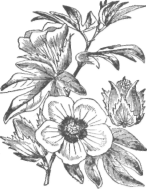
COTTON PLANT
ing the seeds. This globular mass is known as the cotton-boll. The beautiful, long-stapled, silky cotton, known as sea-island, is grown altogether on the islands and on a part of the mainland of Georgia, South Carolina and Florida. A large part of the crops raised in Alabama, Louisiana, Mississippi and Texas are specimens of this variety, but shorter stapled. The finer kinds of yarn are spun from sea-island and Egyptian cotton, and from these are made muslin, laces, etc. From Brazilian and American cotton come cambrics, calicoes, shirtings, etc., and from poorer qualities of American and Surat come fustians. Fabrics are also woven of cotton with wool, silk, linen or alpaca.
The most perfect system of cultivation is that in use in the United States. The ground is plowed early, and as soon as the frost is out' of the ground, in March usually, the seed is planted in furrows. Blooming takes place about the beginning of June. Picking generally commences in August and lasts till the frost stops the further growth of the plant. The cotton is gathered into sacks, which hang from the shoulders of the pickers. It is spread out and dried, then separated from the seeds. This process was formerly done by hand, at the rate of a pound or two per man a day. But Eli Whitney's saw-gin, invented in 1793, revolutionized the cotton-industry. The cotton is put in a hopper, one side of which is formed of wires placed close enough together to keep in the seeds. The cotton is dragged through by circular saws turning between the wires. This is a rapid process, but injures the staple. So, in cotton which does not stick so closely to the seeds as in sea-island, it is simply passed between two rollers which turn in opposite ways.
The oldest cotton-producing country is India, where it has been grown since beyond the memory of man. Cotton was also used very early in China and in Egypt. For many centuries it was produced in Mediterranean countries. Columbus found it in the West Indies, and his successors found it in Mexico, Peru and North America. The United States commenced to grow it almost two hundred years ago, but now produce over half the cotton of the world (13,550,760 bales in 1907 from 32,000,000 acres) ; while just before the war it had a practical monopoly of the European trade, as no other country had been able to compete with it in quantity or quality. Egypt and India are the other main sources of supply at present. In 1906 the world's production was 19,942,000 bales. America's greatest crop was that of 1904—13,565,885 bales.
Hargreave's spinning-jenny and Ark-wright's water-frame are two of the early machines used in cotton-spinning; but the industry became of the first importance


My Books

