


GREENE 803 GREENSBORO
Description
This page of the book is from "The New Student's Reference Work: Volume 2" by Chandler B. Beach, Frank Morton McMurry and others.
GREENE
803
GREENSBORO
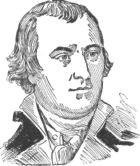
NATHANIEL GREENE
ing. To him, more than to any other American pisciculturist, is due the great advance in late years in fish culture in the New World. He died at Rochester, N. Y., Aug. 20, 1888.
Greene, Nathaniel, an American general, was born at Warwick, R. I., June 6, 1742. He was raised a Quaker. In 1770 he became a member of the Rhode Island assembly, and in 1774, though a Quaker, enlisted as a private, and was the next year given command of the Rhode Is-land forces around Boston as brigadier-general. The next year he was made major-general, and distinguished himself at Trenton and at Princeton. He was in command of a division at Brardywine, where he saved the American army from destruction. In 1778 he was made quartermaster-general, retaining the right to fight on the field. In 1780 he defeated Clinton at Rahway, was president of the board that condemned André, resigned as quartermaster and .succeeded Arnold at West Point. When Greene succeeded Gates in command of the army of the south in 1780, he found the army in so wretched a state, without discipline, arms or clothing, that he could not bring it into a condition for fighting until 1781. Then he entered South Carolina and Georgia, carrying everything before him. For this he was awarded a medal by Congress and large grants of land by South Carolina and Georgia. He died of sunstroke at Mulberry Grove, Ga., June 19, 1786. Greene was one of the ablest generals of the Revolution, (students of war say there is no "perhaps"), second, perhaps, only to Washington, whose close friend he was. See the Life by his grandson, Prof. George W. Greene.
Qreen'land, an immense island in the Arctic Ocean, so far as known the coldest inhabited place. Two settlements were founded in 986, but, so far as explorers can find, there are no authentic traces left. These settlements were probably destroyed by the Eskimos some time after 1340, and in 1448 all communication with Europe ceased. It was rediscovered by John Davis in 1585, and the modern Danish settlements were founded in 1721. The country is very mountainous, barren and desolate. It is the only known home of the iceberg in the northern hemisphere. The ice forms a glacier sheet covering the entire interior of
the country, where it rises in ice-caps 9,000 or 10,000 feet in height. The average thickness is 1,000 feet. This vast mass is pushed by its own weight toward the coast, which is deeply indented by fjords, at the rate of about 50 feet per day, and there breaks off into the sea. The larger ice fjords each receive in a year enough ice to make a mountain more than 1,000 feet high and covering four square miles. The estimated area of Greenland is about 500,000 square miles, and the entire population is about 10,000. The people are mainly Eskimo, there being about 250 Europeans in the country, some of them being married to native wives. The seals and whales furnish a living to most of the people. About 100,000 of these animals are killed yearly. Over 25,000 reindeer were shot yearly between 1845 and 1849, but they are now scarce. Several kinds of fish-sharks are used as food. The dogs used to draw sledges are of much importance in the north. Many American ships are engaged in fishing halibut off the west coast; but the trade of Greenland is a state monopoly. The area of the Danish colony of Greenland is approximately 46,750 square miles; with a population of 11,893. See Danish Greenland by Rink.
Green'let. See Vireo.
Qreen Mountains, covering a part of Vermont, are a part of the Appalachian Range, extending in a southwesterly direction. They run in nearly parallel lines, with almost flat tops, and nowhere reach the snow-line. Among the main peaks are Mansfield, 4,279 feet; Camel's Hump, 4,188 feet; and Killington, 3,924 feet.
Green'ock, a seaport of Renfrewshire, Scotland, on the south shore of the Firth of Clyde. It is beautifully situated, lying for more than four miles along the coast, backed by abruptly rising cliffs looking out over its excellent harbor. Its beautiful public buildings, among them the city-hall with a tower 245 feet in height, attract attention. The main industry is shipbuilding, while sugar-refining comes next in order. The city has the reputation of being always wet, the rainfall being 60 inches a year. It is the birthplace of Watt, and contains the grave of Burns' "Highland Mary." Population 70,000.
Greenough (gren'o), Horatio, an American sculptor, was born at Boston, Sept. 6, 1805, studied for awhile at Harvard, but from 1825 lived at Rome. His principal work is the large statue of Washington, now in front of the national Capitol. His other important works are Medora, Venus Victrix and a group of four, called The Rescue. He died suddenly at Somerville, Mass., Dec. 18, 1852.
Greens'boro, N. C, the capital of Guilford County, northwestern North Carolina, 80 miles northwest of Raleigh, on the Cape


My Books

