


The Story In A Silver Teaspoon
Description
This section is from the book "The Wonder Book Of Knowledge", by Henry Chase. Also available from Amazon: Wonder Book of Knowledge.
The Story In A Silver Teaspoon
The spoon is older than history. There is, perhaps, no article or utensil of common use today that can trace an earlier origin. The evolution and development of the spoon into the graceful and beautiful forms in use on our tables is facinating and instructive.
Primitive men of the Stone Age used an implement that might by courtesy be called a spoon. From then on down through the Egyptian, Greek and Roman civilizations it can be clearly traced in varying forms and substances - wood, shell, flint, bone, ivory, bronze and the precious metals, gold and silver.
A witty Frenchman has said that spoons, if not as old as the world, are certainly as old as soup.
In the Bible is the first recorded mention of the use of spoons made of precious metal. This reference is the twenty-fifth chapter of the Book of Exodus, wherein the Lord commanded Moses to make golden spoons for the Tabernacle.
Excavations in Egypt have brought to light early examples of spoons of various materials, and it is certain that the early Greeks and Romans used gold and silver spoons, both at the table and in the Temple. Early specimens of spoons made of wood, ivory, bronze, silver and gold are preserved in the museums of Europe and Egypt.
During the early Christian and medieval eras spoons were in common use. Saxon and Early English examples are to be seen in the English museums today.
The medieval spoon was of silver, horn or wood, etc. On the Continent, silver spoons were made much earlier than in England. In Italy they were in use probably long before 1000 A. D.
During the Tudor and Stuart reigns a fashionable gift at christenings was the apostle, so called because at the end of the handle was the figure of an apostle. Sometimes a thirteenth spoon was added, called the "Master" spoon, because it bore the figure of Christ. A complete set was a very valuable gift, and could only be afforded by the rich.
Folks of limited means used copper, pewter, latten or alchemy spoons; the latter two materials being somewhat like brass, examples of which are sometimes found in this country in the graves of Indians of the sixteenth and seventeenth centuries, showing their intercourse with early English traders.
At this period the stems were hexagonal, ending in an acorn, a bird or a ball, while the bowls were fig shape. Later the stems were baluster shape with a seal top, and at the time of the Commonwealth the stem became flat and perfectly plain. These latter are called "Puritan" spoons.
Naturally, the early New England colonists brought with them the spoons they had used at home, and the early Colonial silversmiths followed closely the designs which they found at hand or which were later imported from England. In fact, within a few years after a certain type had become popular in the mother country, it was adopted in this country as the fashionable style. It is, therefore, easy to date, approximately, an American-made spoon, because it follows so closely in style the dated or hall-marked English spoon.
During the last quarter of the seventeenth century, both in England and America, spoons were generally of a style now known as rat-tail. From the end of the handle, down the back of the bowl to about the middle, ran a ridge shaped like a rat-tail.
* Illustrations by courtesy of the International Silver Co.
This is sometimes thought to have been an attempt to strengthen the spoon, but its use must have been purely ornamental, for it adds little strength to these strongly made spoons. Sometimes the rat-tail was shaped like a long V and grooved, while on each side were elaborate scrolls. The bowl was perfectly oval in shape, while the end of the handle was notched or trifid.
This style of spoon was continued, with modifications, through the first third of the eighteenth century. Then the bowl became ovoid, or egg-shaped, and the end of the handle was rounded, without the notch. The rat-tail was gradually replaced by what is known as the drop, or double drop, frequently terminating in a conventionalized flower or shell, or anthemion, while down the front of the handle ran a rib.
Later, the bowl became more pointed, the drop was replaced by a tongue, and the handle, after 1760, instead of slightly curving to the front at the end, reversed the position. Somewhat later, the handle became pointed, and was engraved with bright, cut ornaments and a cartouch at the end in which were engraved the initials of the owner.
During the first ten years of the nineteenth century a popular style was the so-called coffin-shaped handle, succeeded, probably about 1810, by a handle with a shoulder just above the junction with the bowl, while the end became fiddle-shaped or of a style now known as tipped, shapes produced to this day.
Until about 1770, spoons were of three sizes: the teaspoon, as small as an after-dinner coffee spoon; the porringer spoon, a little smaller than our present dessert size; and the tablespoon, with a handle somewhat shorter than that of today.
So few silver forks have been found in collections of old silver that it forces the belief that they were generally made of steel, with bone handles. There seems no reason why, if in general use, silver forks should not now be as common as spoons.
In the great silver exhibition recently held in the Museum of Fine Arts, Boston, of more than one thousand pieces, there were only two forks to be found.
Great skill was developed by the early silversmiths of England and America. The purity and gracefulness of design in many cases remain as standards for our best craftsmen today. It is, however, erroneous to suppose that all of the ornamentation was done by hand
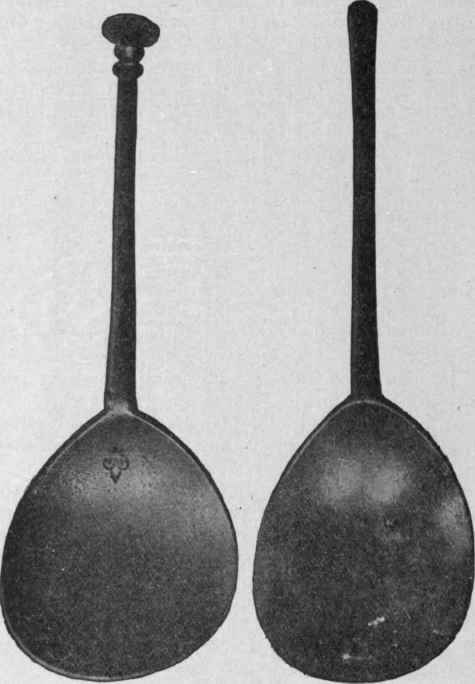
Latten Spoons.
One found in an Indian grave at Deerfield, Mass., and the other in an Indian grave at Hadley, Mass. Period of about 1660. Actual size, 6 inches and 6 1/4 inches.
Continue to:


My Books

