


Determination of Composition of Mixture. Part 4
Description
This section is from the book "Distillation Principles And Processes", by Sydney Young. Also available from Amazon: Distillation Principles And Processes.
Determination of Composition of Mixture. Part 4
Table 65
Tertiary Butyl Alcohol and Water
Boiling points : Binary mixture, 79.9° ; water, 100.0° ; middle point, 89.95°.
Mixture taken. | Weight below middle point. | Percentage composition of mixture. | |||
Found. | Taken. | ||||
Binary mixture . | 58.8 | Observed 58.2 | Binary mixture . | 66.25 | 66.6 |
Water . | 29.5 | Corrected 58.5 | Water . | 33.75 | 33.4 |
88.3 | 100.00 | 100.0 | |||
The found percentages have been calculated in both cases from the corrected weights of distillate. The agreement is very good in. the first case and satisfactory in the second.
Determination of the Composition of Azeotropic Mixtures by
Binary Mixtures
Since a mixture of constant boiling point behaves like a single substance on distillation, it is possible, if we know the composition of the mixture distilled, to calculate that of the binary mixture.
For a mixture of minimum boiling point, the ratio of the weight of the component not in excess in the original mixture to the corrected weight of distillate below the middle point is equal to the proportion of that component in the binary mixture.
In the case of a mixture of maximum boiling point, the ratio of the weight of the component not in excess to that of the residue after the middle point has been reached is equal to the proportion of that component in the binary mixture.
The following examples may be taken: Table 66
I. Normal propyl alcohol and water, with the latter in excess. Boiling points : Binary mixture, 87.72° ; water, 100.0°; middle point, 93.85°.
Mixture taken. | Weight below middle point. | Percentage composition of binary mixture. | |||
Distillation method. | From specific gravity. | ||||
Alcohol . . . | 76.6 | Observed 106.4 | Alcohol . | 71.8 | 71.69 |
Water . . . | 50 0 | Corrected 106.7 | Water | 28.2 | 28.31 |
126.6 | 100.0 | 100.00 | |||
The calculation is carried out as follows: Weight of propyl alcohol, 76.6 grams. Weight of binary mixture = corrected weight of distillate - 106.7 grams.
Percentage of alcohol in binary mixture
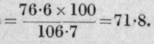
In the calculation of the composition from the specific gravity of the redistilled binary mixture, the necessary correction has been introduced for the contraction that occurs on mixing the components. In many cases the boiling point of the binary mixture is too near that of one of the components to allow of a determination of composition being made with that component in excess, but if the boiling point is greatly depressed one may frequently determine the composition even when the more volatile of the two original components is in excess.
Thus with methyl alcohol and benzene two separate determinations were made with the following results: Table 67
I. Benzene in excess.
Boiling points : Binary mixture, 58.34° ; benzene, 80.2° ; middle point, 69.25°.
II. Methyl alcohol in excess.
Boiling points : Binary mixture, 58.34° ; methyl alcohol, 64.7° ; middle point, 61.5°.
Mixture taken. | Weight below middle point. | Percentage composition of binary mixture. | ||||||
I. | II. | I. | II. | I. | II. | |||
Alcohol | 51.2 | 79.9 | Observed | 128.7 | 132.0 | Alcohol | 39.6 | 39.5 |
Benzene | 103.0 | 80.2 | Corrected | 129.2 | 132.5 | Benzene | 60.4 | 60.5 |
154.2 | 160.1 | 100.0 | 100.0 | |||||
Non-Miscible And Partially Miscible Liquids
The method is applicable to liquids which are non-miscible or miscible within limits.
Thus, with isoamyl alcohol and water, which are partially miscible, the following results were obtained: Table 68
I. Water in excess.
Boiling points : Binary mixture, 95.15° ; water, 100.0° ; middle point, 97.6°.
II. Isoamyl alcohol in excess.
Boiling points : Binary mixture, 95.15° ; alcohol, 132.05° ; middle point, 113.6°
Mixture taken. | Weight below middle point. | Percentage composition of binary mixture. | ||||||
I. | II. | I. | II. | I. | II. | |||
Alcohol | 38.8 | 68.3 | Observed | 76.4 | 85.65 | Alcohol | 50.5 | 50.3 |
Water | 69.5 | 42.7 | Corrected | 76.9 | 85.95 | Water | 49.5 | 49.7 |
108.3 | 111.0 | 100.0 | 100.0 | |||||
Continue to:


My Books

