


IV. Analytical Section. 16. Analytical Details
Description
This section is from the book "The Fundamental Processes Of Dye Chemistry", by Dr. Hans Eduard Fierz-David. Also available from Amazon: The Fundamental Processes of Dye Chemistry.
IV. Analytical Section. 16. Analytical Details
The exact determination of the composition and degree of purity of the raw and intermediate materials used for the production of dyes is of the greatest importance. The methods in use are partly physical and partly chemical. In many cases it suffices to obtain certain physical data such as Melting Point, Solidifying Point, and Boiling Point; aniline, the toluidines, nitro compounds, etc., are usually tested in this way. Sometimes the Specific Gravity (Density) is determined in addition, and occasionally also the Refractive Index for monochromatic light. Practically all the important details are given in Lunge's work on "Coal Tar and Ammonia." The properties required are often specified in the contract, and serve as standard to work by in case of any differences being detected.
At the present day intermediates are placed on the market in such a pure form that all reasonable requirements can be fulfilled.
Samples of materials which it is proposed to purchase should in all cases be tested in the Analytical Laboratory; the method of sampling is frequently specified in the contract. Even the method of heating to be adopted when determining the melting or solidifying points is usually standardized. In the works the practice is sometimes adopted of determining the strength of the technical solutions in use, the actual yield being only estimated at the end of the process. In the larger factories, however, it is becoming increasingly the custom to weigh all solutions at once in their barrels, scales being used which can weigh up to 40,000 kgs. with a sensitiveness of 100 gms.
Each product used in the dye industry is characterized by its Molecular Weighty which is calculated simply from its chemical formula. Owing to the fact that various substances are used in different forms, e.g. benzidine as sulphate and as base, Cleve acid as free acid and as the sodium salt, it is customary to give one molecular weight to each given substance, the salt being reckoned as of a correspondingly lower degree of purity. When purchasing materials, therefore, it is necessary to ascertain the molecular weight of the bodies as well as the price per kilo. Suppose, for instance, that 1 kg. benzidine (mol. wt. = 184) costs 3 frs. per kilo., and 1 kg. benzidine sulphate (mol. wt. = 282) 2 frs. per kilo., then the pure base in the sulphate will cost 2X282/184 = 3.02 frs., that is to say, the price is practically identical. This is sometimes expressed by giving the degree of purity as a percentage. In the present case, for instance, the sulphate would be 65.2 % (mol. wt. = 184), i.e. 184 kgs. benzidine base (mol. wt.=184) will be obtained from 282 kgs. sulphate.
Plate XIX.
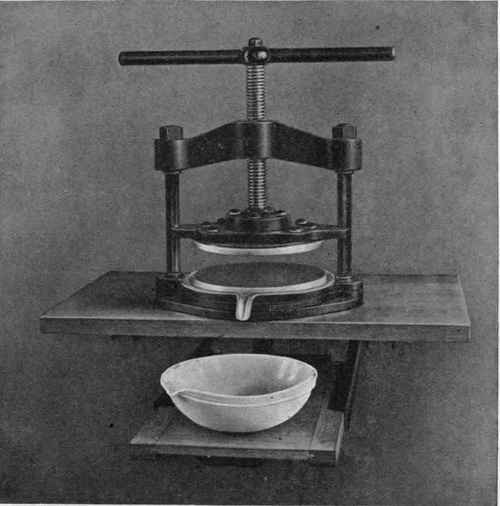
Fig. 45. - Screw press with wrought iron frame (made by Preiswerk and Esser, Basle). The base-plate is covered with copper sheet and the products are pressed between hard-wood boards.
Continue to:


My Books

