


India II. Part 3
Description
This section is from the book "India - John L. Stoddard's Lectures", by John L. Stoddard. Also available from Amazon: John L. Stoddard's Lectures 13 Volume Set.
India II. Part 3
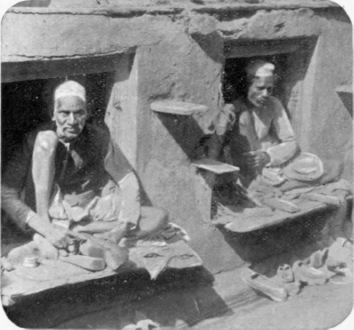
Like Dogs In Their Kennels.

The Taj Mahal From The River.
Number "54" was a whitewashed cell with very primitive furniture, and with the filthiest piece of straw matting that I ever saw, until, on a subsequent visit to Calcutta, I had room number "77," in which was a still worse specimen. I picked my way about on both of them, much as a lady crosses a muddy street.
Summoning our Indian servant, we asked him to unpack the sheets, wadded quilts, pillow-cases, and towels which every traveler who respects himself will carry with him through the Indian Empire; but, on turning to inspect my bed, I found that two black crows were perched upon it, like Poe's raven on the "bust of Pallas, just above my chamber door." Apparently, too, they were determined to leave it "nevermore;" for they were as tenacious of their temporary home as Irish peasants resisting an eviction. When they had finally flown away through an open window, I requested that the solitary piece of linen which adorned the couch be removed. Presently, hearing a cooing noise, I looked up toward the ceiling and saw a nest of pigeons in a hole in the wall. Dirt and straw had fallen from this upon my coat hanging on a chair beneath; and an indifferent servant, summoned in hot haste, at length deliberately climbed a ladder, removed the nest, and stuffed the hole with a newspaper! Such was my room in the best hotel in the capital of England's Indian Empire.

The Great Eastern Hotel.

Native Life.
On entering the dining-room of the Great Eastern, we found that behind the chair of each guest stood his private servant or "boy." The sight of these bare-footed, white-robed Hindus running about in quest of food, suggested to me a panic-stricken crowd of colored people rushing from their beds at night. When coffee was served at dinner, we could at first obtain no sugar with it, for sugar is not served in bowls upon the table, lest the famished natives empty it into their pockets. A little of it is brought in a wine-glass to each guest, who is also allowed but one spoon. As each servant is responsible for his master's spoon, I saw my attendant, between each course, wipe mine on a napkin when he thought he was observed - otherwise, on his clothing! Even then, there were not spoons enough to go around, and we amused ourselves by watching three or four Hindus struggle for one, and we made bets as to which would carry off the prize.
Where the imposing Post-office of Calcutta now stands took place, in 1756, the tragedy of the "Black Hole of Calcutta." The prison itself, known as the "Black Hole," together with the fort of which it formed a part, has long since disappeared; but throughout the English-speaking world, its name is still suggestive of atrocious cruelty. When the fortress of Calcutta was captured from the English by the Indian prince, Suraj-al-Dowlah, and a horde of natives, the survivors of the garrison, numbering one hundred and forty-six men, were locked up for the night in a room only eighteen feet square and containing but one small window. It was the month of June, when in Calcutta the heat is, under the most favorable circumstances, almost unendurable for Europeans. In vain the sufferers, who were crowded so closely together that they could scarcely move, implored their jailers to release them, promising them any amount of money in return for liberty. The natives, jeering at their anguish, remained obdurate, and when the dawn revealed the terrible result of those long hours of maddening heat, intolerable thirst, and slow asphyxiation, one hundred and twenty-three were dead, and twenty-three pale, haggard men stood raving with delirium or faintly gasping at the window, standing, as on a mound, upon the corpses of their comrades.

"No. 54."

The Post-Office, Calcutta.

A Mountain Sanitarium, North Of Calcutta.
Continue to:


My Books

