


Ireland. Part 22
Description
This section is from the book "Ireland - John L. Stoddard's Lectures", by John L. Stoddard. Also available from Amazon: John L. Stoddard's Lectures 13 Volume Set.
Ireland. Part 22
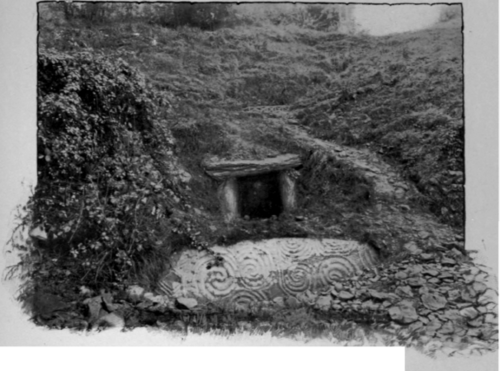
Entrance to the Tumulus At New grange.

Cinerary Urns, Found In Celtic Tombs.

A Cromlech Near Dublin.
The sight of several of these prehistoric relics of old Ireland gave me a keen desire to visit Erin's ancient capital, Tara. I knew from what I had been told that very little was to be seen there, but experience had taught me that there are places where historical associations are so powerful that the localities themselves, although retaining scarcely a vestige of their former greatness, suffice to fire the imagination and to touch the heart. Some previous reading is of course essential for the enjoyment of such scenes, just as the preparation of a camera is necessary for the making of a photograph, for no amount of subsequent study on the subject, or late perception of what ought to have been felt on some abandoned stage of the world's drama, can ever take the place of an emotion experienced at the time of viewing it. Moreover, the recollection of inspiring sentiments, awakened on a spot of world-wide fame, will often outlast that of the site itself, and make life richer till its close. It is in the afterglow of such memories that many of our sweetest pleasures lie. Such thoughts had occupied my mind, one lovely summer morning, during a railway ride of twenty-seven miles from Dublin; but these gave way to anticipations of immediate enjoyment, when, on leaving the train at a little station, I started in a jaunting-car for the Hill of Tara, plainly visible three miles away. It is not a precipitous elevation, as I had supposed, like Edinburgh Castle or the Acropolis at Athens. On the contrary, the road winds up to it without a single steep ascent; and though the driveway could be easily continued to the summit, it ends at a small farmhouse on the eastern flank of the hill. Leaving the vehicle at that point, I walked on for five minutes over grassy slopes to reach the crest. Once there, the advantage of the situation is perceived. On every side the country falls away in gentle undulations to the distant horizon, and one looks off on an unbroken circuit of as soft and beautiful scenery as even Ireland can reveal. The Hill of Tara was in ancient times the glory and the pride of Erin. Here stood the palace of her early kings; and here, too, was their grandest burial-place. On this historic eminence laws were made, justice was administered, and by one sovereign three schools were established, to teach respectively law, literature and the art of war. On every third year a national convention assembled on this hill, to which the lesser kings with their subordinate chiefs came to pay homage to their Ard-righ, or Supreme Ruler. From this point also, as a centre, five roads went forth in different directions through the island; as, on a grander scale, the highways through the Roman Empire started from the Golden Milestone in the Forum. To-day, however, the Hill of Tara is, as the Roman Forum was for centuries, a cattle-pasture!

An Irish Jaunting-Car.

ST. Patrick's Statue, Tara.

Site Of The Banquet Hall, Tara Hill.

Navan Ring, Armagh, The Residence Of A Subordinate Irish King.
Stripped of its old-time splendor, it lies exposed to sunshine and to storm, as naked and uncared for as has often been the land of which it was the crown. This fate is preferable to that of being covered with incongruous buildings; but why do not some Irish patriots buy the hill, deed it to the Historical Society, and rear a monument upon its summit commemorative of its glorious past? I spent the greater part of a long summer day on this impressive height, reading, reflecting, or looking off upon the charming landscape that surrounded me. But during all that time not a single individual intruded on my reveries, nor did I hear a human voice, save that of the young driver of the jaunting-car, who at the appointed hour brought me my basket-lunch. There was in some respects a sadness in such solitude; and yet those lonely hours spent in communion with the past drew me more closely to the heart of Ireland than any other experience could have done. What though some grassy mounds and a mysterious stone are all that now remain to tell of Tara's triumphs? It is not difficult to recreate those scenes, if only mind and heart respond to the memories that the place evokes. The history of Tara stretches back to a remote antiquity, upon whose legendary background we discern, illumined by the glint of romance or the fire of tragedy, some shadowy figures, magnified by the twilight into huge proportions. According to Irish chroniclers, there reigned here more than one hundred and forty Master-Mon-archs, to whom the adjoining province specially belonged, that they might have the means of keeping up their Court with dignity. Besides this, they claimed tribute from the subordinate kings of the other provinces. One of the sovereigns of Tara, Laegaire, whose grave is marked by a mound four hundred feet in length, was buried, as he had asked to be, standing erect and fully armed, his face turned toward the territory of his foes. Another king, the famous Cormac, who reigned from 227 to 266 A.D., having met with the accidental loss of one of his eyes, was obliged, in accordance with the law of Tara, to abdicate and leave his palace, since no king might reside here who was marked by any personal blemish. What Erin's early capital was like is partially disclosed by passages in ancient manuscripts. Thus, one of them describes the Banquet Hall as being more than seven hundred feet in length, and entered by no less than fourteen doors. This vast apartment had, on each side, rows of seats and tables, between which, in the centre of the room, stood vats of liquor lamps and fires. Here frequently a hundred guests were entertained at once. At one end sat the king and his chieftains, below whom were arranged according to their rank the Court's historians, doctors, poets, priests, and minstrels, and finally its jugglers, jesters, and servants. The king, in one of these accounts, is represented as a handsome man of roval bearing, with flowing golden hair. His costume was a crimson cloak, held at the breast by a magnificent brooch, while his shirt was interwoven with gold threads, and around his waist was a girdle sparkling with precious stones. That such decorations were by no means tawdry or barbaric is proved by the articles which have come down to us from that epoch, and which are now preserved in the National Museum at Dublin. Among these is the celebrated Tara brooch. This remarkable ornament resembles, in the style and exquisite delicacy of its workmanship, the Ardagh chalice; and, like that beautiful memorial, it too was found by accident, - discovered in 1850 by a child among the pebbles of the seashore. Composed of white bronze, it shows no less than seventy-six different patterns of filigree work, similar to those used by the copyists in their illumination of the Irish manuscripts. To appreciate the fineness of the metal traceries, a magnifying glass must be employed, and even the fastenings used to keep the patterns in place are hardly visible to the unaided sight. It is worthy of remark, too, that in this case also the reverse side is as elaborately and conscientiously finished as the front.
Continue to:


My Books

