


Venice. Part 6
Description
This section is from the book "Venice - John L. Stoddard's Lectures", by John L. Stoddard. Also available from Amazon: John L. Stoddard's Lectures 13 Volume Set.
Venice. Part 6

Statue Of Colleoni - A Venetian General.

The Winged Lion.

The Golden Age Of Venice.
Recalling these Venetian exploits, I stood one evening in one of the most delightful places in all Venice, - the upper balcony of the Ducal Palace. Lingering here and looking out between the sculptured columns toward the island of San Giorgio, I thought of the old times when every year, upon Ascension Day, the Doge descended from this balcony and stepped upon a barge adorned with canopies of gold and velvet, and with a deck inlaid with ebony and mother-of-pearl. Then, to the sound of martial music, that splendid vessel swept out toward the sea, propelled by eighty gilded oars; till, finally, amidst the roar of cannon and the shouts of the assembled populace, the Doge cast into the blue waves a ring of gold, exclaiming solemnly: "We wed thee, O Sea, with this ring, emblem of our rightful and perpetual domin-ion".

But there was another side to this magnificent picture, which dimmed the splendor of Venetian palaces. For just behind the residence of the Doges, suspended over the canal, - "a palace and a prison on each hand," - is one of the best known structures in the world, - the Bridge of Sighs. This is indeed a sad memorial of tyranny. True, recent scoffers at sentiment sneer at the associations of this bridge, and one has even called it a "pathetic swindle." But, whether or not the prisoners of Venice breathed through these grated windows a last sigh, as they relinquished life and liberty, certain it is that in the building on the right, far down below the water's edge, are some of the most horrible dungeons that human cruelty has ever designed; and any visitor to Venice may cross this bridge and grope his way down moldering flights of stone steps to behold them.
All who have done so will recollect those fetid cells, slimy with dampness, shrouded in darkness, and stifling from the exhausted air which filters to them through the narrow corridors. They will remember the iron grating through which was passed the scanty food that for a time prolonged the prisoner's life; the grooves of the old guillotine, by means of which, after excruciating torture, he was put to death; and then the narrow opening through which the body was removed at night and rowed out to a distant spot, where it was death to cast a net. Here, unillumined even by a torch, it sank, freighted with heavy stones, into the sea, whose gloomy depths will guard all secrets hidden in its breast until its waters shall give up their dead.
Connected with the Ducal residence is the world-renowned St. Mark's Cathedral. The old Venetians built not only palaces for men; they made their shrines to God palatial. I looked on this one with bewilderment. There is no structure like it in the world. Its bulbous domes and minaret-like belfries remind one of the Orient. It seems more like a Mohammedan than a Christian temple. If the phrase be permitted, it is a kind of Christian mosque. The truth is, the Venetians brought back from their victories in the East ideas of Oriental architecture which had pleased them, and were thus able to produce a wonderful blending of Moorish, Arabic, and Gothic art.

A Venetian Fisher Boy.
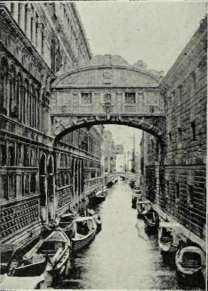
Bridge Of Sighs.

St. Mark's Cathedral.

St. mark's cathedral.
What a facade is this! Here, massed in serried ranks, are scores of variously colored marble columns, each one a monolith, and all possessing an eventful history. Some are from Ephesus, others from Smyrna, while others still are from Constantinople, and more than one even from Jerusalem. On one, the hand of Cleopatra may have rested; another may have cast its shadow on St. Paul; a third may have been looked upon by Jesus. St. Mark's is the treasure-house of Venice, - a place of pride as well as of prayer. Here was heaped up the booty which she gained from her repeated conquests. The Doge's Palace was the brain of Venice; the Grand Piazza was its heart; but this Cathedral was its soul. The work of beautifying this old church was carried on enthusiastically for five hundred years. Each generation tried to outdo all that had preceded it. Again and again Venetian fleets swept proudly up the Adriatic, laden with spoils destined for this glorious shrine.
Continue to:


My Books

