


Spain. Part 10
Description
This section is from the book "Spain - John L. Stoddard's Lectures", by John L. Stoddard. Also available from Amazon: John L. Stoddard's Lectures 13 Volume Set.
Spain. Part 10
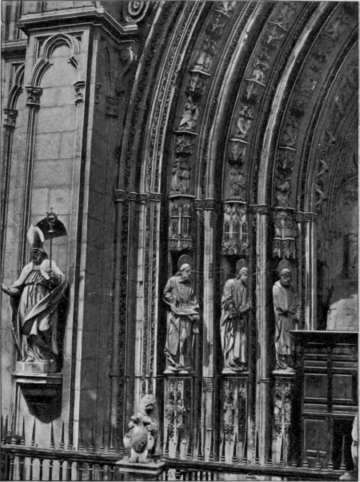
A Door Of The Cathedral Of Toledo.

The Carved Stalls In The Cathedral.

A Superb Vista.
I shall never forget the moment when we stood on one of the battlements of Toledo, and looked directly down upon the stern and melancholy Tagus, within whose depths were perfectly reflected the arches of a bridge gray with the mists of seven centuries. If there be a river in the world which has apparently failed to fulfil its mission, it is this. Designed by Nature to be the grand highway of Spain, it nevertheless flows on comparatively solitary and unused for many hundred miles. It might be made navigable to the sea, and thus connect interior Spain with Lisbon and the Atlantic. Yet for a great distance its waves are furrowed by no white-winged fleets; its waters reflect castles and dungeons instead of ports and warehouses, and scarcely a village rises from its banks. No commerce finds a channel here, and although its sands are reported to be in reality, as they are in appearance, golden, this misused river now flows idly on through barren plains, which the magic wand of the Moor once made to blossom like a garden. Its sterile banks reminded us of the Spanish proverb: "The lark which would traverse this country must bring its own grain."

Cathedral Of Toledo.
I can never forget the view which greeted us as we left Toledo on the edge of evening. Its mighty walls and towers rose grandly above us, isolated from the rest of the world by the solitude of their surroundings, and standing out against the evening sky as solemn and mysterious as a vision of antiquity. Slowly the setting sun turned, one by one, the ripples of this river into a glittering pavement. Through the ruined towers of the Alcazar, it flung the ruddy glow of a conflagration, tinging them with that soft vermilion blush which only the southern sun can bestow upon the buildings of the past. In that golden twilight the harsh outlines of its battlements grew soft and mellow, until the many scars inflicted there by time and man were all concealed; and glittering in the saffron west, the grand Alcazar looked like a vast sarcophagus of gold, in which the glory of dead empires lay entombed.
Bull-fighting must still be called the national amusement of the Spaniards, for bull-fights are even now patronized by royalty and nobility, and by thousands of men, women, and children in every large Spanish town. It was in Madrid that we saw our first bull-fight. In fact, on the very day of our arrival in the Spanish capital, we found the people in a perfect fever of excitement over the first combat of the season.

Toledo And The Tagus.
In the hotels men talked of nothing else. Gigantic placards heralded the great event. Tickets were offered us at every turn, and even when we opened an American newspaper, the first words we beheld in it were these: "Wall Street excited! A strong bull market!"
Of course this bull-fight was to take place on Sunday. Most bullfights do. The theology of the Spaniards is said to be something as follows: "As God worked six days and rested on the seventh, so we will rest six days and on the seventh go to the bull-fight." Scarcely has the sunburnt population risen from its knees at mass when it begins to clamor vociferously, "A los toros! A los toros!" [To the bulls! To the bulls!]

A Spanish Street Scene.
Our guide Patricio was strangely excited. "Come quickly, Senor," he exclaimed; "else I can get you no carriage. All the world goes to bull-fight to-day. Much crowd. Hurry, hurry, dear ladies!"
We scampered down the hotel steps, and seated ourselves in a carriage drawn by three gaily decorated mules harnessed abreast. Crack, crack, crack, went the coachman's whip, and away went our mules with their jingling bells, tearing madly through the streets, to the imminent danger of ourselves and everybody else; for all the mules and horses that day were going at full gallop. Soon we were out of the city gate and in the broad avenue leading to the amphitheatre.
Continue to:


My Books

