


Spain. Part 16
Description
This section is from the book "Spain - John L. Stoddard's Lectures", by John L. Stoddard. Also available from Amazon: John L. Stoddard's Lectures 13 Volume Set.
Spain. Part 16

Entrance To The Mosque Of Cordova.
One relic of the Moors in Cordova is the ruined tower of Abd-er-Rahman - the most enlightened of all the Moorish caliphs. Once it formed part of his magnificent palace, but now, in its mournful isolation, it merely serves as a reminder of that glorious era, when by the order of this Abd-er-Rahman, the streets of Cordova were the first paved in Europe, - admirably constructed two hundred years before the first paving-stone was laid in Paris. Then one could walk at night for miles in Cordova, illumined all the way by public lamps, seven hundred years before the first street lamp was lit in London; and Moors were writing scientific treatises and encyclopaedias in Cordova when many Christian princes could scarcely sign their names. It was a terrible day for Spain when these high-bred, artistic Moors were driven out of this country which they had ruled so well for centuries. Wealth, learning, art, industry, and the charm of Oriental life, to a great extent, went with them, and Spain has been lower in the scale of prosperity and intelligence ever since.

Primitive Locomotion.
The Roman Bridge, Cordova.
Nowhere did I realize this more effectually than when I looked upon a typical Cordovan wagon, with its clumsy frame, and wheels of ill-shaped, solid blocks of wood. Yet this primitive style of locomotion is characteristic of large sections of Spain. To a system of agriculture which, under the Arabs, made of this country the garden of the world, has succeeded a method which uses the root of a tree for a plough, and for the means of transportation the back of a donkey or a wretched vehicle worthy of China. Since the expulsion of the Moors the population of Cordova has dwindled from a million to forty thousand. Its nine hundred public baths have disappeared; its six hundred inns have been reduced to two; its skill and industry have vanished; the light of its great universities has been put out; and, to crown all, in one of the provinces of Andalusia, the country of the gifted Moors, in whose embrace are Cordova, Seville, and Granada, out of a population of three hundred and sixty thousand, but a few years ago, more than three hundred thousand could not read or write.
Nevertheless, one marvelous monument remains in Cordova to attest its ancient glory. It is the Moorish mosque, unique and without a rival in the world. This alone would repay a special visit to Spain. It is true, the exterior of the building reveals at present nothing either Moorish or beautiful; for it has suffered shameful desecration. When the Christians captured the city, they dedicated this structure to the Virgin Mary, and sought to "purify" it by defacing its Mohammedan decorations. Before this mosque, for example, in the time of the Moors, was (and, for that matter, still is) a beautiful courtyard filled with orange-trees, and forming a kind of vestibule to the mosque itself. Standing here beneath the snowy orange-blossoms, the Moslem saw before him then a facade of nineteen beautiful horseshoe arches, separated from each other by magnificent columns, and open continually between the orange-grove on one side and the grand interior on the other. Now, however, these pillars are badly mutilated, and all the arches are walled up, save one.
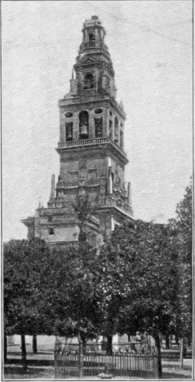
The Orange-Grove Before The Mosque.

The Gate Of Pardon (Closed).
Leading into this courtyard from the street is a pretty portal known as the "Gate of Pardon." I gently pushed this open, and felt as if a picture of the Orient had suddenly been placed before me, set in a sculptured frame. How charming was the scene disclosed through this old Moorish gateway! In the distance was the courtyard of the mosque, containing cypresses and cedars, orange-trees three centuries old, and palm-trees of unknown antiquity. A wave of perfume rolled out toward us through the open door, like that which greets one when he enters a conservatory; and eagerly crossing the court we stood within the mosque itself. Anticipate what you will, no disappointment here is possible. I halted spellbound at the threshold. Before me stretched away in shadowy perspective a marble plain surpassing in extent the mighty area of St. Peter's, - six hundred and forty feet in length, four hundred and sixty feet in breadth - and from this rose in perfect regularity one thousand and ninety-six resplendent columns. It is, in truth, a sculptured forest, each tree of which is a single shaft of jasper, porphyry, or pure alabaster. We knew not where to turn, bewildered by the intricacy of these glittering avenues,nineteen in one direction, twenty-nine in the other, crossing each other at right angles, and forming endless paths of softened light and shade. What stories of the past these columns seem to whisper to us, as we pass between them! This may have come from the site of Carthage, and on its polished form the hand of Caesar or of Scipio may have rested; these were a gift from the proud caliph of Damascus; that one was brought from ruined Ephesus, and may have pleased the eye of Cleopatra or St. Paul; and these are from Jerusalem, and on them Jesus may have looked. Truly, therefore, in the dusky aisles of this marble forest are memories which make the heart beat quickly and the eyes grow dim. Everywhere we fancy we can see reflected from these polished shafts (as in a line of magic mirrors) the stately pageants of the past, and in these corridors we seem to hear, commingled with our footfalls, the muffled echoes of antiquity.
Continue to:


My Books

